Etiological incantation
KalevalaEtiological incantation is the Kalevala’s principle that singing the origin of a harmful force can overcome it. Its importance lies in joining knowledge to action: a hero does not merely describe danger but seeks to master it by telling how it came to be.
Principle and operation
When a hero confronts an aggressive force—a wound, disease, ferocious beast, or venomous serpent—the poem presents the chanting of that force’s origin as a way to overcome it. The underlying idea is that evil could be prevented or defeated if its beginnings and manner of arising were known. The incantation therefore turns explanation into practical power: to sing the cause is to gain a means of acting against its effects.
Wainamoinen’s singing of origins
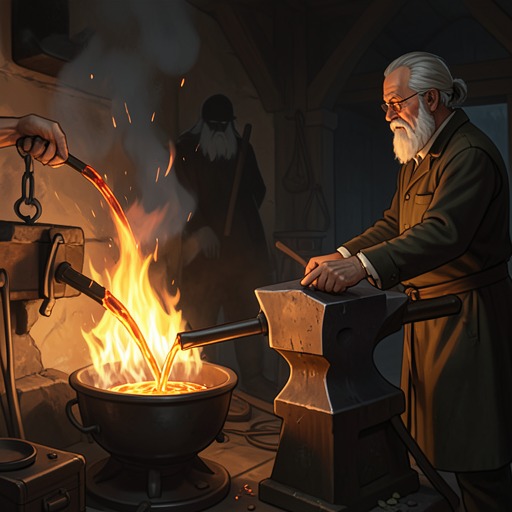
A scene involving Wainamoinen gives the principle a concrete form. After words about his injured knee and torn veins, the ancient singer begins his incantations and sings of the origin of evil. The passage then specifies the origin of iron, placing that account beside his effort to fashion a bolt. The movement from injury to ordered singing and from iron’s beginnings to a usable object makes the incantation at once remedial and constructive: origins matter because they can furnish power over present circumstances.
The sequence also emphasizes composure and command. Wainamoinen’s words are presented as proceeding in perfect order, without an effort to remember. His authority depends not simply on possessing a song, but on being able to deliver knowledge of origins as controlled, effective speech.
Place in the epic’s magic
The principle belongs to a poem in which magic is a defining feature of heroic action. The Kalevala’s poems contain accounts of nature, the origin of things, and human experience; within that wide field, etiological singing gives the account of beginnings a specific force. Origins are not remote background. They can be summoned when danger appears, making song a means of engaging wounds, sickness, and hostile creatures rather than a separate ornament to the story.
The incantations also connect the epic’s imaginative world with a wider body of Finnish song. Early collectors gathered national poetry consisting chiefly of wizard-incantations and pagan folk-lore. Gabriel Maxenius’s 1733 collection brought such poems into print, although he did not understand their connection with Finnish pagan religious worship. That early difficulty of interpretation underscores how much of the material’s meaning rests on recognizing song as an action within a system of belief, not simply as verse about supernatural subjects.
Oral transmission and literary form
The Kalevala took shape from songs preserved and performed by singers. Zacharias Topelius collected eighty epic fragments by inviting Finnish merchants and renowned singers to perform at his bedside, recording the poems as they were uttered. Elias Lönnrot gathered further material from singers and arranged it under the idea of a single epic; a manuscript was sent to the Finnish Literary Society in 1835, and the expanded 1849 edition contained fifty runes and 22,793 lines. The poem’s incantatory knowledge thus reaches its readers through a literary work assembled from a living practice of song.
The account of the epic as descending unwritten from the mythical age and being kept alive from generation to generation by minstrels gives etiological incantation a double significance. Within the poem, singing origins confronts immediate harm; in the history of the work, the repeated performance and collection of songs preserve inherited knowledge. In both cases, song makes knowledge active by carrying it from one occasion—and one generation—to the next.