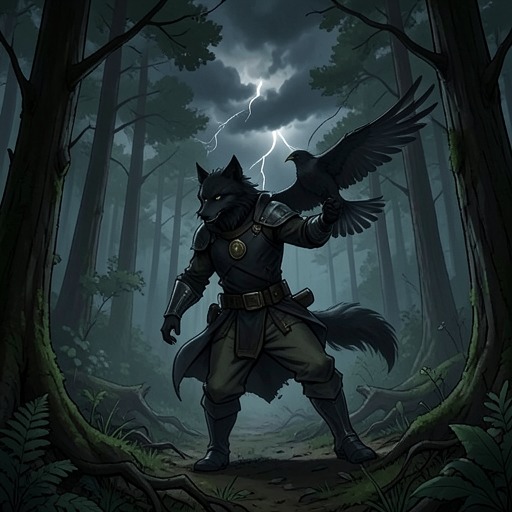
Transformation
KalevalaTransformation is presented as an enacted change of body, not merely a disguise: a figure takes another form and, with it, a new way to move and act. The evidence gives two striking animal embodiments—a woman who becomes a monster-eagle and Wainamoinen, who leaps into the water as a pike. In both, bodily change is expressed as a decisive action, carrying the transformed figure into a different element and mode of power.
Form and bodily change
The clearest account makes transformation swift and intentional. A woman changes her form and features, makes herself another body, and takes sharpened iron scythes. The change is therefore more than an alteration of appearance: the passage joins a new body to the preparation of weapons, making transformation part of an active undertaking. The account then describes her spreading mighty pinions and rising as a monster-eagle. Human and bird forms are connected through action; the eagle’s wings make the newly assumed shape unmistakable, while the iron implements give the transformation a martial dimension.
The description emphasizes both construction and movement. First comes the making of another body; then the figure rises on wings. The sequence makes the change legible to the reader as an event with physical consequences, rather than leaving it as an unexplained shift in identity. The eagle form is not simply named: its pinions lift the transformed figure into the air.
Wainamoinen’s change into a pike
Wainamoinen’s transformation begins with reflection. He resolves to change his form and features and assume a second body, one that is neither a man nor an ancient minstrel, but master of the waters of Northland. The declaration marks a deliberate departure from the identities by which he has been known. His change is then made concrete: he leaps into the waters as a pike and swims swiftly along the river.
The sequence moves from decision to action without an intervening explanation of how the body changes. Its emphasis is on the contrast between the singer’s familiar human identity and his new aquatic life. Wainamoinen does not merely enter the water in human form; he becomes a fish and moves through it as his own domain. The transformation gives his stated intention a visible, bodily outcome.
Animal forms and narrative function
The eagle and pike episodes share a movement across the human-animal boundary, but the resulting forms are distinct. The eagle’s pinions and iron weapons associate transformation with aerial power and combat; Wainamoinen’s pike form is defined by his leap and rapid swimming in the river. In each case, the change enables action in a setting suited to the assumed body: flight for the eagle, passage through water for the pike.
These episodes make transformation a practical narrative device as well as a marvel. A change of body alters what a figure can do in the immediate scene, and the text marks that alteration through concrete movements—rising, circling, leaping, and swimming. At the same time, the shift does not erase the figure’s continuity: the woman acts through the eagle form, and the singer who resolves to become a pike is still identified as Wainamoinen when the change is narrated.
Limits of the evidence
The supplied passages also place transformation near images of grief, death, and birds without establishing that every such image is a metamorphosis. The Maiden of the Rainbow is described as sleeping in death, and another daughter weeps and wrings her hands; these lines present death and mourning, not a stated change of shape. Likewise, a maiden sings to a sea-gull, but the passage does not say that she becomes one. The distinction matters: in the clearest transformation scenes, the text explicitly describes a change of body and follows it with the transformed figure’s movement. The concept therefore rests most securely on the eagle and pike episodes, where bodily alteration is stated and its consequences are shown.