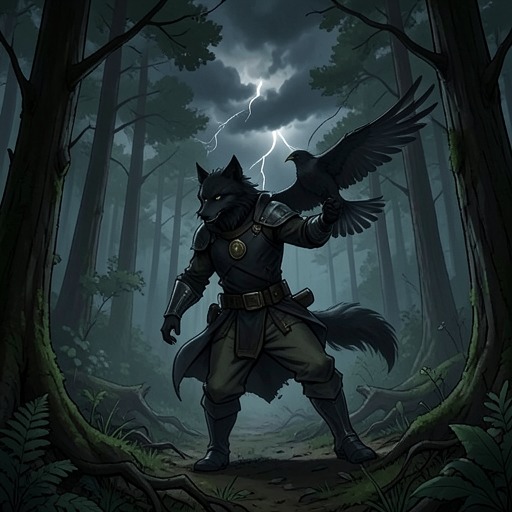
Arts of Transformation and Summoning
KalevalaArts of Transformation and Summoning is the capacity to bring animal forms into a scene and to alter one’s own body and appearance. In the episodes involving Lemminkainen, magic is presented not as an abstract doctrine but as a sequence of visible changes: a golden-horned bull appears, a snow-white rabbit is set down to draw a Wolf’s attention, a squirrel occupies the rafters, a scarlet Fox consumes a golden marten, and Lemminkainen himself becomes a mighty eagle. The contrast between these conjured creatures and his bodily transformation shows two related uses of magic: making new agents act in the world, and remaking the magician as an agent of flight.
Conjuring Animals
The animal sequence begins with a bull whose horns are described as gold and silver. The bull’s metallic features make its appearance conspicuous, but the episode gives no general account of how the conjuring works; the magic is conveyed through the direct arrival of a creature before the conjurer. Summoning is thus shown as an action with an immediate material result, not merely as a claim or prediction.
Lemminkainen then conjures a snow-white rabbit and places it on the floor to attract the Wolf’s attention. Its purpose is tactical: the rabbit serves as a lure within a contest involving other conjured animals. The episode makes the animal’s placement as significant as its appearance. Magic creates a creature and puts it in a particular position so that another creature’s attention can be redirected.
A squirrel is next conjured on the roof, where it jumps among the rafters. The scene shifts the action upward from the floor to the roof-space, making the setting part of the successive magical maneuvers. The squirrel is later driven from its perch, and the sequence continues with Lemminkainen making a scarlet Fox. That Fox eats a golden marten. Across these appearances, the summoned forms do not simply accumulate as marvels: they enter a chain of attraction, displacement, and consumption. The color and material details—the rabbit’s whiteness, the Fox’s scarlet coat, the marten’s gold, and the bull’s precious-metal horns—give each apparition a distinct visible identity.
Changing Body and Appearance
The second mode of magic is Lemminkainen’s transformation of himself. The narration identifies him as a young hero and handsome Islander before describing him as changing both his form and his features. He also puts on different clothing and changes into another body. These details present transformation as comprehensive: it affects appearance, raiment, and bodily form rather than only providing a disguise in one narrow sense.
The change culminates in his becoming a mighty eagle. The transformation is abrupt, and the eagle’s new capabilities immediately shape what follows: Lemminkainen rises on magical wings and tries to fly toward the highest heaven. The episode therefore links altered form to altered movement. The conjured animals are placed within an earthly sequence of encounters; the eagle gives Lemminkainen a way to ascend beyond the ground-level scene. The account establishes his attempt, but does not, in the available passage, establish that he reaches heaven.
Uses and Narrative Pattern
Summoning and transformation share a concern with changing the available possibilities of a scene. A conjured animal can attract attention, occupy a new place, or act upon another creature. A changed body enables Lemminkainen to take on a different appearance and attempt a kind of movement that his prior form could not perform. In both cases, magic operates through concrete forms and consequences: the rabbit is placed on the floor, the squirrel is on the rafters, the Fox eats the marten, and the eagle takes flight.
The episodes also distinguish the magician’s relation to the forms he produces. The animals are conjured into the surroundings as separate creatures, whereas Lemminkainen’s eagle form is his own altered body. The difference matters: one technique expands the cast of active beings in a scene, while the other changes the protagonist’s identity and physical means of action. The narrative moves between these possibilities without pausing to define a formal system of rules, allowing the visible sequence of transformations to carry the meaning of the magic.
Taken together, the scenes make transformation and summoning a practical, adaptable power rather than a single spectacular feat. Their effects range from distraction and predation to disguise and attempted ascent. Lemminkainen’s shifting forms and the animals’ successive appearances give the magic its momentum: the scene is repeatedly reorganized as one creature draws attention, another takes its place, and the magician finally changes himself into a being of flight.