Finnish afterlife belief
KalevalaFinnish afterlife belief is presented as a set of related but not wholly consistent ideas about what happens to the dead: some clans denied a future life, yet their funeral customs equipped the dead as if existence continued beyond the grave. Other accounts describe spirits lingering at their tombs, undergoing purification, and eventually entering Manala, an underworld with its own ruler, landscape, and hazards.
Funeral Practice and Belief
The account highlights a contradiction between doctrine and practice among Finnish clans that did not believe in a future life. They nevertheless buried the dead with knives, hatchets, spears, bows and arrows, kettles, food, clothing, sledges, and snow-shoes. The range of provisions and equipment implies a practical recognition of needs beyond death, even where explicit belief denied that such a life existed. Rather than presenting a single settled creed, the account shows funeral practice preserving assumptions that formal belief might reject.
The Dead’s Passage
In the account’s reconstruction of early belief, spirits remained in their graves until their bodies had completely disintegrated. Kalma, the god of the tombs, and his daughter presided over this interval; after purification, the spirits were admitted to the Kingdom of Manala. The dead’s passage was therefore not immediate: it depended on both the decay of the body and the completion of a spiritual process.
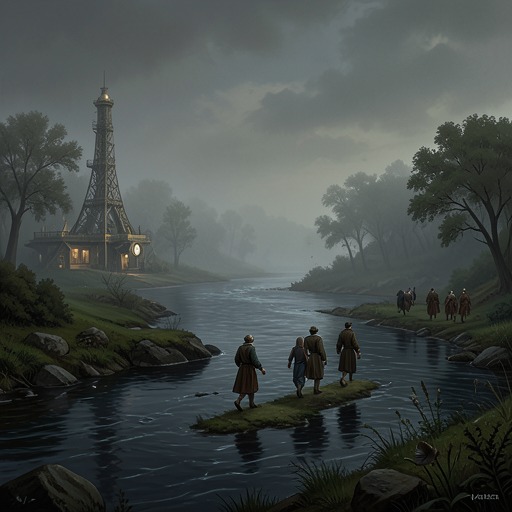
The route to Tuonela was itself a trial. The dead were said to cross nine seas and then a river identified with the Finnish Styx, described as black, deep, and violent, with whirlpools and waterfalls. This geography makes entry into the afterlife a hazardous transition, not simply arrival at a distant destination.
Manala as an Inhabited Counterpart
Manala, also called Tuonela, was understood as corresponding to the upper world. The Sun and the Moon visited it; its wetlands and forests housed creatures, while its coal-black waters held fish. The underworld was thus not an empty realm but a parallel environment with its own natural life. Even the serpent’s teeth were traced to seed-grains from the fields and forests of the land of the dead, extending the connection between the two worlds into the origins of its creatures.
Tuoni ruled this subterranean domain. The account presents him as the leader of the dead to their home as well as their counsellor, guardian, and ruler. The afterlife consequently has both a landscape to traverse and an authority governing the dead once they arrive.
The Dead as a Source of Wisdom
The Kalevala also gives the dead a place in the pursuit of knowledge. When Wainamoinen needed three words of magic to finish a boat, he searched unsuccessfully in animals and in the kingdom of Tuoni, then went to the grave of the ancient wisdom-bard Antero Wipunen. There he found the words he needed. The episode does not erase the danger associated with crossing into the realm of the dead; instead, it makes the grave a boundary that can be crossed in search of knowledge unavailable among the living. Together with the burial customs and the journey to Tuonela, this narrative presents death as separation from ordinary life but not as the end of all relation, need, or significance.