The power of song and incantation
KalevalaThe power of song and incantation is the Kalevala’s joining of poetic speech to action: words can be imagined as capable of changing material things, while song also gives form to feeling and holds a scattered body of inherited poetry together. Wainamoinen speaks in magic measures, and the epic presents creation, craft, and music as domains in which voiced language can act. The idea is at once a feature of the mythic world and a principle of the poem’s own composition and performance.
Definition and scope
The preface describes incantations as frequent in Finnish poetry, and characterizes the Kalevala as an epic in which the power of speech is more than ornamental. Wainamoinen’s words are explicitly framed as magic measures. Elsewhere, song is presented as a power that can bring forms into being: the singer does not only name what exists but can sing something into a changed condition. These passages establish a broad imaginative principle, rather than a single spell with one fixed use.
The principle reaches beyond human singers. Wainamoinen acknowledges Ukko as his creator and imagines the greater reach of the creator’s wisdom-singing. The ensuing image gives song extraordinary scope: Ukko could sing floods into honey, sands into red berries, and pebbles into barley. These transformations are examples of what divine song can accomplish, while their measured sequence also makes the claim through poetic parallelism. The world is pictured as susceptible to a voice powerful enough to alter its substance.
Making and remaking through song
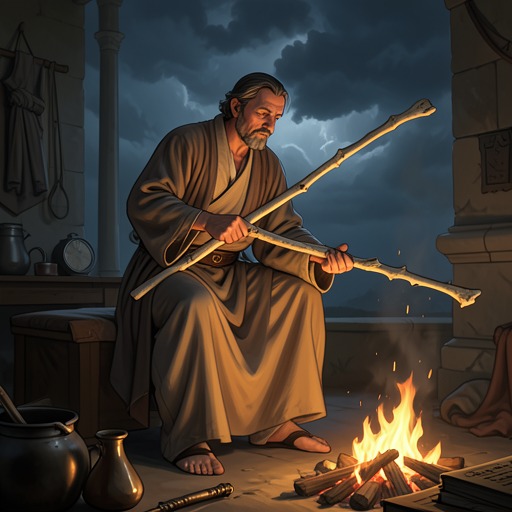
The power is also practical. When Wainamoinen finds Tuoni’s auger, he sings a purple forest into life and brings slender birches into it. He then shapes the birches into shafts and runners, moulding them by his will to make anew his magic sledge. The episode moves from the recovery of a tool to the production of its material: song supplies the forest, and deliberate shaping turns its growth into a working vehicle. The scene makes magical speech part of a sequence of purposeful craft, not simply a display of verbal mastery.
The passage also gives this power a distinctive scale. Wainamoinen does not make an object appear without context; the song produces timber that can be formed into the parts his sledge needs. Creation and workmanship meet in the same action. In this account, the singer’s authority lies in making the world answer to speech and then directing what has been made toward a particular use.
Musical form and emotional effect
The Kalevala’s own verse supports its concern with voiced language. Its metre is described as an eight-syllabled trochaic line with a part-line echo, characteristic of Finnish poetry; the preface adds that Finnish words strongly favor a trochaic movement and that everyday conversation can fall into verse. Alliteration joins rhythm of sound to rhythm of time. The form is therefore presented not as a detachable ornament but as a pattern suited to the language and to the epic’s repeated acts of singing.
The preface particularly associates this metre with expressions of tenderness between mothers and children. That emphasis broadens the meaning of song beyond magical command: the same sonorous form that can carry an incantation can also voice attachment. The epic’s power of song encompasses both an imagined capacity to alter the world and a poetic capacity to give recurring human feelings memorable shape.
The harp as instrument and vulnerability
The harp episodes make song audible within the narrative. In the account of the harp’s birth, Wainamoinen is the ancient minstrel at the center of its making and use. When the harp comes into view, he lets the aged try its strings and gives it to the young magicians. Music thus passes between generations and gathers different ages around an instrument associated with the Northland’s pride and beauty.
When Wainamoinen plays, gladness and pleasure unfold through the music, whose harmony echoes from the hills and mountains. The scene represents sound as more than private expression: it spreads outward through a landscape in the poem’s telling. The minstrel’s response is also physical and vulnerable. His tears flow as he plays, described as pearly drops; mastery of music does not exclude grief, but gives it an audible and visible form.
That musical power is not invulnerable. During a storm, the winds roar and the waters lash; the war-ship is tossed high, and the fish-bone harp is thrown away. The loss establishes a sharp contrast with the harp’s earlier beauty and emotional force. Later, the sacred harp is finished anew, and Wainamoinen sits on the rock of joyance. The movement from making, to performance, to loss, and then to renewed making gives the musical motif a narrative life: song can shape experience, but its instruments remain exposed to disruption.
Oral inheritance and epic structure
The power attributed to song has a counterpart in the Kalevala’s history of transmission. The preface describes its poetry as having descended unwritten from a mythical age, kept alive from generation to generation by minstrels, or song-men. Zacharias Topelius collected eighty epic fragments by inviting Finnish merchants to sing at his bedside and copying their songs as they were uttered. Elias Lönnrot gathered further poems from singers during journeys among the people, then arranged the collected material under the central idea of a great epic. The work’s poetic speech is thus represented both as an action within its stories and as a practice through which its traditions survived.
The resulting architecture is continuous but contains nearly independent parts, including the contest of Youkahainen, the Kullervo episode, and the legend of Mariatta. This combination of continuity and relative independence fits an epic assembled from many collected fragments without reducing it to a single, unbroken episode. Song and incantation consequently operate on two connected levels: within the narrative, voiced words make and transform; across generations, sung poetry preserves and carries the material from which the Kalevala takes shape.