Artificial Life and the Golden Bride
KalevalaArtificial Life and the Golden Bride describes a test of Ilmarinen’s powers as a magic metal-worker: he can shape precious metals into a maiden’s likeness, but the resulting figure remains unable to speak, see, or walk. Her beauty makes the attempt compelling; her silence and coldness expose its limit. When Wainamoinen tells Ilmarinen to return the virgin to the furnace, the story turns a technical marvel into a question about what artifice cannot create.
Materials, labor, and the wish for a bride
The episode begins with prolonged grief: the account says that someone wept one month, then another, and then three months in full succession. From the depths of the ocean, the magic metal-worker gathers gold; from the mountains, he gathers silver. The materials are precious, but their origins are also remote and elemental. Before the bride exists, the narrative has already joined desire to distance, labor, and a long accumulation of matter.
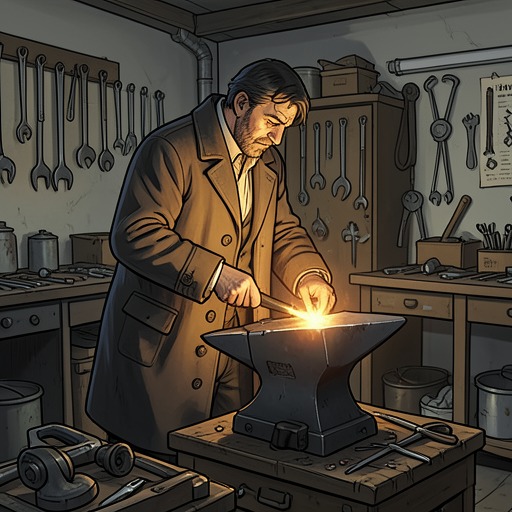
Ilmarinen is identified as the magic blacksmith, working ceaselessly at his forging. His workshop depends on collective bodily effort as well as individual mastery: workmen, gloveless and hatless, fan the flames within the furnace. The scene does not present creation as an effortless spell. Fire must be maintained, metal gathered, and repeated work sustained; even a master’s power takes place within demanding material conditions.
The first result is not the bride he seeks. A lambkin rises from the magic fire, wearing hair of gold and copper. Ilmarinen’s stated desire is for “a bride of beauty” born from molten gold and silver, so he throws the lambkin back into the furnace and adds more gold. This reversal makes the forging a sequence of attempts rather than a single act of creation: the furnace yields a form, the form fails to answer the wish, and the smith tries again with more material.
A beautiful body without ordinary capacities
From the fire a virgin at last rises, golden-haired and silver-headed, beautiful in form and feature. Ilmarinen continues to work on her through nights and days. He forges feet, hands, and arms from gold and silver, giving the image a recognizable human outline. Yet the account immediately distinguishes bodily shape from bodily function: her feet are not for walking. The added limbs complete her appearance without enabling ordinary action.
The same division governs her face. Her mouth is magical but speechless, and her eyes are not for seeing. Ilmarinen calls her “a priceless maiden,” then qualifies the praise by wondering whether she could speak in wisdom. That condition matters: the figure’s value is not established by material splendor alone. In the scene, the possibility of meaningful speech marks a capacity the crafted body does not possess. Her silence is not merely an ornamental detail; it is evidence that the maker has not produced a speaking person.
The work thus draws a sharp line between representation and life. The maiden can look like a bride, and the metals can be shaped into the visible parts of a human body, but appearance does not supply movement, perception, or voice. The more completely Ilmarinen fashions the exterior, the clearer the remaining absences become. His skill is real, yet it cannot make the image act or answer.
The test of warmth and Wainamoinen’s response
The distinction becomes intimate when Ilmarinen sleeps beside the golden image he has forged. The account contrasts the two sides of the bed: the side wrapped in furs and blankets is warm, while the parts beside the maiden are chill. The contrast is physical and immediate. Precious metal may resemble a body closely enough to lie beside its maker, but it does not share his warmth.
Wainamoinen addresses Ilmarinen as “Magic brother, wonder-forger,” acknowledging the extraordinary skill behind the work even as he rejects its implication. He tells the smith, “Throw the virgin to the furnace,” directing the crafted figure back toward the source from which she emerged. His instruction makes the furnace’s role circular: it first produces the image, receives the failed result again, and remains the available destination when artifice proves unable to become life.
What the golden bride makes visible
The episode does not deny Ilmarinen’s power; it defines its boundary. He can gather gold and silver, command a furnace, and shape a maiden’s features and limbs. But the narrative tests the achievement against capacities that craftsmanship has not supplied: walking, seeing, speaking, and warmth. The image’s beauty and its failures belong together, preventing its splendor from being mistaken for personhood.
The golden bride therefore gives material form to a distinction between making an object and making a living companion. Her construction advances through effort and repeated refinement, but each improvement in likeness leaves the central absence untouched. Wainamoinen’s intervention closes the episode not with a new technique, but with a return to the furnace. The wonder of the forged figure is real; so is the limit that its beautiful body cannot cross.