Reverence for the Bear and Bear-Hunting Rites
KalevalaReverence for the Bear and Bear-Hunting Rites presents the hunt for Otso as a relationship to be negotiated, not merely a pursuit ending in capture. Hunters are set in readiness, but Wainamoinen’s words address the bear as a beloved woodland presence and promise him peace, plenty, and welcome in Kalevala. The hunt culminates in a substantial feast for Otso, the assembled hosts, and the village; then the people ask about the bear’s birth, and Wainamoinen answers with an account of his origin. Across these stages, the poem places preparation, address, communal eating, and explanation within one continuous observance.
Preparation and Address
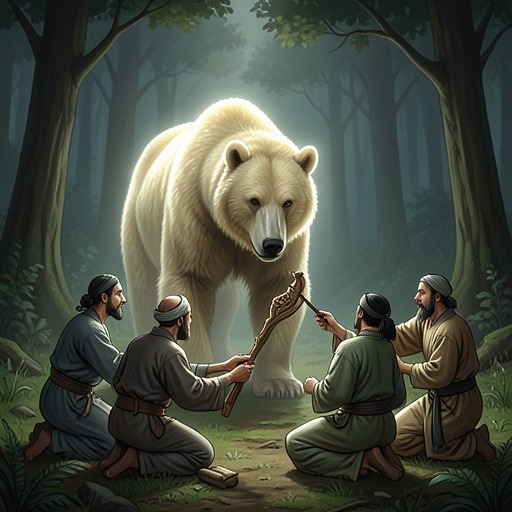
Before the encounter, the hunters are told to be ready and to wait in their kennels. The staging establishes that this is a hunt, but the language that follows resists treating Otso as an anonymous quarry. Wainamoinen addresses him as “Otso, thou O Forest-apple,” and calls him “Bear of honey-paws and fur-robes.” The names draw attention to the bear’s woodland associations and distinctive body even as the hunt proceeds. The line “Learn that Wainamoinen follows” announces the pursuer, but does so within a direct address to Otso, rather than as a report about an unseen animal.
Wainamoinen’s later greeting makes that relation more explicitly affectionate: “Otso, thou my well beloved,” followed by “Honey-eater of the woodlands.” These repeated forms of address give the bear a place in the spoken exchange. The text does not give Otso a reply; the relationship is voiced by Wainamoinen. Still, the words make the hunt’s terms audible. He asks that anger not swell in the bear’s breast, addressing the possibility of conflict before setting out the welcome that follows. The scene’s ritual quality lies partly in this sequence: the hunter names the bear, acknowledges the danger of anger, and speaks of peaceful treatment rather than reducing the encounter to force.
The Promise of Peace and Plenty
Wainamoinen tells Otso, “We shall never treat thee evil,” then promises, “Thou shalt dwell in peace and plenty,” and “Thou shalt feed on milk and honey.” The assurances place hospitality alongside the hunt. They do not erase the fact that the people have prepared for Otso’s capture or that the narrative calls him sacred booty. Instead, they shape how the bear is spoken of and received: the expected quarry is also a beloved guest whose treatment is governed by promises of care and abundance.
That double status gives the episode its central tension. The address imagines Otso among friends in Kalevala, living peacefully and eating well, even as the hunters stand ready for him. The poem does not explain away the contrast, and the available scene does not describe Otso accepting the invitation. Its emphasis is on what the human speakers undertake to say and provide. Respect appears not as an absence of hunting but as a ritual language of affection, welcome, and restraint surrounding it.
The Feast and Its Distribution
The hunt leads into a feast announced as “the feast of Otso.” Kettles are swung from the fire on a polished iron crane, and the food and drink are plentiful for the assembled hosts. Wainamoinen’s account of the provisions reaches beyond the gathering: there is “Plenty more to give the village.” The feast is therefore described at more than one scale. It feeds those present, but its abundance also extends outward to the community.
This distribution matters to the rite as the poem represents it. Otso’s feast is not confined to a private meal or to the hunters who waited for him. The village is included in the surplus, so the conclusion of the hunt becomes a communal occasion. The sequence from prepared hunters to food shared among hosts and villagers gives the bear’s capture social consequences: it is narrated through hospitality and provision as well as through pursuit. The iron crane and the kettles anchor that abundance in concrete preparations, while the mention of the village makes its reach explicit.
Origin and Sacred Meaning
During the feast, the people ask Wainamoinen to tell them of Otso’s birth and whether his origin was ignoble. The question shifts attention from the hunt’s practical outcome to the bear’s beginnings. Wainamoinen answers by rejecting lowly descriptions: “Otso was not born a beggar,” “Was not born among the rushes,” and “Was not cradled in a manger.” The repeated denials give the response a formal, cumulative shape. Rather than presenting the bear as an ordinary creature whose importance ends with the hunt, the narrative pauses to establish a distinguished origin.
The answer closes by naming “This the origin of Otso,” calling him “Honey-eater of the Northlands,” and identifying this origin as the source “Whence the sacred booty cometh.” The sacred significance is thus made explicit in the account itself: Otso is not simply food secured by hunters but a being whose provenance is recounted before the feast is complete. Hunting, affectionate address, public sharing, and origin-telling are connected within the episode, without collapsing into one another. The hunters’ readiness marks the pursuit; Wainamoinen’s promises frame the bear’s treatment; the feast distributes plenty; and the people’s question makes Otso’s origin part of their shared knowledge.