Creation of the World from the Cosmic Egg
KalevalaThe Creation of the World from the Cosmic Egg presents the world as emerging through a sequence of natural actions: a duck seeks a place to nest on Ilmatar, its eggs break into the ocean, and their fragments become part of the ordered world. Creation here is neither a single command nor a finished act. It proceeds through nesting, incubation, breakage, and the continuing movement of the water-mother, making living creatures and the sea active participants in the formation of the landscape.
The Duck Finds a Nesting Place
After Ilmatar’s supplications, a duck descends and flies about the water-mother. Its arrival gives the scene a practical, creaturely beginning: the bird is searching for somewhere to build a dwelling and raise its young. Ilmatar provides a safe nesting place, and the duck slowly circles, looking until it notices her shoulders. The body of the water-mother thus becomes the ground on which the first nest can be made.
The exchange is small in scale but decisive in consequence. The duck does not arrive as an announced maker of the world; it seeks shelter for its eggs. Ilmatar’s body, meanwhile, is at once part of the oceanic setting and a place where life can take hold. The episode makes the emerging world feel inhabited from its beginning: its first construction is a nest, made by an animal, on the body of a living being.
Seven Eggs and Their Rupture
On Ilmatar’s shoulders, the duck builds its nest and lays six golden eggs, followed by a seventh of iron. It then sits upon them to hatch them. The detail gives the nest an ordered inventory before anything has yet been made from it: six eggs share one material description, while the seventh differs. The scene does not explain that contrast, so its importance lies in the particular composition it records rather than in an assigned symbolism.
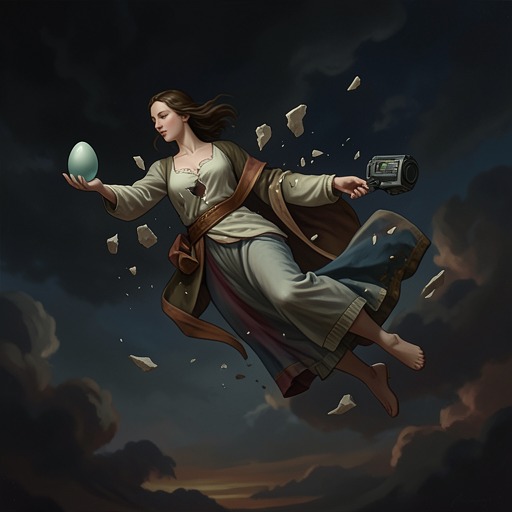
The turning point comes when the duck shakes its body in succession. The nest is shaken from its foundation, and the eggs fall into the ocean, where they dash to pieces on the bottom of the deep waters. The change is abrupt: what had been a protected place of incubation becomes a scattered mass at the sea floor. Yet the breaking is not merely the end of the duck’s attempt to hatch its eggs. The narrative immediately makes the fragments consequential, changing an accident into the material beginning of a world.
From Broken Egg to Ordered World
The account distinguishes an upper and a lower half, equal to one another, and identifies the lower half as the source of the nether vault of Terra. It also associates the shining of the new sun and the lighting of the full moon with the emerging world. The language therefore turns the egg’s division into an ordering principle: a single broken form supplies contrasting parts and gives the cosmos its vertical arrangement.
This creation depends on transformation rather than preservation. The eggs do not remain intact, and the nest does not survive its displacement. Their destruction opens the way for the world’s formation. The event’s sequence makes the reversal plain: the duck’s effort to keep its eggs safe ends in their shattering, but that shattering supplies the beginnings of a larger structure. The ocean is both the place where the nest is lost and the depth in which the pieces become the basis of creation.
Ilmatar Continues to Shape the Sea
The making of the world does not end with the eggs. Ilmatar remains in the sea as the water-mother, with the waters spread before her. Wherever she turns her hand, a fertile hillock rises; where she rests her foot, the water also receives a formed place. Islands are created, rocks are fastened in the ocean, and pillars of the sky are planted. The account thus moves from the accidental breaking of the eggs to a continuing process in which Ilmatar’s gestures give the sea durable features.
The two modes of creation remain distinct. The egg’s fragments provide the first divisions and beginnings, while Ilmatar’s movement shapes particular places within the watery expanse. Neither the duck nor the water-mother is reduced to a passive backdrop: the duck’s nesting and the eggs’ fall initiate the transformation, and Ilmatar’s actions continue it. The world emerges through relationships among body, animal, egg, and ocean, with the sea serving not as empty space but as the medium in which creation takes form.