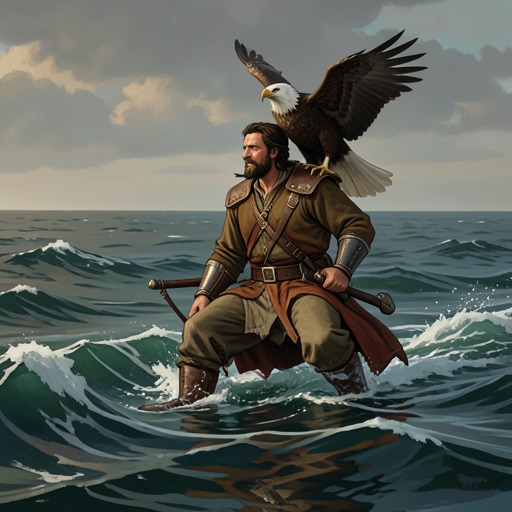
Rescue of Wainamoinen by the Eagle
KalevalaThe rescue of Wainamoinen by the Eagle turns a desperate passage at sea into an unexpected arrival in Pohyola. Wainamoinen, stranded and near physical collapse, is borne to the Northland by a bird from Pohyola; once there, however, he is not immediately safe or at home. The Eagle’s intervention saves him from the water, while Louhi’s later response brings him into shelter. Together, the two rescues change the direction of his journey without erasing its costs: he reaches land exhausted, grieving, and dependent on people whose country is not his own.
From endurance to crisis
The episode presents Wainamoinen as having swum through the deep sea for days. By the evening of the eighth day, his endurance has given way to bodily distress: his toenails have been lost, and his fingers are described as dead and dying. The details make his peril physical rather than abstract. He is not merely uncertain of his route; prolonged exposure has begun to disable him, and the sea offers no obvious place to rest or build a home. His lament registers a crisis in which survival itself, not the completion of a chosen journey, has become the immediate question.
That exhaustion shapes the terms of the rescue. Wainamoinen is an old and truthful hero and an ancient minstrel, but those identities do not protect him from bodily weakness. The narrative places the renowned singer at the surface of the ocean, unable to command a safe landing by himself. The contrast matters: this is a moment when his accustomed heroic stature cannot overcome the environment, and help must come from outside his own powers.
The Eagle’s intervention
A bird arrives from far Pohyola: an Eagle from the west, explicitly noted as not among the largest of its kind. It flies over the waves, strikes its beak against the sea-cliffs, circles, and finally perches. From there it sees Wainamoinen on the ocean and addresses him. The encounter begins not with a display of force but with recognition: the bird notices the stranded hero and asks why he is swimming in the deep billows. That attention interrupts Wainamoinen’s isolation and opens a means of escape.
The Eagle tells Wainamoinen not to lose heart and invites him to place himself between its shoulders. Wainamoinen rises above the water and seats himself on the bird’s feathered back. The scale of the action reverses the earlier picture of helplessness: the exhausted swimmer is carried aloft, along the path of the breezes, instead of struggling through the water under his own strength. The bird’s size is striking precisely because it is not described as exceptional among eagles; its significance lies in what it does, not in a claim that it is the greatest or most powerful bird.
The flight takes Wainamoinen to the distant shore of the Northland, identified with Pohyola. The Eagle sets down its burden and flies away to join its fellows. Its help is decisive but limited: it delivers Wainamoinen from the sea, yet does not remain to guide him, comfort him, or arrange his return. The landing ends one immediate danger while leaving the hero alone in an unfamiliar place.
A landing without refuge
After the Eagle departs, Wainamoinen weeps and moans. His hair and beard have been disordered by the surging waves, and the narrative gives this distress a measurable duration: he weeps through three days and as many nights. He does not know which way to travel. The rescue has therefore not restored him to his former security. Land is safer than open water, but arrival in the Northland leaves him disoriented, without a clear route onward, and visibly marked by the ordeal.
The contrast between aerial deliverance and prolonged grief keeps the event from becoming a simple triumph. Wainamoinen has been saved from drowning, but the Eagle’s departure means that salvation does not immediately amount to care. The three days and nights also separate the bird’s action from Louhi’s: the first rescuer carries him to shore, while the next stage begins only when someone hears him. His lament, previously a private expression of distress, becomes the sound that makes a further intervention possible.
Louhi brings him to shelter
The Maiden of Pohyola hears weeping from the seashore and recognizes it as the lament of a hero. She hastens home to tell her mother, Louhi, hostess of Pohyola. Louhi goes out from her dwelling and court-yard, hears the crying herself, and identifies it as the anguish of a bearded hero. The rescue thus shifts from an encounter between Wainamoinen and a bird to a human response prompted by listening: the Maiden carries the news, and Louhi acts on what she hears.
Louhi pushes a boat into the water and rows swiftly to the shore. She finds Wainamoinen with his face trembling and his locks disheveled, and addresses him. She then takes the hapless hero from his place of sorrow, seats him safely in her boat, and brings him to her home by the sea, to the dwellings of Pohyola. There she feeds him, gives him warmth and shelter, and allows him to rest. The scene completes what the Eagle’s flight could not: Wainamoinen is no longer merely deposited on foreign land but received into a household and provided for.
The episode’s decisive turn is therefore a sequence of limited acts of aid. The Eagle saves Wainamoinen from the sea and carries him to the Northland, but leaves him on the shore; the Maiden hears his grief and informs Louhi; Louhi comes by boat and gives him food, warmth, and shelter. His arrival in Pohyola follows from this chain of recognition and assistance. The rescue preserves the vulnerability established by his long swim while changing his immediate condition from exposed survivor to guest under Louhi’s care.