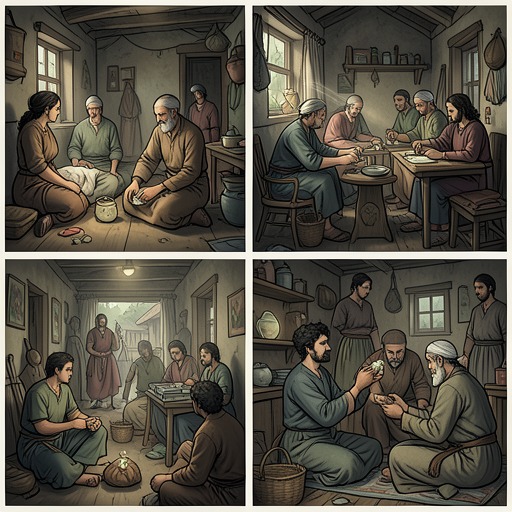
The Birth of the Nine Diseases
KalevalaThe Birth of the Nine Diseases makes illness a family of supernatural offspring: Lowyatar, a blind and ancient woman of Tuonela, bears nine children after the east wind impregnates her, and the poem links their arrival to sickness among the people of Wainola. Their birth joins the Death-land to the living world, while Louhi’s intervention turns the children’s story into a threat directed beyond their mother’s home.
Lowyatar and the Wind
Lowyatar is introduced as the blind daughter of Tuoni, an old and wicked witch described as the worst among the women of the Death-land. The account gives her a stark identity before describing her pregnancy: she belongs to the realm of the dead, and her blindness distinguishes her even within that sinister setting. The poem presents her not as an ordinary mother but as a figure through whom destructive forces enter the world of the living.
The change begins when the evening winds rise. Lowyatar becomes heavy with child through the east wind’s impregnation, a conception in which no human father or ordinary domestic setting is named. The wind connects the supernatural birth to weather: what moves through the air becomes the means by which the burden of disease is formed. The passage thus places the origin of the children in elemental forces rather than in a human household.
The birth scene also invokes Ukko. The Highest speaks from the heavens while Lowyatar wonders how to lose her burden and where to lay her evil children. The supplied passage preserves the beginning of his speech but not its full instruction, so the precise counsel cannot be established from these lines. What is clear is the contrast in scale: Lowyatar’s distress and impending delivery are met by a voice from above, making the birth part of a cosmic order as well as a private ordeal.
Delivery and Naming
At last Lowyatar is delivered of her burden. She lays the offspring in a cradle beneath golden covers, an image that sets the precious appearance of the bedding against the harm associated with the children. The poem locates the birth on a summer evening and states that nine children are born. That number makes the event more than the arrival of a single affliction: disease emerges as a multitude, with several distinct forms gathered into one supernatural family.
Lowyatar names her offspring. The names given in the passage include Colic, Pleurisy, Fever, Ulcer, Plague, and Consumption. They make the children’s nature legible through bodily suffering: rather than leaving illness as an abstract misfortune, the poem assigns it names and familial origin. The evidence here does not supply the remaining names, so the list cannot be completed without going beyond the passage.
The account compares Lowyatar’s care for her offspring to an artist’s love for what skilled hands have fashioned. The comparison gives the scene an unsettling double quality. The children are described as evil, yet their mother tends them with the attachment of a maker to a finished work. Creation and nurture, ordinarily associated with care, are therefore turned toward beings whose existence threatens others. The image does not make the diseases harmless; instead, it places their destructive potential alongside a mother’s evident investment in them.
Louhi’s Intervention
Louhi, identified as the hostess of Pohyola, enters the sequence after the children have been born and named. She banishes the other children to a fog-point in the ocean. The passage does not identify in these lines which child, if any, is excepted, or explain the exact circumstances of Louhi’s decision. It does establish a decisive separation: the offspring do not remain together with Lowyatar, and their path leads outward from her cradle toward a remote, mist-covered place.
The banishment links the children with the purpose of bewitching the lowland people and engendering strife and envy. Their danger therefore extends beyond the fact that their names signify diseases. The poem associates them with social disruption as well as bodily affliction, making their reach communal. Louhi’s action gives the birth a further consequence: the children become subject to movement and direction beyond their mother’s immediate care, and the ocean’s foggy boundary becomes part of the story of how their influence travels.
Sickness in Wainola
The consequences become visible when Wainola’s maidens sicken. The affliction is not confined to one age or station: young and old, men and heroes are all included among those struck by the worst diseases. The passage moves from a birth in Tuonela to a broad outbreak among the living, giving the episode its central reversal of scale. Nine children emerge from one mother, but their effects extend across a community.
The event’s force lies in this progression from origin to consequence. Wind impregnates Lowyatar; she delivers and names the children; Louhi sends the other offspring away; and sickness reaches the people of Wainola. The poem explains disease through supernatural genealogy rather than treating it as an unexplained condition. At the same time, its images resist a simple separation between the beautiful and the harmful: golden covers surround the cradle, and a mother cherishes what she has made, while the named children bring affliction and threaten social peace. The birth episode thus makes illness both intimate, as a mother’s burden and care, and collective, as a force that can overtake a whole people.