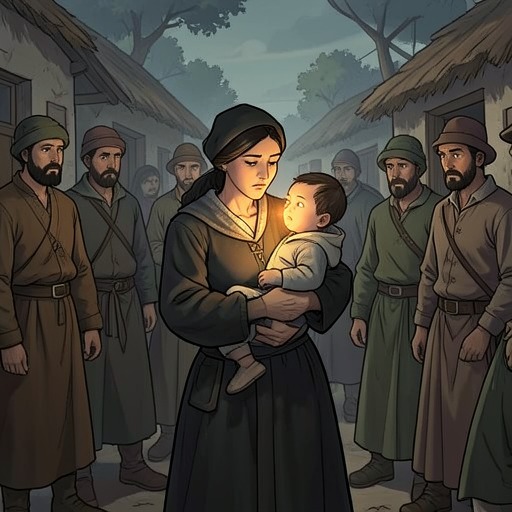
Mariatta’s child’s recognition as heir
KalevalaMariatta’s child’s recognition as heir turns a baptism into a public judgment over who may inherit authority. Wirokannas summons the aged Wainamoinen to assess the infant, but the child himself answers the accusation against him; the scene ends not with Wainamoinen’s verdict, but with Wirokannas’s blessing and the grant of royal heirship.
The child brought for judgment
The episode begins with Mariatta searching for her child and finding him among reeds and rushes. She takes him on her bosom to her father’s dwelling. The child is described as a golden infant, while the account of his birth places him in a manger and associates his paternity with a berry. These details become the grounds on which his status is disputed: he is not presented as a conventional heir whose standing is already settled, but as a child whose birth makes others question whether he can be accepted and blessed.
When Mariatta seeks the priesthood to baptize him, Wirokannas intervenes. His refusal makes the baptism more than a private act: the child’s fitness is put before Wainamoinen for judgment. Wirokannas calls the ancient singer to inspect the infant and report whether he is good or evil. The scene thus makes religious recognition depend on a verdict about the child’s origin and worthiness, while placing that verdict in the hands of the old hero.
Wainamoinen’s ruling
Wainamoinen examines the infant carefully. His decision rests on the child’s lowly circumstances and unusual parentage: the baby is an outcast, born and cradled in a manger, and, as Wainamoinen puts it, “the berry is his father.” From these premises he condemns the child as unworthy. He does not merely refuse approval; he orders Mariatta’s son taken to the marshes and his head dashed against a birch tree.
The severity of this sentence makes the judgment a decisive conflict rather than a disagreement over ritual procedure. Wainamoinen has been called to distinguish good from evil, but he treats the child’s disputed birth as proof of guilt. The infant’s smallness intensifies the disparity between the power of the judge and the vulnerability of the person judged: the child is only two weeks old, yet the ruling threatens his life before he can otherwise establish his place among the people.
The infant’s answer
The sentence is interrupted when Mariatta’s child speaks. He directly addresses Wainamoinen as the “Son of Folly and Injustice” and calls him a “Senseless hero of the Northland.” Rather than accept the older hero’s authority as final, the infant challenges the fairness of the judgment. His reply recalls that Wainamoinen himself was not treated justly or welcomed by his people, turning the judge’s own experience into evidence against his decision.
This answer reverses the scene’s hierarchy. Wainamoinen had been summoned to assess the child and report on his moral character; now the child’s speech exposes a failure in the judge’s reasoning. The infant is no longer simply the object of other people’s decisions. By speaking for himself, he contests the standard by which he has been condemned and makes the question of injustice central to the recognition ceremony.
Blessing and succession
After the child’s reply, Wirokannas acts as the authority who can complete the rite. He touches the infant with holy water and gives him a blessing. He also grants him the rights of royal heirship, freedom to live and grow into a hero, and the prospect of becoming King and Master of Karyala. The movement from a threatened death sentence to blessing and succession is the event’s sharpest reversal: the child whom Wainamoinen would banish is formally admitted to a future among the living and the powerful.
The final grant is prospective rather than a report that the child already rules. Wirokannas authorizes him to grow into a hero and ruler; the scene establishes a recognized claim and anticipated future. Its closing emphasis on Karyala makes the outcome more than a rescue from immediate danger: Mariatta’s child receives a public place in the political order. In the surrounding narrative, the years pass and Wainamoinen recognizes his powers waning, setting the old singer’s decline beside the child’s newly declared future.
Narrative significance
The episode brings the poem’s old and new orders into direct encounter. Wainamoinen represents established wisdom and is given the role of judge, yet his verdict fails when the child answers with an argument grounded in remembered injustice. Wirokannas’s blessing, not the old hero’s condemnation, determines the child’s recognized standing. The transition is therefore enacted through speech and ritual: judgment is challenged, holy water is applied, and heirship is conferred.
The sequence also makes the infant’s origin and social vulnerability inseparable from the dispute over legitimacy. His unusual parentage and manger-born status first furnish the accusation against him; his reply then prevents those circumstances from being treated as a sufficient reason for exclusion. Recognition does not erase the contested origin. Instead, the scene resolves the immediate contest by granting the child a future that Wainamoinen’s sentence would have denied, and by naming him as a prospective ruler of Karyala.