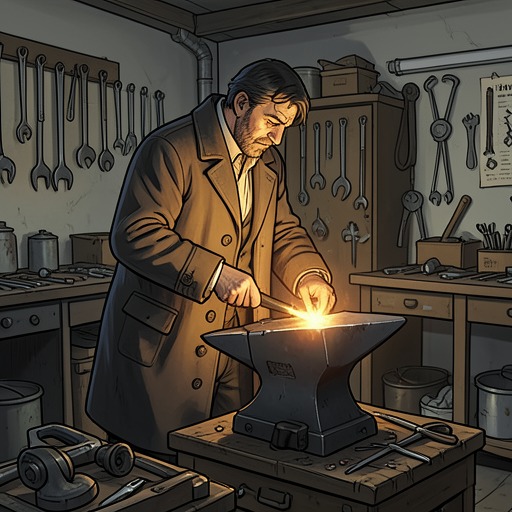
Ilmarinen Forges the Sampo
KalevalaIlmarinen Forges the Sampo turns a marriage bargain into a feat of supernatural craftsmanship, then exposes the gap between fulfilling a condition and winning its promised reward. Wainamoinen enlists the master smith to make the Sampo for the sake of a maiden of Pohyola; Ilmarinen succeeds, and Louhi takes the finished marvel away. Yet the smith’s request for the maiden’s willing answer remains unresolved, leaving the episode’s achievement divided between an object secured and a bride not obtained.
The bargain and the summons
The undertaking is framed as an exchange. Wainamoinen points to a maiden seated on the rainbow and walking upon purple clouds, then names the Sampo as the work to be made and the virgin as its reward. The promised bride gives the commission its personal stakes: this is not simply a demonstration of Ilmarinen’s skill, but labor undertaken in expectation of marriage.
Wainamoinen’s own magic marks the movement toward that commission. After speaking of what might be taken from him, he sings again in magical accents and sings a storm-wind into the heavens. The narrative then turns to his direct appeal to Ilmarinen, addressing him as a master of the forge and asking him to make the Sampo and its many-colored lid. The sequence places the smith’s specialized craft alongside Wainamoinen’s song-magic: the work requires Ilmarinen’s forging, but the events leading to the request are shaped by Wainamoinen’s powers and purposes.
The work at the forge
The forging proceeds through a measured sequence. On the next day Ilmarinen lays his bellows; on the third he builds his furnace and begins to forge the Sampo. The song identifies him both as an ancient blacksmith and as the eternal magic artist, joining long-established mastery to a creation that exceeds ordinary smithing. The delay matters: the Sampo does not appear instantly at the request, but emerges through the preparation of tools and furnace and the labor that follows.
When Ilmarinen bends down to inspect the metals at the bottom of the furnace, he sees the Sampo rising and sees its lid in many colors. That moment makes the object visible as the product of his work: first it is promised, then forged, and finally discerned within the materials of the furnace. The colored lid links the completed marvel to the repeated description in the commission, so that the finished object answers to the design set before the smith.
What the Sampo does
The completed Sampo is described through its rhythmic operation. Its lid rocks to and fro as it grinds: one measure at daybreak, a second for the market, and a third for the storehouse. The account emphasizes repeated production and distinct uses, rather than merely naming the Sampo as a treasure. Its value lies in what it continually yields and in the way its output reaches both the day’s beginning and the needs of exchange and storage. The separate measure associated with money further establishes that its abundance includes wealth as well as provisions.
This working rhythm also gives the marvel a particular form in the song. The Sampo is neither only a beautiful object nor only a prize in a marriage bargain: it is a machine whose rocking lid and grinding action make its extraordinary abundance legible. The repeated measures turn magical plenty into an ordered process, and the compact pattern of daybreak, market, and storehouse makes the result sound regular and dependable.
Possession and the unfulfilled reward
Louhi, hostess of Pohyola, takes away the magic Sampo joyfully. Her taking marks the transfer from the smith who made it to the figure who carries it off; the account thus distinguishes the maker’s labor from control of its product. Ilmarinen’s part in the bargain has produced the object, but does not by itself secure the bride.
After the Sampo has been taken, Ilmarinen modestly pleads for the maiden’s willing answer. The emphasis on willingness sharpens the contrast with the earlier promise: the maiden is not simply another possession delivered alongside the machine. The episode closes its account of the bargain with the imbalance still in view. Louhi has the wondrous Sampo; Ilmarinen has not the Bride of Beauty. The forging is completed, but its promised human reward remains unsettled, making the episode’s success real and incomplete at once.