The Recovery of the Celestial Fire
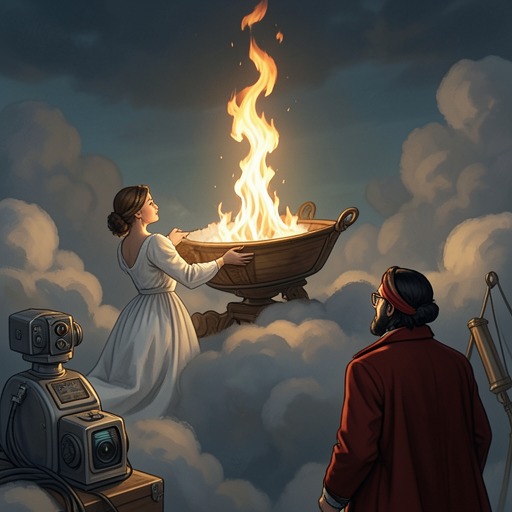
KalevalaThe Recovery of the Celestial Fire turns a cosmic loss into a chain of physical encounters: fire descends into the waters, passes through the bodies of fish, and is finally taken back to the hearths of Northland. Wainamoinen’s recovery joins two scales of the Kalevala’s world—the extraordinary route of a heavenly fire-ball through the waters and the practical need to warm the dwellings of Wainola and Kalevala.
Background and the fire in the waters
The Alue Waters react violently to the Fire-child. Their surface hisses and sputters, and the waters are described as fiery red while the disturbance recurs through three nights of summer and nine nights of autumn. The lost fire is therefore not simply absent from human dwellings: its presence has unsettled an entire aquatic environment, making the waters both the place where the crisis is visible and the medium through which the fire must be recovered.
The fish register that disturbance as a loss of their own. The salmon weeps for its grotto, the whiting mourns its cavern, and the lake-trout laments its dwelling. These brief images give the crisis a sequence of submerged homes under threat, rather than presenting the waters as an empty setting. The Fire-child’s passage has consequences for the creatures that inhabit the waters, and their grief accompanies the fire through the stages of its concealment.
The fire passes through the fish
The fire’s underwater passage is represented through predation. A trout darts out and swallows the whiting, the fish that has eaten the Fire-child. Later, a gray-pike swallows the lake-trout and quickly eats the tortured Fire-fish. The repeated pattern makes the fire’s location difficult to reach: it is carried inside one creature, then concealed within another, as each predator becomes the next container. The chain also links the earlier mourning of the fish to the later capture of the pike; the same aquatic world that suffers from the fire’s presence holds the means of recovering it.
Wainamoinen, identified as an ancient minstrel, uses a net to break this chain. The fish are driven in countless numbers toward the magicians’ net, which he draws through the water on ropes of flax-thread. He carries the catch to a blue point in the waters near a red bridge on the headland, then lands the fish there and casts the pike onto the shore. The capture is methodical: a search through the water becomes a haul of many fish, and the particular pike that matters is found among the catch. The named point and bridge give the recovery a definite landing place between the waters and the shore.
From the pike to the heavenly fire
The pike is identified as the Fire-pike, and the Sun-child responds to its capture by expressing a wish to carve and handle the fire-fish. The episode thus shifts from concealment to exposure: what had been inaccessible within a succession of fish is now brought onto land, where it can be approached and handled. The Fire-child, Fire-fish, and Fire-pike names track the changing forms through which the fire appears in this part of the story, while the caught pike makes the hidden route materially present.
Wainamoinen considers how to carry the magic fire-ball to Wainola’s fireless hearth-stones and cold dwellings. Its path is also described on a cosmic scale: it has come from the heights of the seventh heaven and through nine regions of the ether. Wainamoinen then snatches the fire of heaven from the fingers of the Sun-child. The act brings the celestial object within reach, but not without consequence: the fire singes Wainamoinen’s beard. The return is achieved through direct contact with a power that remains physically dangerous, rather than through a costless recovery.
Return to Northland
Wainamoinen takes the willing Panu and the willing fire of Ukko, placing them in a box of tinder. This careful containment contrasts with the fire’s earlier passage through the waters and fish: once recovered from the pike and taken from the Sun-child, it must still be carried in a form that can be conveyed home. The fire’s willingness is explicitly noted, and the tinder box becomes the practical vessel for its return.
The closing movement restores fire to Northland, to the chambers of Wainola, and to the hearths of Kalevala. The destinations narrow from a region to dwellings and finally to hearths, locating the consequence of the celestial recovery in domestic life. The event’s structure follows the fire from cosmic height to aquatic concealment, through a net and onto the shore, then into a tinder box and back to inhabited homes. Its significance lies in that conversion: an extraordinary heavenly power, lost amid the waters, becomes warmth again at the hearth.