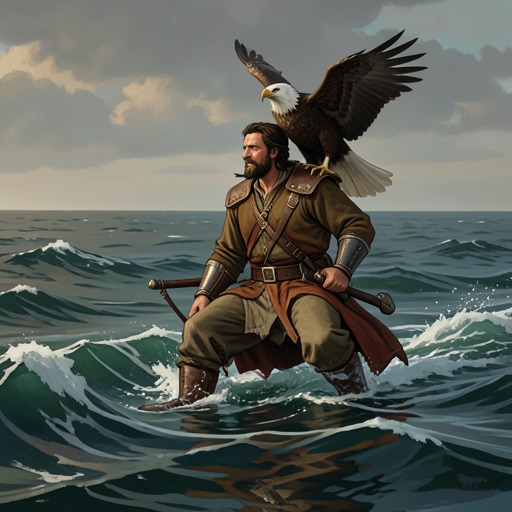
Youkahainen Shoots Wainamoinen
KalevalaYoukahainen Shoots Wainamoinen turns a minstrel’s envy into an ambush, and a journey toward the sea into a fall from the saddle and an uncertain fate on the waves. Youkahainen’s arrows do not kill Wainamoinen in the scene; they knock him into the water, where a storm wind carries him away. The event shifts the story from rivalry in song to physical danger, while the boast that follows exposes the gap between what Youkahainen believes he has done and what the narration actually establishes.
Causes and Preparation
The episode opens as Wainamoinen arranges a journey. He is described as old and truthful, and his route takes him to the blue sea’s margin without wetting his horse’s hooves. The approach to the shore gives the attack a clear threshold: Wainamoinen is travelling onward when a rival who has been waiting for him makes the journey dangerous.
Youkahainen’s motive is stated as a grudge nourished in his heart: envy of Wainamoinen, the wonderful enchanter. The account presents the attack not as a sudden accident but as the consequence of this sustained resentment. Youkahainen prepares a cruel crossbow made of steel and other metals, paints it in many colors, and has his arrows ready. The weapon’s careful preparation contrasts with the abrupt violence of the final shot; this is a planned attempt against a rival, not a chance encounter.
The waiting gives the plan its shape. Youkahainen remains ready with the strung bow, waiting a long time without growing weary. At daybreak he is near a holy stream and whirlpool, by a sacred river’s waterfall. These landmarks place the encounter at moving water before the action carries Wainamoinen out into the sea. Youkahainen is identified as the Lapland minstrel and as being of Pohyola, while Wainamoinen approaches along his own journey; the meeting is arranged by the ambusher’s patience, not by a declared contest between the two men.
The Three Shots
When Youkahainen bends the bow, he braces the weapon on his left knee and plants his right foot firmly. The first arrow flies over Wainamoinen’s head and scatters the flock of lamb-clouds. Its passage into the sky makes the miss visible on a scale beyond the two men: the shot travels upward through the clouds, but leaves Wainamoinen untouched.
Youkahainen is not discouraged by that failure. He selects and adjusts quickly, then shoots again. The next arrow pierces toward the lower regions and splits old Sand Mountain in two. The account thus gives the second shot a forceful consequence, but it still does not strike Wainamoinen. The repeated misses prolong the danger: Youkahainen keeps recalibrating, and each attempt changes the surroundings without yet reaching his target.
The third arrow finally strikes the steed. It hits near the golden girdle and passes through the shoulder of the racer. The distinction matters: the shot does not directly wound Wainamoinen in the described action. It disables the horse beneath him, breaking the security of the ride and precipitating the fall. After two arrows have gone elsewhere, the third succeeds by bringing down the mount that carries the traveller.
Fall and Aftermath
Wainamoinen goes headlong into the waters, plunging beneath the rolling billows as he falls from the saddle of his dappled magic steed. The movement is sudden and complete: the mounted journey ends not on shore but in the sea. A mighty storm wind then rises, roars over the water, and bears him away across the high, rolling waves and the broad expanse. The immediate consequence is displacement and danger, rather than a confirmed death.
Youkahainen boasts after the storm has carried Wainamoinen off, believing him dead and buried. That belief belongs to Youkahainen; the narrative does not confirm that Wainamoinen has died. The difference between assumption and established outcome keeps the attack from resolving as a simple victory. Youkahainen has achieved the fall and lost sight of his rival, but the sea and storm have taken control of what happens next.
The mother’s answer supplies the episode’s sharpest judgment of the violence: she laments the action as bringing woe to earth and declaring joy and singing gone forever. The response connects the physical attack to what Wainamoinen represents in the narrative: not only a body that can be thrown from a horse, but a figure associated with song. The scene therefore moves from envy, to patient preparation, to repeated shots, and finally to a consequence whose full meaning exceeds Youkahainen’s boast. Its reversal is stark: the archer can strike the steed, but cannot determine Wainamoinen’s fate once the waves take him.