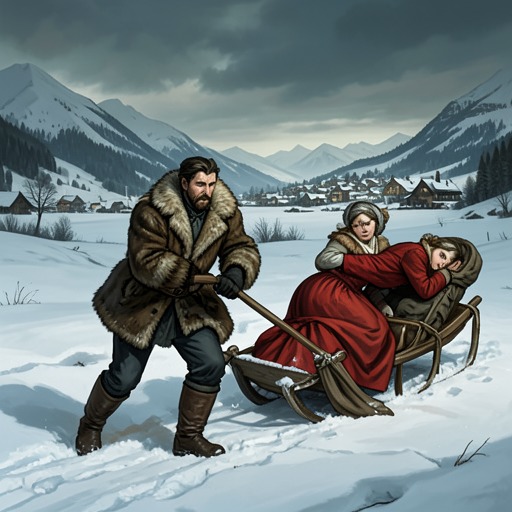
Lemminkäinen Abducts and Marries Kyllikki
KalevalaLemminkainen Abducts and Marries Kyllikki turns a forced removal into a marriage marked by grief and reciprocal vows. Kyllikki, celebrated as Sahri’s pride and beauty, is taken from the place where maidens gather to dance and brought to Lemminkainen’s mother’s cottage. The movement from public gathering to the hero’s family home makes the episode’s central tension visible: marriage joins households, but here that joining begins with Kyllikki’s loss of freedom and her tearful resistance.
Background and the meeting at the dance
The episode follows a warning against spending time wooing Sahri’s favored maiden. Little time passes—scarcely a month—before the narrative turns to a merry evening and the gathering of maidens for dancing. The contrast is pointed: the warning imagines courtship as something to avoid, while the scene presents Kyllikki among her companions in a social space of her own. Her beauty and standing are emphasized before Lemminkainen arrives, so the reader encounters her first as the celebrated object of others’ attention and then as a person whose wishes will become impossible to ignore.
Lemminkainen comes on a stallion described as the fleetest racer of the Northland. He drives beyond the meadow to the place where the maidens meet, and the poem’s quick verbs compress his approach and seizure: he snatches Kyllikki, seats her, and draws a leather cover. The horse and hurried action give the abduction a public, forceful character; this is not a private agreement reached through an extended courtship. The scene’s briefness also sharpens the change in Kyllikki’s circumstances. She moves in moments from the company of the dancers to the control of the man who has carried her away.
Abduction and protest
The poem does not let the speed of the seizure erase its cost. Kyllikki’s wailing and weeping are presented directly after the abduction, and her pleading becomes a distinct part of the encounter rather than a detail absorbed into Lemminkainen’s success. Her grief marks the gap between his action and her consent. The narrative thus holds two facts together: he has physically removed her, yet her response makes clear that the removal is not an uncomplicated romantic elopement.
The exchange that follows sustains the conflict through speech. Kyllikki addresses Lemminkainen as a cruel fighter, while he answers and addresses her as the fair Kyllikki. His language is associated with the broadsword and spear, bringing martial identity into a scene ostensibly concerned with marriage. The contrast matters: his means of acquiring a bride are continuous with the force and combat associated with his heroic persona, while her words register the human opposition that such force encounters. The scene does not describe a battle between them; instead, it lets the tension surface in her accusation, her pleading, and his reply.
Vows and conditions
The relationship changes through an oath rather than through any account of Kyllikki’s sudden affection. The two make vows together, register them in heaven, and swear before Ukko. That heavenly witness gives their promises a solemn authority beyond the immediate encounter, while the fact that both take part distinguishes the vows from the unilateral act of abduction that preceded them. The marriage’s terms are therefore presented as something to be bound by mutual undertaking, even though the episode has already shown how unequal the circumstances of their meeting are.
Dancing and warfare give the promises their concrete stakes. Kyllikki is associated with the village dances, and the exchange makes her visits to them a subject of the oath; Lemminkainen’s broadsword and spear, in turn, make his life as a fighter part of the negotiation. The episode links domestic union to the restraint of activities that define each figure in the scene. Its vows do not erase the coercive beginning, but they introduce an obligation that can later be measured against conduct: the promise is not simply a declaration of marriage, but a rule whose breach can have consequences.
Arrival and significance
After the vows, the pair reach Lemminkainen’s home and birthplace and enter his mother’s cottage. The destination is more than a change of scenery: Kyllikki is transferred from the gathering of maidens at Sahri into the household of her husband’s family. The movement brings the episode from the public setting of dancing to the domestic space in which the marriage will be lived. The mother’s cottage also makes the union a matter of household incorporation, not merely a private bond between two individuals.
The poem’s sequence refuses to make that incorporation look effortless. A warning against wooing leads to a meeting at the dance; the meeting becomes a seizure; Kyllikki’s distress leads into a spoken exchange; the exchange is followed by vows; and only then does the couple enter the family home. Each transition changes the form of the conflict without making its earlier stages disappear. The episode is therefore both a marriage story and a narrative of contested choice: Kyllikki’s protests remain part of the account even as the oath and the arrival establish a shared domestic future. Its decisive tension lies in that unresolved conjunction, between the force that brings her to Lemminkainen’s home and the promises that are meant to govern their life together.