The Capture of the Sampo
KalevalaThe Capture of the Sampo is the episode in which Wainamoinen, Ilmarinen, and Lemminkainen seize the Northland treasure through a combination of enchantment, strength, and craft. Its decisive reversal comes through music: Wainamoinen’s harp quiets the defenders, allowing his companions to reach the Sampo and carry it away. The capture makes the instrument more than a mark of the minstrel’s art; it becomes an active force in the expedition, even as the storm that follows takes it from him.
The Sampo and the Northland
The capture belongs to the Kalevala’s recurring contest between the heroes of Wainola and the people of Northland. The poem’s preface presents raids into the northern country to claim the mysterious Sampo as a repeated part of that conflict, and compares the Finns’ struggles with the darksome Laplanders to the contests between Greeks and Trojans in the Iliad. It also offers a more allegorical interpretation, reading the opposition as one between light and darkness, good and evil. In either framing, the Sampo is not an incidental prize: its possession stands at the center of an ongoing rivalry.
The episode is identified as Rune XLII, following the account of the harp’s creation and music. That placement connects the capture to the preceding scenes of performance rather than treating the raid as an isolated feat of force. The Sampo is found inside a mountain, where its roots have grown nine fathoms deep into the earth. The image gives the heroes a formidable physical task: the treasure is secured not merely behind a gate but bound into the ground.
Music as a means of entry
Wainamoinen’s fish-bone harp has already gathered listeners into a shared response. When the aged try its strings and the young magicians receive it, its music spreads gladness and echoes across the hills and mountains. Wainamoinen’s playing also brings tears to his eyes; the poem makes those pearly tears the origin of sea pearls and the blue duck’s beautiful plumage. Music in these scenes moves between communal feeling and the creation of natural things.
At the mountain, the same instrument acquires an immediate tactical use. As the people of Northland threaten Wainamoinen and his companions, he hastens to the harp and begins to play. He continues until the maidens, the young and the old, and then all the Northland warriors fall asleep. The change is decisive: the defenders’ numbers and hostility no longer block the way to the Sampo. Wainamoinen’s performance does not simply accompany the raid; it creates the opening through which the other heroes can act.
Opening the mountain and taking the treasure
With the Northlanders asleep, the heroes from Wainola hurry to obtain the Sampo and its many-coloured lid. Wainamoinen calls to Lemminkainen, his daring friend in times of trouble, directing him toward the work ahead. Lemminkainen finds the Sampo within the mountain and labours to free it. The poem stresses the depth of its hold: roots have extended nine fathoms into the sand and earth. A mighty ox is also introduced in Northland before the account reports that the Sampo loosens and its coloured lid falls silently.
The work depends on more than Lemminkainen’s strength. Ilmarinen, the magic blacksmith, anoints the hinges, bars, and locks. The gates then open in silence for Wainamoinen. The contrast between the minstrel’s loud, enveloping music and the quiet opening of the barriers gives the capture its characteristic combination of spectacle and craft: the defenders are overcome by sound, while the mountain’s fastenings yield through careful preparation.
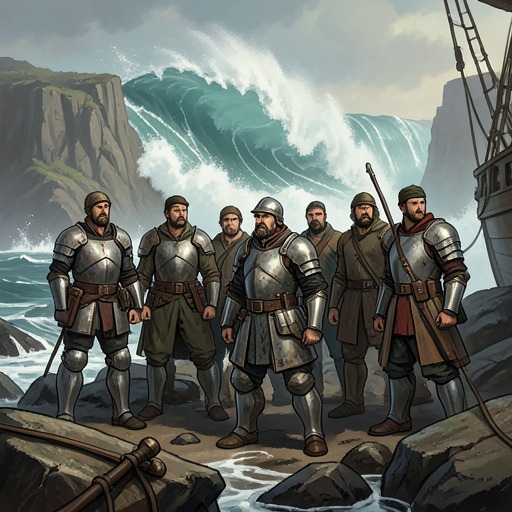
Once the Sampo is free, Wainamoinen brings Ilmarinen and Lemminkainen together, hides the treasure in his waiting vessel, and places it aboard Wainamoinen’s warship. He then calls his people, crew, men and maidens, and heroes together. The capture thus becomes a collective departure, not just the private achievement of the three leaders. The Sampo is removed from Northland by a company assembled under Wainamoinen’s command.
Aftermath and narrative significance
The successful seizure reverses the balance of the northern contest: the heroes have reached a treasure guarded in the mountain and put it aboard their ship. Yet the return does not preserve every instrument of their success. In the storm that follows, the warship is tossed high and the fish-bone harp is swept away. The poem therefore places the loss of Wainamoinen’s harp in the immediate aftermath of the capture, separating the instrument from the treasure it helped secure. The account does not make the harp’s fate identical with the Sampo’s; it establishes the harp’s loss as a distinct consequence of the voyage.
That contrast sharpens the episode’s treatment of power. The Sampo is taken through coordinated action, while the harp’s reach proves temporary: its music can overcome the Northland warriors, but it cannot protect itself against the sea. The event also makes the Kalevala’s song-magic concrete. Singing and playing do not merely describe a contest or praise its heroes; they change what the heroes can do, turning a guarded mountain into an accessible prize. The capture joins enchantment, workmanship, and communal effort, while the storm that follows begins to unsettle the victory.