Lemminkäinen’s Trials for Louhi’s Daughter
KalevalaLemminkäinen’s Trials for Louhi’s Daughter makes courtship a test of deeds: Louhi’s daughter is promised not freely, but conditionally, as Lemminkäinen is sent from one dangerous task to the next. The surviving sequence records his claim to have caught the wild moose, his return as a victor to Pohyola, and Louhi’s demand that he kill a swan in the River of Tuoni with a single arrow. The passage ends as he accepts this third test, leaving its outcome beyond the scene presented here.
Marriage Made Conditional
The trial sequence is framed by Lemminkäinen’s desire to marry Louhi’s daughter. The wild moose is not an incidental quarry: the condition attached to bringing it back is a chance to woo the maiden. The demand makes a personal relationship depend on the suitor’s completion of tasks set by her mother, and turns the pursuit of marriage into a public measure of his capability.
After the hunt, Lemminkäinen goes as a victor to the dwellings of Pohyola and addresses Louhi. He asks her for her fairest virgin as his future bride. Louhi, identified as hostess of the Northland and of Pohyola, does not grant his request on the strength of his success. Instead, she sets a further condition. The exchange therefore renews the obstacle at the moment Lemminkäinen expects his achievement to count: completing one demand earns him an audience and a new demand, not the bride.
The Tests in Sequence
The moose hunt is the first clearly established achievement in the supplied sequence. Lemminkäinen later tells Louhi that he has caught the moose of Lempo and done what she required. His statement connects the boast of a successful hunt to the condition that began the wooing, and presents the completed task as grounds for asking again for her daughter. The narrative thus gives the episode a repeated pattern: a demand, a claimed accomplishment, and a renewed request for marriage.
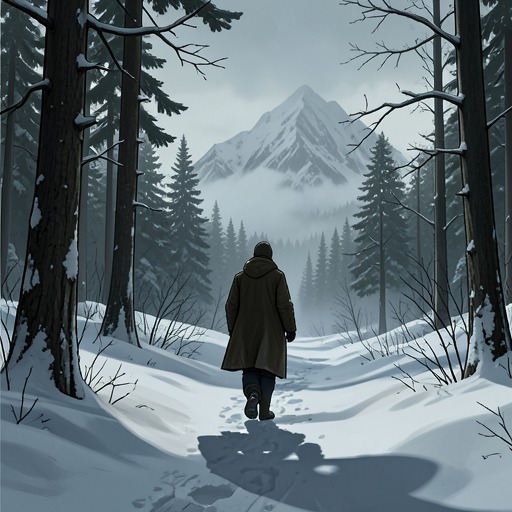
A second test lies between that first success and the audience in Louhi’s court. The narration calls what follows Louhi’s second test of heroes, and Lemminkäinen hastens forward to accomplish it, undaunted. The larger sequence identifies this trial with the fiery horse, but the quoted portion supplies no account of how he completes it. What it does establish is the escalation’s structure: his progress has already required more than the moose, and the second task has not ended his pursuit. He rides over the snow-capped hills of Lapland to Sariola, dismounts, and enters Louhi’s court to make his claim.
The Third Demand and Its Stakes
Louhi responds to the request for her daughter by naming another task: Lemminkäinen must kill the swan in the River of Tuoni, where it swims in the black death-river. The setting and the required act distinguish this demand from the earlier hunt. The suitor is not merely asked to bring back another animal; he must attempt a killing in a river explicitly associated with death.
Louhi also sharply limits his means. He may try with only one crossbow and one arrow from his quiver. That restriction concentrates the danger into a single attempt and denies him the security of repeated shots. The trial’s terms make success uncertain even before the action begins, while the river’s name and description give the task a grave setting. Lemminkäinen is called reckless as he takes up this third test, a characterization that signals the risk in his persistence without resolving what happens next.
Narrative Function and Limit
The episode advances by withholding the marriage while registering each step as an achievement or fresh obstacle. Lemminkäinen’s return as a victor and his claim that he has fulfilled Louhi’s demand create a brief expectation that the earlier work may secure the bride; Louhi’s next condition immediately redirects the action. The sequence makes the suitor’s determination inseparable from the danger imposed by the tests.
The available passage closes at the threshold of the swan challenge: Lemminkäinen has accepted it, but no result is given here. The scene therefore leaves both the task and the marriage unresolved. Its decisive movement is not a final victory but the transition from two prior tests to a third, more tightly constrained demand.