The Birth of Wainamoinen's First Harp
KalevalaThe Birth of Wainamoinen's First Harp is the episode in which Wainamoinen sees the remains of a mighty Northland pike not as waste but as the beginnings of an instrument. The turn comes after force has failed: Lemminkainen’s sword breaks without harming the monster, while the feast leaves bones that can be put to another use. The first harp thus emerges from a change in attention—from the creature as an opponent to its remains as material for making.
From open water to stillness
The episode begins in motion. The companions have passed through the dangers of the current, a sacred stream, and a whirlpool; at length the vessel reaches open water and the broad lake. There, suddenly, its motion ceases. The transition from perilous passage to an abrupt halt gives the encounter its threshold: the journey has not simply ended, but the water has brought the travelers face to face with the great pike.
Wainamoinen addresses Lemminkainen as they confront the mighty fish. The available account places the pike among the extraordinary things found in the water, making the encounter part of a larger world in which the lake yields both danger and material possibility. The scene’s focus, however, falls not on a detailed contest but on the sharply stated failure of the weapon: Lemminkainen breaks his sword into pieces and does not harm the water-monster. The attempted answer of force leaves the pike unharmed and the human weapon ruined.
A failed weapon and a change of purpose
Wainamoinen then addresses his companions with a rebuke, calling them poor apologies for heroes. His words register the disparity between the challenge and their response: even a warrior’s weapon proves ineffective against the water-monster. The broken sword is a concrete measure of that failure, not a victory over the creature. The episode does not linger over a successful killing by combat; instead, it moves toward what can be made after the encounter.
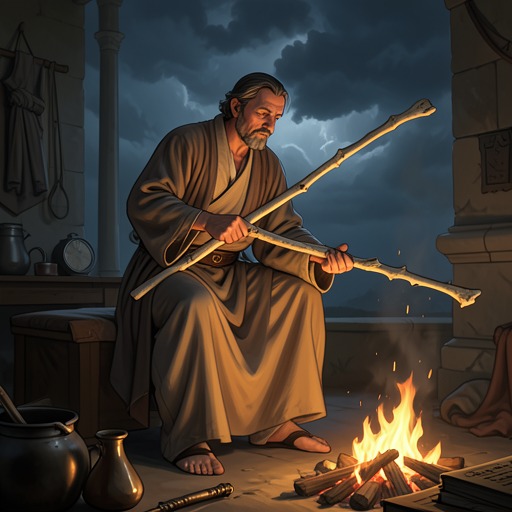
After the feast, fish-bones remain on the rocks as its only relics. Wainamoinen, described as an ancient minstrel, looks at the pile of fragments and ponders it. That pause changes the meaning of the remains. What the feast has left behind is no longer merely the evidence of eating, and what the failed attack could not accomplish is answered by a different kind of skill. The story pivots from breaking a sword to studying bones: violence has reached its limit, while making has only begun.
The pike’s remains become an instrument
Wainamoinen imagines that something wondrous might be built from the monster’s jaws, teeth, and fish-bones. He connects this possibility to the skill of the forger-artist and the hands of the magician. The proposed work therefore joins practical making to the epic’s world of magic: the bones are the physical substance, but their transformation depends on a maker capable of seeing and shaping their potential.
The narrative next shows Wainamoinen setting himself to work designing. It calls him a fish-bone artist, a description that gathers the episode’s reversal into a single image. The same creature that resisted the sword now supplies the material from which an instrument can be conceived. The account establishes the first harp’s pike-bone origin through this sequence of encounter, feast, observation, and design; its emphasis is on the moment when Wainamoinen recognizes a new use for the remains.
Significance of the episode
The episode makes creation follow directly upon failed force. Lemminkainen’s sword is broken and the pike remains unharmed, but the aftermath is not empty: the bones left on the rocks become the basis for Wainamoinen’s design. The change is not a reversal in which the monster is defeated after all. Rather, the narrative redirects attention from mastery of the living creature to inventive work with what remains.
That redirection also defines Wainamoinen’s role in the scene. He is not presented only as a companion in danger or a witness to the feast; as an ancient minstrel, he recognizes artistic possibility where others have left fragments behind. The first harp’s origin is consequently tied to both the material world of the lake and the maker’s perception. Its beginnings are specific and humble—jaws, teeth, and fish-bones on the rocks—yet Wainamoinen’s design makes those remnants the starting point of something wondrous.