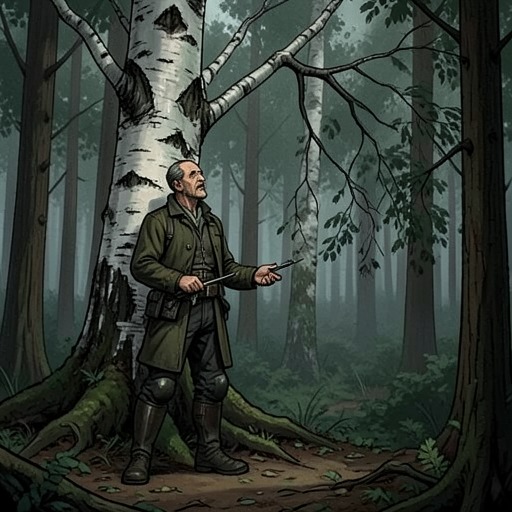
The Loss and Failed Recovery of Wainamoinen's First Harp
KalevalaThe Loss and Failed Recovery of Wainamoinen's First Harp is the turning point at which a handmade source of music and communal delight disappears into the sea. The storm casts the fish-bone instrument from Wainamoinen’s ship, and the water-maidens carry it below the waves. His later search yields only the scattered matter of the seabed, not the harp; the loss is permanent, and a second instrument must take its place.
The Harp Before the Storm
The lost instrument had been fashioned by Wainamoinen and was presented as a wonder: the harp of joy, described as the pride and beauty of Northland. Its value is established not only by its making but by its use. Wainamoinen first lets the aged try its strings, then gives it to the young magicians. The harp thus passes among generations and becomes a shared instrument, rather than remaining merely the possession of its maker.
When Wainamoinen plays the strings he has fashioned, gladness gathers upon gladness, and the harmony carries across hills and mountains. The scene makes the harp’s musical force part of the surrounding world. Later, as Wainamoinen plays and sings, tears flow from his eyes like pearls. Joy and grief are both present in the instrument’s history before it is lost: its music can move the community, while the minstrel’s own response gives that music a deeply personal weight.
The Storm and the Loss
The loss comes amid a violent reversal. Winds roar and lash the waters until the waves turn white; the warship is tossed high into the air, and the fish-bone harp is thrown away. The storm is described as tearing up the bottom of the deep sea, enlarging the scale of the upheaval: the instrument does not simply fall within reach of its owner but vanishes into a sea made violently inaccessible.
Water-maidens carry the magic harp to their home beneath the billows. That detail gives the disappearance a destination, but not a route back. Wainamoinen is heavy-hearted and speaks of having lost what he created. He tells his comrades not to weep, even as he declares that the harp will never again be found on land or ocean during his heroic lifetime. His words register both attachment to the work of his hands and the finality he assigns to its loss.
The Search Beneath the Waves
In the account of the second harp’s making, Wainamoinen reflects that Ahto will never return the first one and that joy and music seem gone forever. He asks Ilmarinen to forge an iron rake, setting it thickly with copper teeth, so that the seabed can be searched. The effort turns grief into a practical attempt at recovery: instead of accepting the harp’s disappearance at once, Wainamoinen equips himself to rake through the place where it has been lost.
Wainamoinen descends to the waters and rakes the sea beds. The search brings up water-flowers, broken reeds and rushes, deep-sea shells, and colored pebbles. These are concrete traces of the seabed, but none is the instrument he seeks. The sequence delays the final answer through a catalogue of recovered fragments, each emphasizing how much the sea yields without yielding the harp. At last, the narration confirms that the fish-bone harp is not found and is lost forever to Wainola.
A Second Harp and the Aftermath
The failure makes the first harp’s loss more than a temporary interruption of music. Wainamoinen’s earlier assertion that it cannot be found is borne out by the search, and the treasure carried beneath the waves does not return. The episode also distinguishes two outcomes: the original instrument remains irrecoverable, while music itself is not abandoned. The answer to loss is not a successful rescue but another act of making.
Wainamoinen eventually finishes a second sacred harp. The poem associates its completion with sources of eternal pleasure for the people of Wainola. The new instrument therefore answers the first harp’s disappearance at the level of use and community, though it does not undo the loss of the original. The contrast is decisive: the storm removes a singular creation from its maker, the seabed search confirms that it cannot be retrieved, and renewed musical pleasure comes through a new harp rather than the recovery of the old one.