The bride's separation and the hardships of marriage
KalevalaThe bride’s separation and the hardships of marriage form a sustained concern in the wedding songs: marriage changes not only a woman’s status, but also her home, kinship ties, work, and security. The departure of the Maiden of the Rainbow from her family is framed as a consequential crossing into another household, while the instruction that follows shows how much labor and adjustment that crossing entails. Set beside Aino’s sorrow at being offered in marriage, the wedding material also distinguishes a bride who is called a chosen wife from a woman whose future is decided for her.
Departure from Home and Kindred
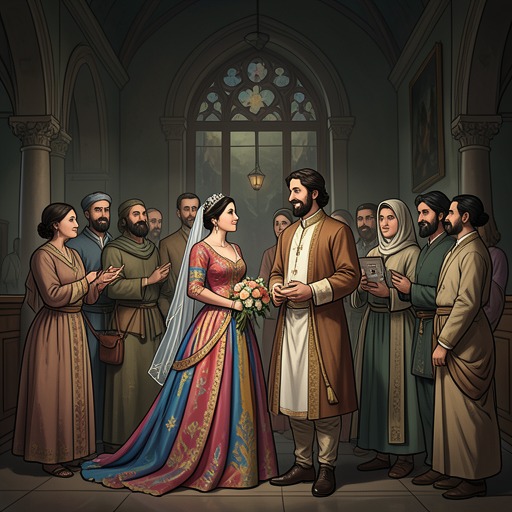
The wedding’s completion does not end the bride’s story; it begins the difficult movement away from the people and place that have defined her life. In the farewell, the mother names the change directly: “Now thou leavest home and kindred,” and the bride is to “Follow him, thy chosen husband,” into a new household. The language places marriage between attachment and separation. The husband may be chosen, but the choice does not spare the bride from leaving her own home, her family, and the familiar ground of childhood.
The mother’s farewell describes this change as a shift in the whole landscape of belonging. The bride goes to other firesides and another mother, while the valleys and mountains are changed and other birds sing her praises. The images make departure more than a physical journey: the places themselves acquire new meanings when the bride no longer lives among her kindred. The wedding thus presents incorporation into a husband’s family as inseparable from loss of the natal household.
The bride’s own departing speech gives the scene a more uncertain emotional register. The account recalls childhood, while a speaker offers comfort that remains doubtful; the autumn evening is dreary, but the bride calls her future still drearier. The farewell’s public language of joining a chosen husband therefore coexists with private apprehension. Marriage is marked as a recognized transition, yet the songs do not assume that recognition makes it easy.
Tears and the Bride’s Unease
The wedding material allows sorrow to be visible rather than treating it as a flaw in the ceremony. The young bride is urged to weep sincerely, and her grief is imagined as abundant enough to become rivers. The exhortation does not erase her tears or immediately turn them into happiness; it gives her distress a place within the farewell. A child playing by the stove then asks why the bride is crying, making her sadness a question that the household cannot simply overlook.
This attention to tears contrasts with the more formal assurance that the bride is joining her chosen husband. The farewell voices can praise the marriage and still acknowledge that its emotional cost falls sharply on the person who must leave. The image of another mother is especially charged: the bride is expected to enter a new family relationship just as she separates from the mother and kindred who have been her own. The songs hold those conditions together instead of reducing the departure either to celebration or to lament alone.
Aino’s story sharpens the distinction between choice and obligation. When Youkahainen seeks relief from his torment, he offers his sister Aino to Wainamoinen as a bride, promising her as a lasting wife. Aino is then shown answering her mother tearfully and naming her sorrow. Her proposed marriage is embedded in an exchange made by her brother, not introduced as her own choice. Beside the wedding farewell’s reference to a “chosen husband,” this episode exposes how differently a marriage can be framed: a bride’s new life may be spoken of as chosen, while another woman’s future is pledged by kin.
Marriage as Instruction and Labor
The next rune turns from farewell to preparation. Its opening asks who will teach the Maiden of the Rainbow, and identifies Osmotar as the bride-adviser. The question itself presents entry into marriage as something requiring instruction: the bride must learn how to live in her husband’s dwelling and how to meet the expectations of a second mother. Osmotar’s counsel is directed not toward courtship but toward the daily responsibilities that begin after the wedding.
The advice describes housewifery as work performed under pressure. Osmotar recalls that, when she was a young housewife, she carried out her duties at the proper time and drenched herself in perspiration. The detail makes labor bodily and strenuous, not an abstract virtue. Her instructions also include a warning against simply following the husband’s mind and fancies, suggesting that the bride’s adjustment is not represented as uncomplicated obedience. She must enter the new household, but the counsel recognizes that its demands require judgment as well as effort.
The remembered account also brings physical vulnerability into the instructional voice: a willow branch and an alder club appear, and a cudgel is aimed at the speaker’s forehead. The passage does not make the bride’s future a promise of effortless welcome. Instead, the advice carries the weight of experienced hardship, placing domestic labor alongside the possibility of harsh treatment. The new wife is being prepared not only to work but to negotiate a household in which her standing and safety cannot be taken for granted.
A Passage Without Guaranteed Ease
Taken together, the farewell and the bride-adviser’s speech give marriage a double structure. The bride is publicly joined to a husband and expected to become part of his household; at the same time, she leaves her childhood home, mourns that departure, and faces unfamiliar duties. The movement from daughter to wife is therefore not a clean exchange of one secure identity for another. Its emotional and practical costs remain visible in the songs.
The contrast with Aino prevents the idea of a chosen marriage from becoming a general rule. Her brother’s offer turns her into the object of a bargain, while the Maiden of the Rainbow is addressed as the man’s chosen wife. Even in the latter case, the farewell emphasizes what the bride must surrender and the work she must undertake. The material’s significance lies in holding these conditions together: marriage may be celebrated as union, but the bride’s separation, labor, and uncertain welcome remain central to what that union demands.