Wainamoinen's Prophecy of Return
KalevalaWainamoinen's Prophecy of Return turns a departure into a promise whose fulfillment belongs to a distant, uncertain future. Wainamoinen leaves Wainola foreseeing that, after generations have passed, Suomi will remember his wisdom and hunger for his teachings; when that need arrives, he says, he will return bearing the Sampo, light, peace, and plenty. The prophecy therefore closes his departure without making it final: the singer is gone, but the prospect of his return remains attached to the future needs of his people.
The future need for his return
The prophecy begins not with a date or a personal timetable, but with repeated cycles of the sun. Suns will rise and set in Suomi through generations before the North learns Wainamoinen’s teachings and recalls his sayings. This scale separates his departure from any immediate homecoming. His absence is measured across a long succession of ordinary days, while the forecasted change is cultural: the people will come to recognize the value of what he taught and remember what he said.
That recognition is described as hunger for true religion. The phrasing makes the promised return depend on a need that has not yet become urgent at the moment of departure. The prophecy does not say that Wainamoinen will return as soon as he leaves, nor does it specify when the generations will have passed. Instead, Suomi’s eventual spiritual appetite supplies the condition for his coming. His future presence is imagined as an answer to a lack that the present scene leaves unresolved.
What the promise brings
When Suomi needs him, Wainamoinen says it should watch for his coming at dawn. The image gives the future arrival a clear point of anticipation, but no calendar date: dawn marks an opening, a transition from darkness to light, rather than a measurable time within the generations-long wait. The instruction to watch keeps his people oriented toward a return even as his departure carries him out of their immediate reach.
The promised gifts join material abundance to restored brightness and order. Wainamoinen undertakes to bring back the Sampo and to restore golden moonlight and silver sunshine, followed by peace and plenty to the Northland. The promise connects the return of a lost source of prosperity with the return of celestial light and collective well-being. These benefits are stated together, but the prophecy does not describe how Wainamoinen will recover the Sampo or accomplish the restoration; it presents them as the substance of his future pledge, not as events already completed.
Departure and suspended fulfillment
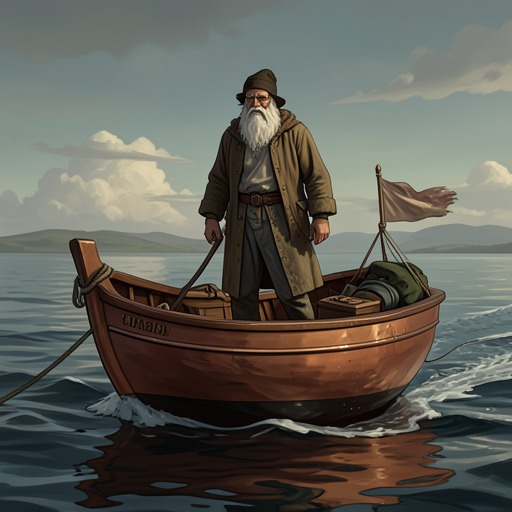
The narrative places the prophecy beside a concrete departure. The ancient Wainamoinen leaves his tribe in Kalevala in a copper-banded vessel, which gains the far horizon and reaches a purple-colored harbor. There his copper boat is firmly anchored. The movement from leaving his people to reaching a distant harbor gives the promise a physical counterpart: Wainamoinen has passed beyond the community that is to wait for him, rather than remaining among them to fulfill it at once.
The final detail complicates the image of a complete leave-taking: he leaves his magic harp behind. The vessel carries Wainamoinen away, while the harp remains associated with the place he has departed. The passage does not explain what becomes of it, or make its presence a guarantee of his return. Instead, the contrast leaves a remainder in Kalevala even as the prophecy directs attention toward a future reunion.
The return thus remains promised but unshown. Wainamoinen’s words point beyond his own departure toward a time when remembered teaching and spiritual hunger will call him back; the narrative, by contrast, ends this movement with his vessel anchored at a distant harbor. The Sampo, sunlight, peace, and plenty belong to the anticipated future, not to the scene of departure. That gap between pledge and fulfillment is the prophecy’s defining force: it preserves the possibility of restoration while leaving Suomi to wait.