Barrayar
MemoryBarrayar is the homeworld at the center of Miles Vorkosigan’s return from a life built around Imperial service and the invented identity of Admiral Naismith. Its single wormhole route to the galactic nexus runs through Komarr, making the planet’s geography a source of political vulnerability as well as a limit on Imperial reach. As Miles moves between ImpSec headquarters, the Imperial Residence, his family’s district, and finally the space lanes beyond Barrayar, the planet becomes more than a birthplace: it is the place whose obligations he cannot separate from himself.
Geography and the gateway
Barrayar’s position in interstellar traffic is defined by a single connection. Miles reflects that the route linking it to the galactic nexus passes through Komarr; control of that gateway therefore carries direct strategic consequences for Barrayar. Komarr, by contrast, has six important wormhole jump points in close practical proximity, making its local space a crossroads and a target. The difference is not merely cartographic: a world with one passage depends on whoever holds it. Miles’s account sets Barrayar’s constrained access against Komarr’s network of routes and conveys why control of the neighboring planet matters to the Empire.
The worlds also represent different histories. Komarr has never experienced a Time of Isolation and has remained connected to the galactic mainstream, while Barrayar’s past and outlook seem archaic to a Komarran even when the planet is not as old as it appears. Its population and political culture are presented through that contrast, rather than through a general survey of the planet. The contrast gives Barrayar a particular texture in Miles’s thoughts: its sense of age is bound up with its history and relative separation, not simply its years.
Imperial center and historical layers
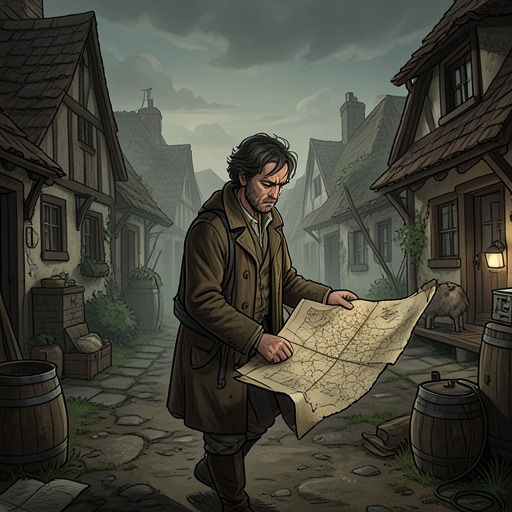
The capital, Vorbarr Sultana, concentrates the institutions Miles must confront after returning from service. Standard procedure brings him from the military shuttleport directly to ImpSec headquarters in a groundcar. The immense gray building is regarded as one of the capital’s ugliest, and its reputation is tied to the story that its architect went insane after the abrupt eclipse of Emperor Yuri, its patron. Its imposing public façade gives way to a discreet side entrance used by couriers, spies, informers, analysts, secretaries, and other staff. The setting makes the machinery of state concrete: intimidating from the street, it is also a workplace reached by people with ordinary official business.
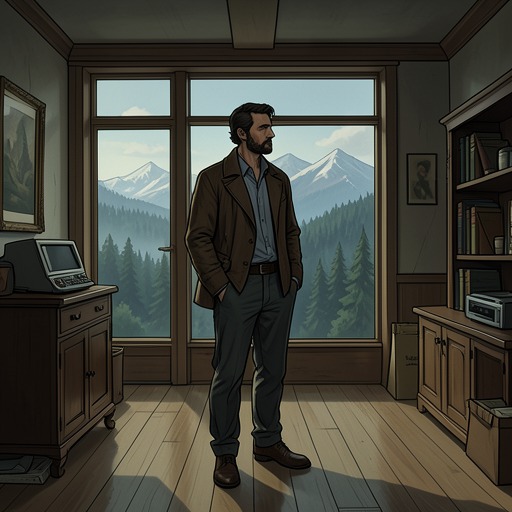
The Imperial Residence holds another kind of history. Its north wing is the only part of the sprawling complex less than two centuries old, having been burned to the ground during the War of Vordarian’s Pretendership and rebuilt. The Emperor’s ground-floor office, where Gregor meets Miles, is deliberately unlike a museum: sparely decorated, furnished with art by living young artists, and containing no antiques. Within a building marked by dynastic history, this private room projects a present-focused imperial household. Miles’s audience there is both personal and political, taking place in a residence whose architecture carries the memory of conflict without making every room a relic.
District, terrain, and travel
Away from the capital, Barrayar opens into Miles’s home district. During a journey south with Martin Kosti, he recognizes the northern border when the blue shadows of the Dendarii Mountains appear on the horizon. Rather than take a direct line, he directs Martin east and plans to cross the district on a broad route, passing north of the urban traffic. A lightflyer carries them over the landscape: a small, maneuverable vehicle between an antigrav sled and an airplane, equipped with fail-safe systems but still demanding judgment from its pilot.
The district measures roughly 350 kilometers from its northern lowlands to its southern mountain passes and about 500 kilometers east to west, following the mountain chain along its highest ranges. Only about its northern fifth is flat, fertile plain, and only half of that land is usable. The nearest city is visible to the travelers, but Miles has Martin steer wide of its high-traffic areas to avoid the city computer’s control of lightflyer routes. These concrete details make Barrayar’s terrain a practical condition of travel and governance: distance, mountains, limited farmland, and managed urban airspace all shape how a district is crossed.
Reach, commerce, and Imperial obligations
Barrayar’s limited access also helps explain why Miles’s career has relied on an identity operating beyond the ordinary reach of its forces. He has spent a decade cultivating Admiral Naismith, the supposed leader of the Dendarii Free Mercenary Fleet, because an ostensibly independent mercenary outfit can appear beyond political and geographic barriers that restrict Barrayaran regular forces. In one operation, Simon Illyan delegates to Miles the recovery of a Barrayaran courier and vital diplomatic packets taken by hijackers. The episode is not located on Barrayar, but it shows how the planet’s state projects power along the wormhole routes and why it may use a deniable force where its own military presence is constrained.
The Empire’s relationship to those routes is economic as well as strategic. From an orbital transfer station near Komarr, Miles considers the traffic moving through the system: cargo and passengers connect Barrayar with other routes, while fees and taxes from the stations generate income far beyond what can be extracted from the homeworld’s backcountry farmers. He reminds himself that this far-flung traffic is also part of the Barrayaran Imperium. The homeworld’s concerns therefore extend beyond its land and capital; its prosperity and influence depend on a wider network that Miles once served under an assumed name.
Return and the meaning of home
After his medical discharge, Miles returns to Barrayar amid a personal crisis. A message from Alys Vorpatril invites him to a luncheon at the Imperial Residence and makes clear that Gregor wants a private conference. Miles understands that he must face his apology and their strained relationship, even as he wishes he could avoid the encounter. Later, his parents’ message from Sergyar reaches him by government data beam and express jumps, much faster than a physical message disk. The contrast in transmission time gives family news its own place within the Empire’s connected geography, while the message’s timing sharpens the uncertainty surrounding what his parents know.
At the end of his journey, Miles comes back from Komarr to a warm, lit Vorkosigan House. He spends the evening not in a formal role but in the kitchen with his Armsman and Ma Kosti, joking with the cook, hearing news about Martin Kosti’s basic training, and watching the corporal play with the kittens. In the wine cellar he opens one of his grandfather’s rarest, oldest bottles, finds it spoiled, and pours it away rather than drink it for symbolism; he chooses a newer bottle he knows is good. The small domestic action closes the larger question of whether he belongs on Barrayar. He has rejected the idea that he can preserve only the parts of himself suited to a life among the Dendarii, and his return places duty, family, and a future on the homeworld in the same frame.