Imperial Military Hospital
MemoryThe Imperial Military Hospital is the Barrayaran medical institution where Miles Vorkosigan’s post-cryorevival seizures are investigated and treated. Its veterans clinic and neurology laboratory give the episode a concrete institutional setting: Miles arrives seeking an explanation for frightening, unpredictable attacks, and leaves with a tested device and a daily procedure for managing them. The hospital’s contribution is not a simple cure, but a sequence of examination, experiment, diagnosis, and adaptation.
Setting and Medical Resources
The hospital’s veterans treatment division is Miles’s chosen starting point for a preliminary seizure examination. He considers the Imperial Military Hospital the most logical place to go because it has extensive experience with cryo-revival cases on Barrayar and immediate privileged access to his medical records, including classified files. His Dendarii Fleet surgeon’s notes should also save weeks of repeating information already recorded elsewhere. Choosing the hospital therefore means bringing together records from different parts of Miles’s life and service, rather than beginning his diagnosis from scratch.
The decision also has a practical personal consequence. Ivan Vorpatril has threatened to take Miles bodily to the clinic of his choice, or to report his continued foot-dragging to Gregor. By scheduling the examination himself, Miles prevents Ivan from forcing the issue. The visit is not merely a medical appointment: it is a way for Miles to take control of the timing and venue of care he has been resisting.
Diagnosis in the Neurology Laboratory
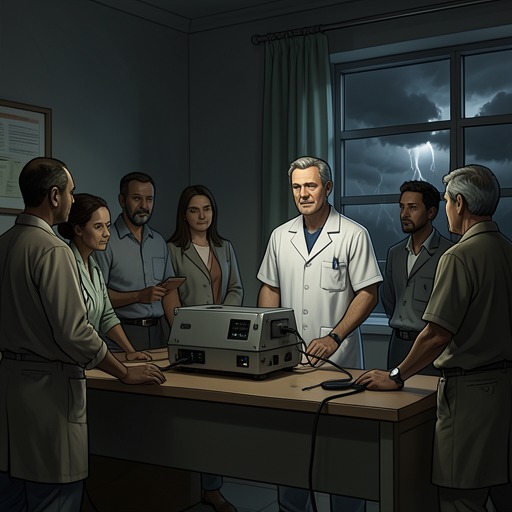
The hospital’s role expands from routine examination to experimental investigation. A neurologist and a cryonicist work together on Miles’s case, using a laboratory seizure to capture the event under observation. On the sixth day, they succeed in triggering an attack. Miles comes around on an examination table, his head secured in a large scanner and his body connected to monitoring equipment. The three technicians nearby attend closely to the instruments, while the doctors excitedly compare the results; the scientific value of the seizure briefly takes precedence over the patient’s wish to be addressed.
The neurologist, Dr. Chenko, explains the resulting diagnosis in his office with data disks and displayed models. After Miles’s cryonic revival, his brain began producing unusually high levels of neurotransmitters. These accumulated in neural reservoirs until stress or excitement could prompt a sudden release, temporarily shutting down normal neural function and accounting for the hallucinations Miles experiences during an attack. The hospital’s tests make the mechanism legible as a pattern that can be monitored and deliberately managed, even though Chenko emphasizes that Miles’s condition is unusual.
The investigation also establishes why a straightforward drug treatment is not promising. Miles appears to overproduce dozens or perhaps hundreds of neurotransmitters, making broad suppression impractical; even if the production could be reduced, that would only lessen the frequency of seizures, not eliminate them. Chenko instead locates the central difficulty in the reservoirs’ molecular release mechanism. The distinction guides the hospital toward controlling the consequences of the buildup rather than attempting to suppress every chemical involved.
From Laboratory Proposal to Treatment
Chenko proposes a miniature version of the neural stimulators used in the laboratory, combined with feedback sensors to report dangerous neurotransmitter buildup. Miles would be able to trigger an attack voluntarily, in a controlled place and at a chosen time, effectively releasing the accumulated neurotransmitters before they precipitated an uncontrolled seizure. The doctors expect scheduled, controlled attacks to be milder and shorter. The proposed intervention does not promise that the underlying condition will disappear; it offers a way to make its episodes more predictable and less disruptive.
Miles asks whether the seizures might continue for the rest of his life, and Chenko cannot say: the condition is unique in his neurological experience. After sitting with that uncertainty, Miles agrees to try the approach. When Chenko later reports that the microengineering has produced a device small enough to fit beneath the skull, he invites Miles back for testing before final calibration and surgery. The plan has moved from a laboratory concept to an intervention designed for an individual patient.
The hospital then performs the surgery to install the device’s internal portion. The procedure proves less lengthy and frightening than Miles expected; Chenko, now familiar with his patient’s slightly paranoid outlook, allows him to remain awake and watch the operation on a monitor positioned above the head clamp. Miles is permitted to go home the following morning. Two afternoons later, he returns to Chenko’s neurology laboratory for a smoke-test, making the hospital the setting both for installation and for the first check that the system can work outside the earlier diagnostic experiment.
Routine, Autonomy, and Significance
The smoke-test demonstrates a practical reduction in the attacks’ severity. Chenko reports that Miles’s convulsive symptoms lasted barely half as long as his uncontrolled seizures and that his body movements were suppressed; the hangover-like effects are also expected to diminish, though Miles is asked to observe and report how he feels over the next day-cycle. The hospital’s work thus ends not with a claim of complete recovery but with a measurable improvement and a plan for continued observation.
Chenko instructs Miles to make use of the activation unit’s monitor as part of his everyday routine. He is to check his neurotransmitter levels at the same time each evening and whenever they rise above one-half, but before they exceed three-quarters, discharge them using the stimulator. The device translates a specialist’s diagnosis into a repeated task Miles can perform himself. Chenko tells him he can fly the next day, an immediate indication that the test has not required him to remain indefinitely under hospital care.
The Imperial Military Hospital’s narrative importance lies in this shift from unexplained bodily interruption to informed, if ongoing, management. Its clinicians use Miles’s records, a deliberately induced seizure, laboratory monitoring, and an implanted feedback system to make a singular condition more comprehensible and controllable. The result is neither a cure nor a return to life before the seizures: it is a structured means for Miles to recognize rising risk, choose when to act, and reduce the duration and force of an attack.