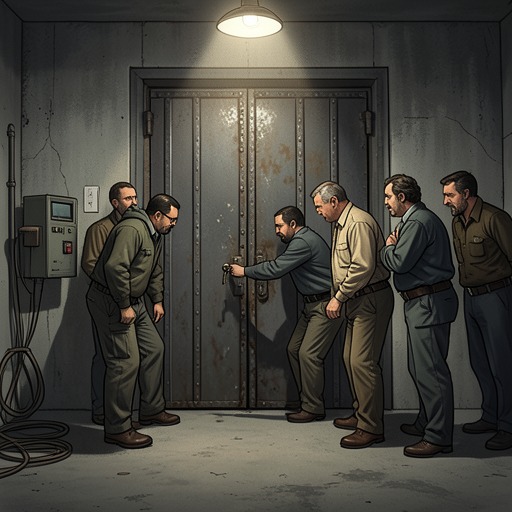
Weapons Room IV
MemoryWeapons Room IV is an aisle within ImpSec’s Evidence Rooms, deep in the sub-sub-basement, where stored objects and their records become material for Miles Vorkosigan’s investigation. The room serves first as the setting for opening and counting a sealed biocontainer, then as the site of a witnessed demonstration using one of its remaining capsules. Its significance lies in that change of function: a storage place becomes a controlled examination space, and the box’s contents become evidence that can be handled and observed.
Setting and Function
The room is identified with the Evidence Rooms and, more specifically, with Aisle 5 and Shelf 9. Miles brings a team there near dawn, after ordering ImpSec Forensics to send its senior officer and arranging for Vaughn Weddell to be brought in from home. Ivan Vorpatril is also present. Later, Miles returns with a forensic technician and a group of witnesses, again directing the work around the same shelf and the same small bio-sealed box. The room’s placement in the sub-sub-basement makes it part of the institution’s secured evidence-storage complex; the scenes show that access to its contents is governed by inventories, seals, examination procedures, and witnesses.
The first examination begins with the container’s exterior. The forensic officer finds evidence that it has been moved several times, including fingerprints and smudges, but none appear fresh. He records the marks by laser scan so they can be checked against Evidence Rooms personnel and, if necessary, the wider population of the Empire. The container’s screamer-signal circuit, intended to detect removal from the Evidence Rooms, has never activated. No hairs or fibers are found, and the officer notes that the room’s air filters leave little expectation of dust. These observations do not identify who moved the box; they establish what the examination can and cannot show before its contents are opened.
Inventory Discrepancy
Ivan removes the box from its shelf and sets it on a lighted examination board. Its numeric lock is elementary rather than secure: the access code is listed in the inventory description, and Ivan uses that record to open it. Inside, a shockproof gel-pack is scored with six parallel slots. Three contain tiny brown capsules; three are empty. The inventory describes six sealed vector-delivery units originally, with one removed for examination five years earlier and recorded as destroyed. That accounting would leave five, but only three are present. The difference makes the inventory itself part of the evidence: the box’s current contents do not match the number expected from its documented history.
The physical arrangement sharpens the discrepancy. The capsules are small enough for a child to swallow, and their placement in individual slots makes the missing units legible at a glance. The forensic officer proceeds to inspect the seal from inside after Ivan opens the lid. Miles recognizes that the capsule removed years before could complicate the inquiry, and he hopes laboratory records will help resolve that complication. The room therefore holds both the object and the limits of what can immediately be inferred from it: the count establishes a shortfall, but the excerpt does not settle when or by whom the capsules disappeared.
The Witnessed Demonstration
Miles later brings an array of witnesses to Aisle 5 in Weapons Room IV. Vaughn Weddell, previously skeptical of the investigation’s direction, watches with fascination as the procedure proceeds. Shelf 9 is out of reach, so Ivan hands Miles the familiar box. Its Auditor’s seal remains unbroken, and two brittle brown capsules are inside. Miles takes one and rolls it between thumb and forefinger before announcing that the assembled group should watch. He presses until the capsule snaps, then waves it twice above his head.
The broken capsule releases an exceptionally fine, smoky tan powder. It hangs briefly in the air and dissipates, leaving a small smudge on Miles’s fingers. Ivan holds his breath as Miles asks Weddell how long they should wait. Weddell advises giving the powder at least ten minutes to spread throughout the room. The scene establishes the physical release and the planned interval for the test; the supplied passage does not report what happens after that wait. Rather than merely describing a suspicious substance, Weapons Room IV becomes the space where its behavior is staged before witnesses.
Evidentiary Role
Across both visits, the room links administrative records to observable material facts. The inventory supplies the expected count; the opened box supplies the actual count; the exterior examination records marks and the inactive removal alarm; and the later demonstration shows what happens when a capsule is broken. None of these details alone answers every question about the container’s history. Together, however, they give Miles a setting in which discrepancies can be identified, procedures observed, and a claim tested in public view.
The room’s narrative role is consequently active but bounded. Its shelves preserve the objects under investigation, while its examination board, seal, light, and assembled witnesses make those objects available to scrutiny. The transition from counting capsules to releasing their powder turns stored evidence into an event witnessed in the same institutional space. Weapons Room IV is not simply a backdrop for the inquiry: it is where the difference between what the records say and what the evidence contains becomes concrete, and where Miles begins to demonstrate the substance’s physical effect.