Vorkosigan House
MemoryVorkosigan House is the ancestral residence of the Vorkosigan family and a setting where the weight of that inheritance changes as the household empties, gathers again, and makes room for a new generation. Its imposing architecture preserves the appearance of an old Vor stronghold, but its scenes in the novel turn on a quieter contrast: a house built for crowds and public power is, at first, almost entirely empty. It becomes a refuge during Simon Illyan’s convalescence and, by the end of the events described, a home Miles Vorkosigan begins to occupy on his own terms.
Setting and Architecture
The House occupies the middle of a city block that once held three old-style mansions. The Imperium had bought the building at one end for security purposes during the regency of Miles’s father, while the dilapidated mansion at the other end had been replaced by a small park. Vorkosigan House itself stands behind a narrow strip of lawn and garden, within a semicircular drive and a stone wall topped with black iron spikes. Its four stories of gray stone, arranged in two main wings with irregular architectural additions, give it the mass of a fortress. A force screen just inside the wall provides the actual protection; the romantic image of bats and ravens around the old building is at odds with the practical security measures and with the scarcity of Earth-descended bats on Barrayar.
The contrast between the House’s old appearance and its changing defenses is visible at the entrance. During the height of the regency, three full platoons of ImpSec guards had taken turns around the clock at posts in and beyond the building. On Miles’s return, one young corporal guards the gate. Inside, a palm-lock opens the front door automatically. Miles notices that no Vorkosigan Armsman in the family uniform is there to admit him, and that he must operate the door himself. The shift from platoons and household attendants to a lone guard and automated entry makes the building’s reduced activity tangible before he has even crossed the threshold.
An Empty Ancestral Home
The first return finds Miles entering the House in rain and evening gloom. Its black-and-white paved hall is shadowed and cold, and he pauses before turning on the lights: he has never before had the whole residence to himself. His slow tour takes him through spaces that are physically intact but no longer organized around a working household. The great kitchen, once a lively place during his childhood, retains some utensils but has no food. Its pantry, freezer, and refrigerators have been emptied, and the refrigerators are disconnected. Miles resets the smallest one, considering whether to obtain provisions or ask a retired servant to return, but he is uncertain how long he will stay.
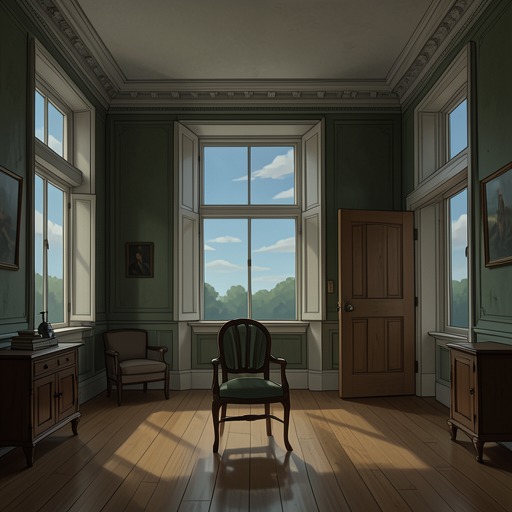
His bedroom in the side wing, overlooking the back garden, is likewise preserved but scarcely lived in. Miles finds it as he left it only months earlier, so neat that its order emphasizes the absence of ordinary use. He recalls that he had occupied it during an earlier period when he was too unwell to change much in the room. The House stores continuity in its rooms, but continuity is not the same as life: a familiar chamber can remain untouched while its occupant has changed and the wider household has receded.
That emptiness takes on a more serious meaning after Miles’s departure from ImpSec. He enters the House carefully and waits until the doors close behind him before his composure gives way; he remains shaken for an hour. Later, he withdraws to a small former servant’s room, taking a bottle from the cellar but lacking the resolve to open it. He also brings his grandfather’s dagger into the room and leaves it beside the bottle. The House offers privacy, but the scene makes clear that solitude is not automatically comfort. Its minor rooms can shelter Miles from other people while also enclosing him in a crisis he cannot immediately resolve.
A Household Built for Company
The silent chambers recall a very different Vorkosigan House. Miles imagines it as a residence designed for a continual bustle of guardsmen, staff, maids, grooms, gardeners, couriers, visitors from the Vor, and children, with successive Counts and Countesses Vorkosigan at its center. He associates its fullest social life with his great-grandparents’ generation, shortly before the end of the Time of Isolation. Looking out toward the curved drive, he pictures the older pattern of carriages arriving and guests disembarking. The House’s scale therefore records not only family wealth or age, but a social function that has largely fallen away.
Miles compares the organizing energy of that older household with his experience of running the Dendarii Free Mercenary Fleet. Both suggest an institution animated by many people and by a central figure who coordinates their activity. He wonders whether the Fleet might continue after its founder, as the House has endured through eleven generations since the first Count, and whether it might also be repeatedly altered. In this comparison, the residence is not merely a container for family memory: it offers Miles a way to imagine that something he has built could live on without his constant direction.
Refuge for Illyan
During the investigation into Illyan’s breakdown, Miles proposes that Illyan convalesce at Vorkosigan House. General Haroche questions whether the residence can be considered secure compared with ImpSec headquarters, particularly while the possibility of sabotage remains unresolved. Miles presents the move as hospitality offered in his father’s name and place, not as an abduction. The House’s significance thus shifts from inherited privacy to a practical alternative setting for care, even as security concerns remain part of the decision.
Illyan leaves ImpSec headquarters with only a valise. Martin Kosti drives him and Miles to the House in the old armored groundcar, where Alys Vorpatril has already arranged for a cleanup crew to prepare the guest suite. Fresh sheets, towels, soap, and flowers have been put in place, and Martin quickly distributes Illyan’s few belongings before being sent to the kitchen. A tea service follows in a sitting room overlooking the back garden: its sandwiches, stuffed eggs, meatballs, peach tarts, sweet wine, and chocolate help turn a formal change of residence into an act of welcome. The meticulously prepared room and meal show the family household’s capacity to respond to a need that the institutional patient room had not met.
Inheritance and Change
The House’s rooms continue to register change after Illyan’s stay. Once Miles has completed his report for Gregor, Illyan’s belongings have been removed and the guest suite restored to a clean, nearly sterile order. Looking out at the snowy back garden, Miles remembers the rooms from his grandfather’s time, when they held military objects and the accumulated atmosphere of an older generation. Their present emptiness prompts him to move his own possessions there. His mother approves, noting that he has remained in the small room upstairs since he was five.
That move gives the novel’s use of Vorkosigan House a modest but decisive conclusion. Miles does not renovate the ancestral residence or restore its old crowds; he takes over a set of rooms that has become available and begins to live in them. The transition links the House’s long family history to his immediate future without treating inheritance as a finished identity. It is at once a residence, a record of vanished household patterns, a refuge for a vulnerable friend, and a place where Miles can begin to inhabit the family role that its architecture has long seemed to announce.