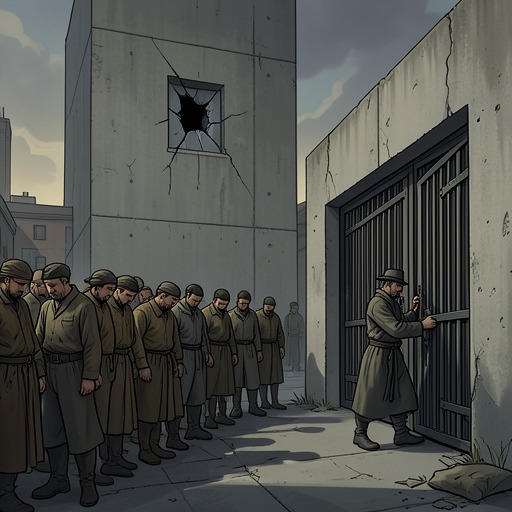
Manikova's conquest of Gault using his clones
Mickey7Alan Manikova’s conquest of Gault using his clones transforms a technology presented as a breakthrough in human replication into an instrument of planetary rule. Gault’s fragmented settlements leave Manikova room to grow from welcomed newcomer to an overwhelming military majority; by the time its clans unite, their resistance can do little more than send a plea for help across interstellar distance.
From public breakthrough to private expedition
Before Gault, Manikova had become famous for claiming that he had found a way to record and replicate a human mind. His demonstration made the process’s physical cost stark: he produced a duplicate of Universal Eternity, Inc.’s human-resources director, had her speak to the assembled dignitaries, then tranquilized her and broke her body back down into slurry. The demonstration sent the company’s stock soaring and made Manikova, already one of the Union’s richest people, by far its richest. Public opinion on Eden shifted from suspicion to celebrity acclaim, but Manikova did not settle into the wealth and attention. He liquidated his holdings, including the company, and the scale of the transactions helped trigger a planetary recession. A year later, he departed alone in a custom-built interstellar transport carrying equipment, supplies, and the prototype replication unit. His destination was unknown.
The colony he reached had been founded by wealthy private interests opposed to the taxes that supported people without ownership of automated production. Its declared creed, Radical Liberty and Self Reliance, had produced settlements organized around private family groups rather than a shared public good. Manikova’s arrival therefore met a society with resources and a hospitable environment, but little capacity or willingness to act together.
A foothold in a divided colony
By the time Manikova arrived, Gault had grown from its original 120 colonists to a population of about ten thousand. Most were established well enough not to face immediate starvation, but the settlements remained fragmented and unevenly prosperous. Neighbors generally did not help those in difficulty. Against that background, Manikova initially looked useful rather than threatening: he brought supplies that the separate groups could not yet produce, and offered one of the smaller clans food, seeds, and advanced technology developed on Eden during the roughly two centuries since Gault’s founding.
In return, the clan gave him a place to live and a base of operations. Once secure there, he turned single-mindedly to making more versions of himself. Human replication consumed substantial raw materials, including calcium and protein; the process could draw on basic elements, but producing the necessary feedstock from crops and livestock required great quantities of food and generated extensive waste. An existing human body was a more direct source. The distinction between replication as a technical process and the colony’s people as its supply of material would soon disappear.
Replication becomes conquest
Manikova exhausted the feedstock he had brought to Gault in about nine months. By then, he had nearly a hundred copies of himself and had built two more replication units. At first, he abducted indigent people and loners, whose disappearances were less likely to attract notice. When that supply ran out, he began taking people with families and friends. Only after these losses became apparent did suspicion settle on the newcomer. The clan that had hosted him sent Security forces to his compound to question him.
The encounter revealed what the host clan had not been given: Manikova had kept his advanced military technology to himself. Although he was still outnumbered on the planet by about twenty to one, Gault lacked the political coordination that might have made its population’s greater numbers decisive. Manikova put every member of his host clan into the replication hopper, turned them into copies of himself, armed them, and attacked a neighboring settlement. The welcome that had secured his foothold thus became the means of multiplying his forces.
The remaining clans took nearly a year even to consider a united response. During that delay, Manikova’s copies grew to an absolute majority of Gault’s human population. The clans eventually did gather together, but their belated cooperation came too late to reverse his advantage. Their most consequential act was not a successful counterattack: it was sending a final, desperate message to Eden describing the takeover and asking for help.
The plea reaches the Union
Help could not arrive quickly. The message took seven years to reach Eden, and the authorities spent almost two more deciding whether to respond. The original settlers had not been well regarded when they left, and their reputation had not improved; public sentiment largely treated the disaster as someone else’s problem and a fitting consequence of their choices. Parliament nevertheless concluded that Manikova might eventually threaten other worlds and had to be dealt with.
The decision produced the Union’s first—and, at the point of the account, its only—interstellar military expedition. A ground invasion across seven light-years was judged impractical, and even a wealthy world such as Eden would strain its budget to build and fuel a ship on the scale required. The chosen vessel, Eden’s Justice, was a slightly up-armored colony ship. It departed Eden’s system four years after Gault’s message arrived with a crew of two hundred, six orbital bombardment craft, and a large supply of fusion bombs. The expedition’s initial plan was to enter orbit around Gault, make contact with Manikova, and assess his intentions toward the Union and Eden.
Significance
The conquest grows directly out of two linked conditions: Manikova’s ability to reproduce himself and Gault’s refusal to build institutions of mutual aid or coordinated defense. His early generosity wins him shelter and a base; his selective sharing conceals the military advantage that will overturn that welcome. Once people become feedstock, the colony’s many isolated households offer little defense against an enemy who can both manufacture a growing force and exploit divisions among his opponents.
The episode also changes the scale of the Union’s response to its own technological and political risks. A private replication project on a distant colony becomes the reason for an expedition across seven light-years, while Gault’s appeal exposes the limits of a society that treats its isolated settlements as undeserving of help until their crisis may endanger others. The first interstellar campaign begins not with an immediate rescue, but after years of delay and a calculation that Manikova’s power could spread beyond the world he had taken.