10 Downing Street
Munich10 Downing Street is the Prime Minister’s official workplace and one of the novel’s central political settings. Through Hugh Legat’s work there, it becomes a place where the appearance of calm is maintained amid military preparations, emergency parliamentary business, and negotiations over war and peace. Its narrow entrance, familiar offices, ticking clock, and Cabinet Room form the domestic-looking interior of a government under mounting pressure.
Entrance and Interior
Legat reaches the house after crossing Horse Guards Road, where a change has taken place during his brief absence: anti-aircraft guns have appeared on the parade ground, soldiers are building a sandbag wall around a searchlight battery, and a gun barrel is being raised almost vertically. He wipes his face before entering; in the Private Office, appearing flustered is an offence to be avoided. The armed preparations outside and the effort to look composed at the door establish the contrast that persists throughout the Downing Street scenes.
The entrance is watched by reporters, but their attention quickly fades when they realize Legat is not someone important enough to photograph. A policeman knocks once, and the door opens. Inside, Legat experiences the same sensation he has had on each visit during the four months since his secondment from the Foreign Office: the house feels like a gentlemen’s club that has fallen out of fashion. The black-and-white tiled lobby, Pompeiian-red walls, brass lantern, grandfather clock, and cast-iron umbrella stand—with a solitary black umbrella—give the setting a settled, almost leisurely character. A telephone rings somewhere deeper inside, but the doorkeeper returns to his leather coachman’s seat and the Evening Standard.
The house’s calm is also a matter of routine and appearance. In the passageway, Legat checks himself in a mirror, straightens his tie, smooths his hair, and braces his shoulders. The Cabinet Room door is closed; so is Sir Horace Wilson’s office. The corridor to the Prime Minister’s Private Secretaries’ rooms lies to the right. The Georgian building seems imperturbable, but closed doors and ringing telephones place urgent business just beyond its composed surfaces.
Offices and the Working Day
Legat shares the smallest office with Miss Watson, whose desk is nearly hidden behind piles of folders. She has worked in Downing Street since the premiership of Lloyd George and prepares answers to Parliamentary questions. When she tells Legat that Osmund Somers Cleverly has been looking for him, the cramped office becomes a point of contact in the larger machinery of government: files, inquiries, and messages pass through an unshowy workplace rather than a ceremonial room.
At six o’clock, Big Ben’s chimes carry through the open windows. Miss Watson stands, collects her hat and coat, and leaves with one of the Prime Minister’s red dispatch boxes, full of her annotated files. The emergency recall of Parliament over the Czech crisis has ended her leisurely summer. She is to cycle down Whitehall to the Palace of Westminster, leave her bicycle in New Place Yard, and take a private staircase to the Prime Minister’s office. There she will meet Lord Dunglass, the Prime Minister’s Parliamentary Private Secretary, to discuss answers to written questions. Legat recognizes that her departure gives him an opportunity: Downing Street’s routine is being redirected by the crisis, and the files are on their way to Parliament.
The house also serves as a broadcast setting. At eight o’clock, Big Ben chimes again as Neville Chamberlain prepares to speak from Number Ten. Chamberlain’s hands shake; a page falls from his speech, and he bends stiffly to retrieve it. He asks for water, which Legat pours too generously, leaving beads on the polished table. The British Broadcasting Corporation announcer introduces the Prime Minister to listeners across the Empire, the American continent, and other countries. A green light glows beside the microphone as Chamberlain adjusts his cuffs and takes up the speech. The scene turns the private rooms of government into a public platform, while its small mishaps disclose the strain beneath the broadcast’s formal presentation.
Messages, Meetings, and Diplomatic Work
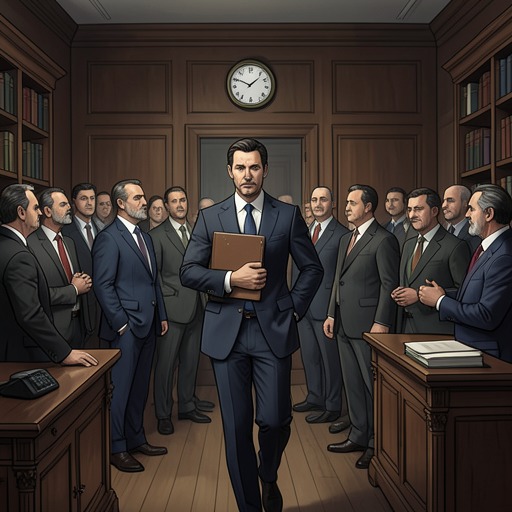
Later, in a Cabinet meeting at Downing Street, a telegram from Berlin reaches Chamberlain a little after ten at night. The Cabinet table is occupied by twenty ministers; Wilson is also present to report on his meeting with Adolf Hitler, alongside Cabinet Secretary Edward Bridges. Most of those present are smoking. A large sash window overlooking the garden has been opened to clear the smoke, and a warm night breeze stirs papers scattered across the table and carpet. Lord Halifax is speaking when Legat enters and places the telegram before Chamberlain. The Prime Minister acknowledges it with a nod, then directs Legat to sit with the officials along the far wall. Legat settles beside Cleverly, whose crossed arms and legs and twitching foot register the tension of waiting. The telegram is identified as Hitler’s reply.
Downing Street’s reach extends beyond the rooms themselves. While carrying out the Prime Minister’s instructions during the Munich negotiations, Legat has a draft declaration typed, changes the return flight from late morning to early afternoon, arranges transport through the protocol department of the German Foreign Ministry, and calls Cleverly in Number Ten with an update. Cleverly reports that the atmosphere in London could not be more positive and asks when Legat will return. Legat replies that the Prime Minister is to have another private talk with Hitler that morning; Cleverly immediately asks whether Halifax knows. The exchange shows how the London office remains a communications hub even when Legat is working abroad, and how private diplomacy can outrun the knowledge of senior colleagues.
Crisis, Public Celebration, and Private Return
After the Cabinet meeting, Cleverly tells Legat there is no need to wait for its conclusion: Cecil Syers will handle the boxes, and Legat can take the weekend off. Legat leaves Downing Street a little after ten at night and walks through streets filled with celebrating people as fireworks flare over London. Inside the house, files and official messages have carried the crisis through the evening; outside, the response has become a public celebration.
The distinction between official reassurance and private doubt continues after Legat gets home. He later recalls hearing Chamberlain on the wireless telling the Downing Street crowd that there was peace for their time. Legat’s response is that Chamberlain should not have said it and regretted it as soon as he had done so; he also hears that Mrs Chamberlain had persuaded her husband to make the declaration. In this sequence, Downing Street is not merely an address associated with power. Its rooms host the work of managing the crisis, its doorway opens onto a celebrating crowd, and its public assurances are set against the continuing fear that war may still come.