German Foreign Ministry
MunichThe German Foreign Ministry is a sprawling three-storey nineteenth-century building on Wilhelmstrasse, in the heart of Berlin’s government district. It is both a working centre of Nazi diplomacy and a setting where information changes hands: telegrams arrive from London, official accounts record confrontations, broadcasts are translated, and Foreign Ministry staff become links in a clandestine effort to prevent war. The building’s significance rests in that double role. Its ordinary administrative spaces serve a state preparing for conflict, while also giving its opponents a place to communicate and act.
Setting and Public Face
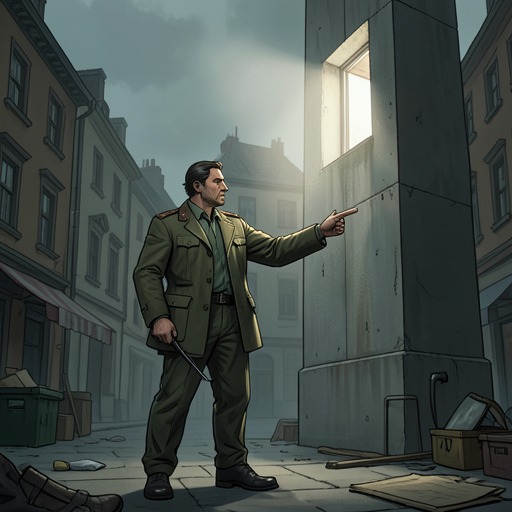
The Foreign Ministry stands amid the government buildings of Wilhelmstrasse. Its stone façade can acquire a festive appearance beneath swastika banners, but the public display does not guarantee public enthusiasm. As Paul von Hartmann and Erich Kordt walk beside a passing column, only a handful of ministry staff have gathered outside. Across the road, people at the Propaganda Ministry watch from the windows; on the street, few linger, and those present neither wave nor cheer. The contrast makes the ministry’s setting politically charged: spectacle is visible, but the response around it is subdued.
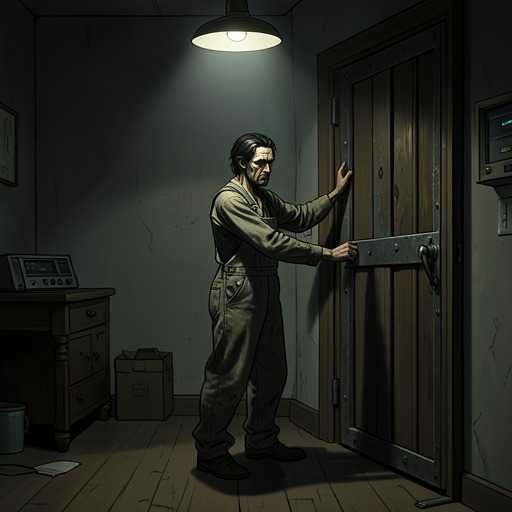
Erich Kordt steers Paul von Hartmann through an unused entrance whose heavy wooden door is permanently barred. Its porch offers privacy from the street, and there they encounter the head of the Foreign Minister’s Private Office and a young legation secretary holding an impromptu meeting. This is not a dramatic public entrance but a marginal, sheltered threshold within the government quarter. The scene establishes how the ministry’s physical surroundings can offer discreet pockets for contact even while the regime’s official theatre unfolds nearby.
Offices and Documentary Work
The ministry’s importance is also expressed through paperwork. In one episode, Erich Kordt produces a six-page typed account of his meeting that morning with Sir Horace Wilson. Dr Paul Schmidt, the ministry’s chief interpreter, has written the account in deliberately bland official language. The pages use the large typeface preferred by Adolf Hitler, a small material detail that links the building’s clerical work to the leader whose decisions the documents describe. Their formality does not erase the confrontation they record: Wilson has delivered a prepared warning about British support for France in the event of hostilities, and Hitler has responded angrily. The account makes the ministry a place where diplomatic encounters are converted into records that can be carried, read, and acted upon.
The State Secretary, Ernst von Weizsäcker, also assigns the ministry a rapid-response task after Neville Chamberlain’s radio speech. He requires a German translation within thirty minutes of its delivery and entrusts the work to Paul von Hartmann. High in the building’s eaves, beneath the large array of aerials on the roof, a three-woman team handles the broadcast in stages: one stenographer takes it down in English, another types the notes, and Paul von Hartmann writes his translation beneath the English text before a third secretary prepares the finished German version. The BBC signal has weakened by the time it reaches Berlin; static repeatedly obscures Chamberlain’s voice. The Radio Monitoring Room is therefore not merely a technical outpost. It is where an unstable broadcast is transformed, under a deadline, into an official text for the German government.
Access, Personnel, and Surveillance
The building’s offices are occupied by people whose positions do not translate neatly into political loyalties. When Paul von Hartmann arrives at Ernst von Weizsäcker’s office, Frau Winter is locking up; she tells him that the State Secretary remains at the Chancellery. Her presence at the end of the working day gives the ministry’s administration a practical, human face, while the State Secretary’s absence points to the movement of senior officials between government sites. Later, Ernst von Weizsäcker can arrange for Paul von Hartmann to be accredited to the conference as a translator, using the ministry’s formal procedures to create access beyond its walls.
That access remains subject to scrutiny. When Paul von Hartmann has a list of Englishmen accompanying Chamberlain, Dr Paul Schmidt examines it, but Sturmbannführer Sauer approaches and demands to know whether Schmidt authorised a telephone call to Berlin. The exchange reveals an administrative environment in which a routine communication can attract an accusation of unauthorised conduct. The ministry is not insulated from the regime’s surveillance; its staff work amid competing permissions, political risks, and the possibility that their movements or contacts will be noticed.
A Workplace Within the Resistance Network
The Foreign Ministry’s political significance exceeds its official diplomatic function because some of its personnel are involved in resistance activity. Paul von Hartmann works there, as does Erich Kordt, and their access to government information connects the ministry to a broader opposition network. A core conspiratorial meeting takes place not in the Foreign Ministry itself but in Erich Kordt’s office in the Prussian State building. Its participants include Hans Bernd Gisevius, Count von Schulenburg, Hans von Dohnányi, Colonel Hans Oster, Erich Kordt, and Paul von Hartmann. The distinction between the two buildings matters: the Foreign Ministry supplies people and relationships to the plot, while the meeting described occurs elsewhere.
From that circle, Paul von Hartmann proposes Hugh Legat as a possible route to Neville Chamberlain’s party in Munich. He has already sent Hugh Legat material anonymously, and Erich Kordt’s brother delivered it. The ministry is thus one node in a chain carrying information from German officials to a British recipient, rather than the sole location of the operation. Its employees’ official access and private alliances overlap, making bureaucratic connections a means of resistance as well as service to the state.
Ernst von Weizsäcker understands enough of the danger to warn Paul von Hartmann about Colonel Hans Oster. He says that Oster’s activities have not gone entirely unnoticed and that the previous tolerance of dissent may be changing as National Socialism enters a more vigorous phase. Yet he also has Frau Winter add Paul von Hartmann to the conference list as a translator. The ministry’s administration therefore holds both possibilities at once: its hierarchy can signal the narrowing space for dissent, while its credentials and personnel can still enable movement and contact.
Narrative Significance
The building binds together the novel’s principal forms of evidence. A telegram from London prompts Paul von Hartmann’s attention; Dr Paul Schmidt’s account preserves the substance of a diplomatic clash; Chamberlain’s broadcast is caught through static and rendered into German; and ministry personnel help connect confidential information to Hugh Legat. Each document passes through a different part of the institution’s work, from reception and interpretation to circulation. The ministry’s rooms make the political crisis legible as a struggle over who can hear, record, verify, and transmit information.
Its architecture reinforces that function without turning the building into a refuge. The public façade stands under the symbols of the regime; the unused entrance offers only temporary privacy; the high monitoring room listens outward to a distant broadcast; and the offices remain exposed to surveillance and changing political conditions. The Foreign Ministry is consequently neither simply a site of Nazi authority nor a safe headquarters for its opponents. It is an institution whose ordinary machinery serves both diplomacy and the dangerous, incomplete work of resistance.