Wilhelmstrasse
MunichWilhelmstrasse is a central Berlin government thoroughfare and a charged setting for the novel’s early crisis scenes. Beside the German Foreign Ministry, military power moves conspicuously through the capital, even as the street’s subdued atmosphere makes the spectacle feel less like a confident public display than a sign of apprehension and concealed purpose.
Government Quarter and Setting
In the heart of Berlin’s government sector, Wilhelmstrasse runs beside the sprawling, three-storey nineteenth-century building housing the German Foreign Ministry. The street links the Ministry’s official world with the nearby Reich Chancellery, placing Hartmann’s work and movements within immediate reach of the institutions directing the crisis. Its importance is therefore practical as well as symbolic: government business, military display, and guarded access to state buildings converge along the same route.
The Armoured Column
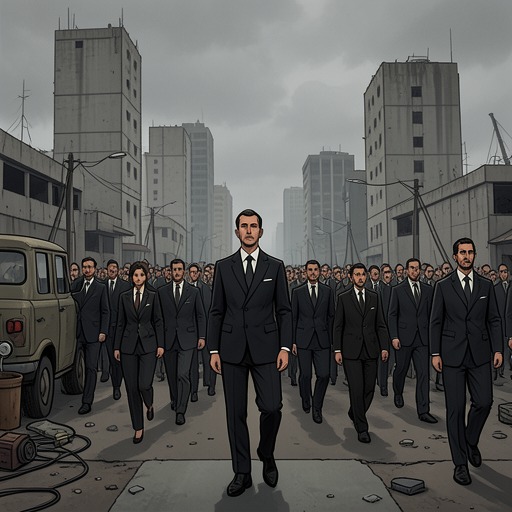
From the Ministry, Hartmann watches a column of olive-green military vehicles trundle south along Wilhelmstrasse from the direction of Unter den Linden. It includes artillery half-tracks, tanks carried on transporters, and heavy guns hauled by trucks and teams of horses; Hartmann judges its length to indicate a full motorised division. The movement makes the prospect of war physically present outside the office window. Yet the response on the street does not resemble a mass celebration: only a handful of Ministry employees gather, while onlookers in the German Propaganda Ministry across the road lean from its windows. Few people linger below, and nobody waves or cheers. Under motionless swastika banners and an overcast sky, the scene’s public display of military strength is countered by an atmosphere of unease.
A Private Exchange on the Street
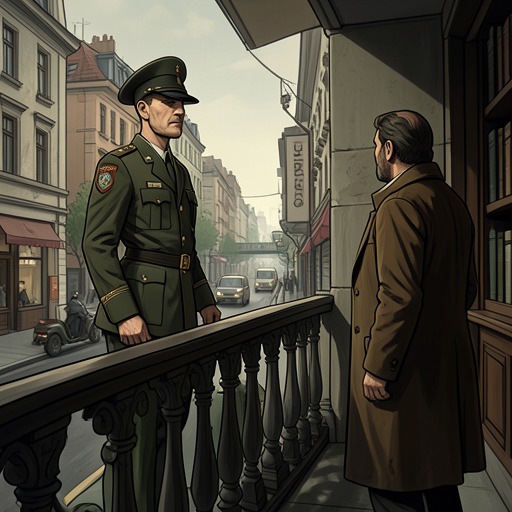
Hartmann telephones Kordt amid the noise of the passing vehicles, then the two men leave the Ministry and walk in the column’s direction. Kordt steers Hartmann into a disused entrance about two-thirds of the way down the building, using its barred doorway and recessed porch to speak out of public view. There he produces a six-page, typewritten account of Sir Horace Wilson’s meeting that morning, prepared by the Foreign Ministry’s chief interpreter, Dr Schmidt. Wilhelmstrasse thus becomes more than a backdrop to the military procession: at its edge, a guarded document passes between officials. The contrast is sharp—armoured vehicles moving openly down the road, and information about the crisis changing hands in a sheltered recess.
The Route to the Reich Chancellery
Later, at night, Hartmann carries a folder along the Ministry’s façade toward the railings of the Reich Chancellery. The street is nearly empty; a cleaner is shovelling up the horse manure left by the parade, and the scrape of his spade is the only sound noted in the scene. At the Chancellery, Hartmann passes an open gate, a policeman, and armed Schutzstaffel sentries before being admitted to the reception hall. The route connects the day’s public procession to the guarded corridors of power, while the cleaner’s work leaves an unceremonious trace of the spectacle behind. Across these scenes, Wilhelmstrasse is both a conduit for state authority and a place where the strain beneath its displays becomes visible.