British Foreign Office
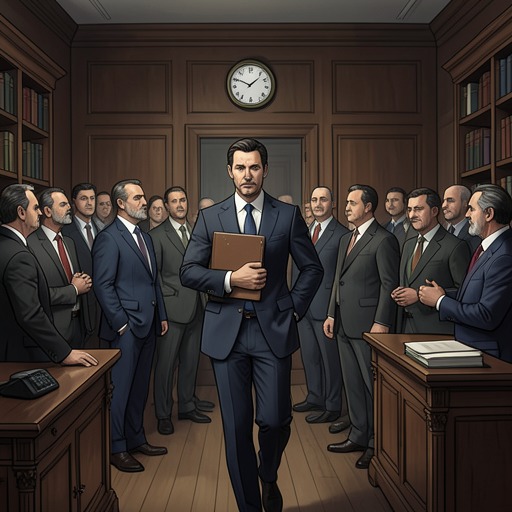
MunichThe British Foreign Office is both a seat of government and the first institutional setting in which Hugh Legat’s anonymously delivered military document is examined. Its formal architecture places power in a carefully ordered space, while the late-night business within it turns that space into a point of contact between a private warning and the machinery of British government.
Setting and Architecture
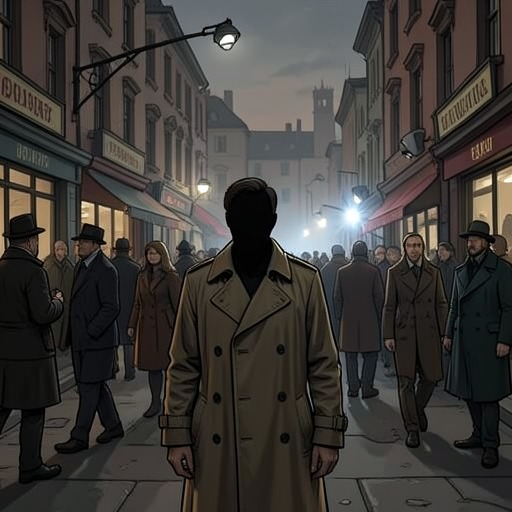
Legat reaches the Foreign Office after crossing the street and entering through a large iron gate into a vast quadrangle of ministerial buildings. The offices are distributed around it: the Colonial Office and Home Office occupy the left-hand corners, the Indian Office the upper right, and the Foreign Office stands beside Legat, reached by a flight of steps. At that late hour, lights burn in each building, while spectators throng the street outside.
Inside, a grand, lofty corridor expresses the Victorian imperial style. The Permanent Under-Secretary’s room occupies a ground-floor corner overlooking both Downing Street and Horse Guards Road. The room’s position has practical as well as symbolic force: proximity measures influence, and the Permanent Under-Secretary can reach the Prime Minister in the Cabinet Room within ninety seconds of being summoned.
Legat Brings the Directive
At home, Legat has found an official-looking envelope left at his door by a person who departs in a small car. His name is misspelt on it, and its heading identifies a secret German military document dated 30 May 1938. Carrying it into the Foreign Office seems dangerous to him; he considers passing it up the chain of command so that he will no longer have it in his possession.
By a quarter to ten, he has crossed the crowded street and entered the Foreign Office. The night porter nods to him, and in the outer office he finds Miss Marchant, the senior secretary on duty, alone. Legat says he needs to see Sir Alexander Cadogan urgently. When Cadogan reads the document, he sits bolt upright: it is Adolf Hitler’s directive for war on two fronts, with the main effort in the south-east, under Strategic Concentration Green. Its instructions describe an attack on Czechoslovakia, including a rapid breach of the frontier fortifications and a surprise attack by the Luftwaffe.
Testing the Evidence
Cadogan reads the pages in sequence, turning each one over and placing it neatly to his right before squaring the completed document. His first question is whether it is genuine. Legat believes that it is, and Cadogan agrees that the document appears authentic. Its date and wording give him grounds for comparison: the directive records Hitler’s decision to destroy Czechoslovakia by military action in the near future, language Cadogan recognizes as almost identical to what Adolf Hitler said to Horace Wilson that morning.
The Foreign Office scene distinguishes what the paper appears to establish from what remains uncertain. Even if genuine, the document does not explain who supplied it, why it was supplied, or why it was addressed to Legat. Cadogan raises those questions explicitly and tells Legat that officials will examine the matter and speak with him the next day. The building is therefore not simply a destination for the document; it is where its significance is assessed and its unknown provenance becomes a matter for official inquiry.
Telegram and Immediate Use
That inquiry is interrupted by a telegram from Berlin. Miss Marchant brings it into the room, and Cadogan, who has been waiting for it, reads it intently. He mutters in frustration, then identifies it as the latest message from Adolf Hitler and says the Prime Minister must see it at once. He gives the folder to Legat, who is returning to Number Ten, and says that the separate business of the leaked directive will be put into the system for examination.
In the Foreign Office, two kinds of information thus converge without being treated as interchangeable: an urgent official telegram and a clandestinely delivered directive whose source is unknown. Cadogan sends the former directly onward while placing the latter into a process of scrutiny. The contrast makes the office’s role concrete: it is a place where documents acquire institutional weight, but where even a paper that seems authentic must still be tested for what it can—and cannot—reveal.