London
MunichLondon is the novel’s public stage for the 1938 crisis and the city through which its political stakes become immediate: a speech heard over the radio, trenches cut in a park, airships rising above the capital, and urgent work conducted from government offices. It is also the setting for Hugh Legat’s private passage between duty and home. The city’s changing mood—from anxious stillness to fireworks and celebration—never quite erases the warning that the crisis has been deferred rather than resolved.
The capital under threat
Shortly before one o’clock on Tuesday 27 September 1938, Hugh Legat arrives at the restaurant of The Ritz, London. Seated beside a tall window, he orders a half-bottle of 1921 Dom Perignon beyond his means, opens The Times to page seventeen, and reads for the third time Adolf Hitler’s speech of the previous night at Berlin Sportpalast. The scene places international danger within the measured rituals of a London lunch: a newspaper, a table, an unaffordable bottle, and a man repeatedly returning to the same words in search of their meaning.
The restaurant’s quiet seems to extend beyond its windows. Legat notices subdued guests and waiters, with no laughter, while workmen dig slit trenches in Green Park in the humid weather. The contrast makes preparation for war part of the city’s visible landscape, not merely a government concern. London’s ordinary public spaces are being altered in anticipation of attack even as people continue to dine nearby.
The speech has reached Legat through the British Broadcasting Corporation. Its scale and force contrast with the enclosed restaurant: Hitler’s voice is described as metallic and remorseless, punctuated by the pounding of his hand on the podium and the approval of fifteen thousand people. The radio carries that distant mass gathering into London, where its threatening claims are measured against the trenches outside. The city becomes a place where faraway political spectacle and local physical preparedness occupy the same moment.
Streets, signals, and civil preparation
After an urgent telephone call, Legat imagines the consequences in a stark sequence: Germany attacking Czechoslovakia, France declaring war, Britain supporting France, and his children wearing gas masks. He pictures the diners leaving their white tablecloths to shelter in the trenches in Green Park. The prediction is not presented as an event already accomplished; it is the terrifying future he struggles to grasp. London’s streets and parks give those possibilities concrete form.
When Legat hurries back into the restaurant, the staff have already cleared his table. Outside, Piccadilly has no taxi available. He waves his rolled newspaper at passing cabs, gives up, and walks down St James’s Street, glancing across the road in case he might see his wife. His route carries him through a city that is at once familiar and unsettled: the humid air makes his shirt cling beneath his old-fashioned suit, while the clubs along Pall Mall shine behind their tall windows beneath a dull, threatening sky.
At the steps from Carlton House Terrace to St James’s Park, a silent crowd of about twenty people watches a small airship rise behind the Palace of Westminster and pass the spire of Big Ben. Legat can see several more south of the Thames, tiny silver shapes already thousands of feet high. The ascent is beautiful and surreal, but the crowd’s subdued attention and the sight of multiple craft turn spectacle into a sign of emergency. A bystander’s remark that the balloon has gone up gives the scene its plainspoken recognition that preparations are no longer abstract.
Government work and the clock of the crisis
London’s political machinery appears through the rhythm of office hours and urgent parliamentary business. At precisely six in the evening, Big Ben’s chimes carry through open windows into 10 Downing Street. Miss Watson rises, gathers her coat and hat, and takes away one of the Prime Minister’s red dispatch boxes, filled with her annotated files. The recall of Parliament for an emergency debate on the Czech crisis has ended her leisurely summer. Legat knows the route she will take by bicycle down Whitehall to the Palace of Westminster, where she will meet Lord Dunglass to discuss answers to the Prime Minister’s written questions. Her departure gives Legat his chance to act.
The city’s institutions are linked by more than ceremony. In a later stretch of work, Legat reads a dense account of Hitler’s reasoning: Germany’s growing need for food, the strain of sustaining rearmament, and its vulnerability to trade sanctions and disrupted supplies. The proposed answer is the acquisition of living space in Europe. London is where these claims become material for urgent political decisions, not simply a distant argument: Legat reads, follows developments, and carries out instructions while the prospect of war hangs over the capital.
That work continues through practical arrangements. Legat has a draft declaration typed by Miss Anderson, changes the planned return flight from late morning to early afternoon, contacts the German Foreign Ministry’s protocol department about transport, and telephones Oscar Cleverly at 10 Downing Street. Cleverly reports that the atmosphere there is positive and the press is jubilant, but asks whether Lord Halifax knows that Neville Chamberlain will have another private conversation with Hitler. The juxtaposition of administrative details and high diplomacy shows how London’s crisis unfolds through schedules, documents, calls, and the movement of officials as well as through public alarm.
Celebration and the unsettled return
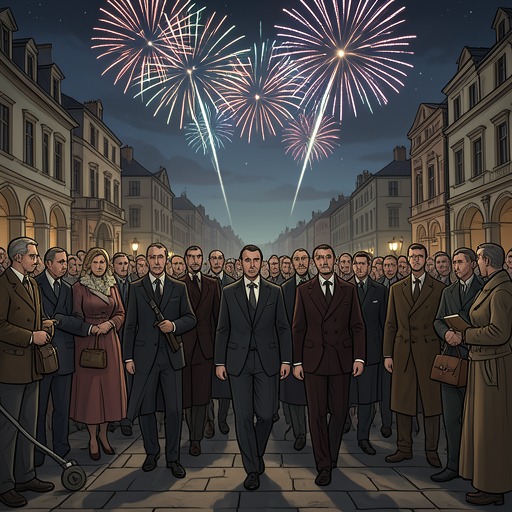
After a Cabinet meeting, Legat is told by Cleverly that he need not wait until its conclusion: Cecil Syers will handle the boxes, and Legat can take the weekend off. He leaves 10 Downing Street a little after ten at night. The streets are filled with people celebrating, and fireworks flash across the city. London has shifted, at least outwardly, from the hush of the restaurant and the sight of trenches to noisy public relief.
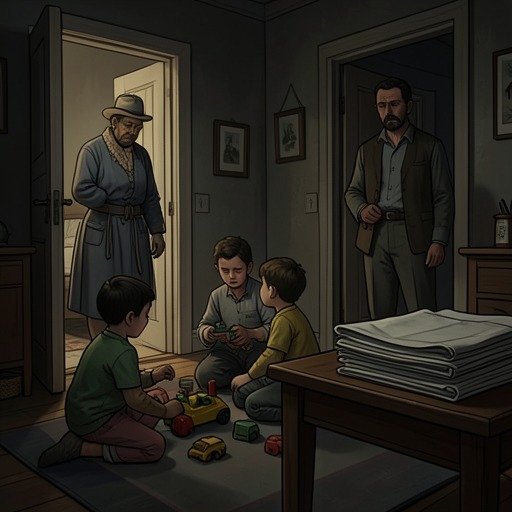
At home, the upstairs windows are dark and Legat supposes the children are asleep. Pamela has been reading in the sitting room; when he enters, she puts her book aside, embraces him, and tells him she has missed him. Their reunion makes the public crisis intimate without making it disappear. When she asks what the hope and celebration have been about, Legat describes the mood as relief, understandable when he looks at the children, but says that what has happened is a tripwire laid down for the future, one Hitler will cross sooner or later.
Pamela does not reply. Legat takes up his suitcase and goes back out into the night. In Smith Square, rockets continue to rise; cries of delight sound in the gardens, and falling sparks briefly illuminate the old buildings before they return to darkness. London’s celebration is therefore given a double aspect: it expresses genuine relief, yet its bursts of light cannot settle the danger Legat foresees. The city’s movement from trenches to fireworks is not a passage from threat to safety, but a change in public feeling beneath an unresolved political shadow.