Führerbau
MunichThe Führerbau is a conspicuous setting for the Munich conference: a building designed less as an ordinary government office than as a grand court for Hitler’s guests. Its marble halls, ceremonial entrances and tightly managed access make diplomacy visible as spectacle, while its stairways and private rooms also provide routes for covert action. For Paul von Hartmann and Hugh Legat, the building is both a stage for public negotiations and a place where a concealed document and an unspoken meeting matter urgently.
Architecture and ceremonial purpose
Barely a year old, the Führerbau was designed by Hitler’s favourite architect, the late Professor Troost. Its white stone seemed to sparkle in the morning light. Giant German and Italian flags flanked the southern entrance; British and French flags hung above the northern one. Bronze eagles bearing swastikas stood over the doors, and red carpets ran down the steps and across the pavement. Only the northern entrance was in use, where an eighteen-man honour guard stood with rifles presented beside a drummer and bugler.
Inside, marble covered the floors, walls and pillars. The foyer’s plum-coloured stone and grand staircases contrasted with the greyish-white walls; upstairs, the lighting made the stone seem golden. Dark suits and uniforms filled the space, and the gathering carried the anticipatory buzz of a gala performance. The building was neither a government office nor a Party headquarters. Its function was described instead as resembling a monarch’s court, intended for the enlightenment and entertainment of an emperor’s guests. That courtly quality lends the conference a theatrical frame: officials arrive not simply to negotiate, but to take their places in a carefully staged display of power.
Entrances, access and concealed movement
Hartmann enters past the honour guard without challenge and gives his name to the Nazi SS guards, who nod him through. Later, Legat approaches the building from the granite square at Königsplatz. He passes the flags and bronze eagles, explains his official status to a sentry, and has his name checked by an officer inside the lobby. An adjutant directs him to the British delegation’s reception room on the first floor. These controlled entrances distinguish official access from the building’s less visible routes.
Before the conference begins, Hartmann diverts into a gentlemen’s lavatory, locks himself in a cubicle and opens his suitcase. He takes out a document, unbuttons his shirt and hides it under his vest, then buttons his shirt and checks his hands, which are cold and shaking slightly. After rubbing them together and putting his hat, coat and suitcase into the cloakroom, he can rejoin the public movement through the building without the document in his luggage. The marble grandeur and ceremonial welcome thus contain a small, concealed act on which the scene’s suspense depends.
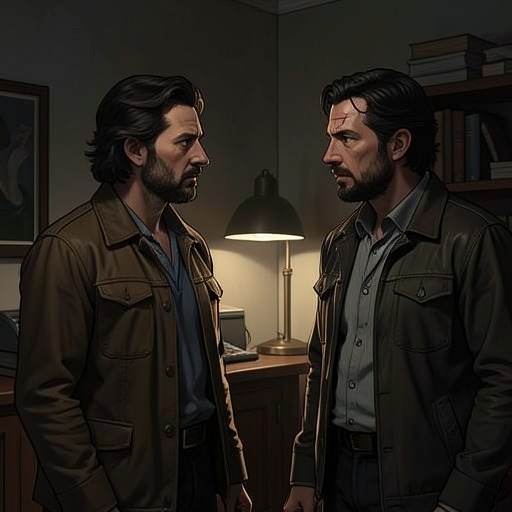
The building’s service stairs later enable another discreet movement. After Hartmann leaves Legat and an official colleague in the corridor, Legat invents a reason to turn back and follows him down. Hartmann continues past the ground floor and down two more flights; Legat reaches a basement passage just in time to see daylight and hear a door slam. The public rooms display the conference, but the lower passageways leave the encounter’s next step unresolved.
The conference room as political theatre
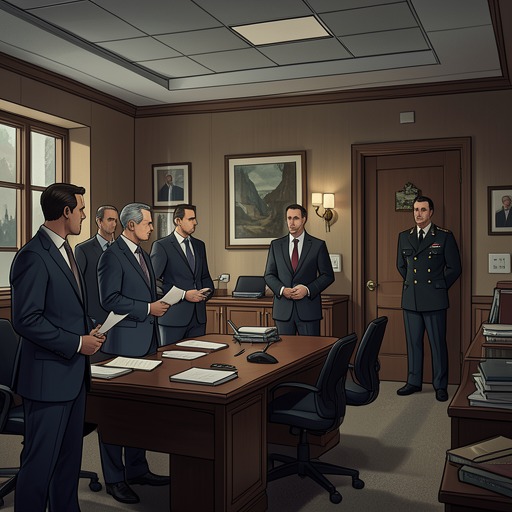
At the entrance to Hitler’s study, Hartmann stands aside as Neville Chamberlain enters first, followed by Benito Mussolini and Édouard Daladier, then Ciano and Sir Horace Wilson. The missing head of the French Foreign Ministry, Léger, leaves an empty chair. Hartmann pauses before entering and takes in the study’s dark wood, enormous globe, floor-to-ceiling bookcase and desk, as well as a heavy central table and a semicircle of armchairs and a sofa arranged by a fireplace. A portrait of Bismarck hangs above the mantelpiece.
Hitler is already seated in the leftmost armchair, with Paul Schmidt beside him. He gestures for the guests to choose their seats. Chamberlain takes the chair nearest Hitler, Wilson sits to Chamberlain’s right, and the Italians occupy the sofa facing the fireplace; Joachim von Ribbentrop and Daladier complete the group, with the place for Léger left vacant. This arrangement turns the study into a compact image of the negotiations: leaders and officials are assigned visible positions around Hitler, while the empty chair marks an absence within the gathering. As Hartmann bends to speak quietly to Ribbentrop, he notices his own watch on the low table in front of Hitler, a personal object unexpectedly exposed in the room’s formal setting.
Narrative significance
The Führerbau gathers opposites into one location. Its flags, guards, carpets and marble make state power monumental, while the hidden document, the unobserved descent through service stairs and the watch on Hitler’s table introduce vulnerability and uncertainty into that display. The contrast between the British and French visitors, in rumpled office suits after their journeys, and the uniforms of the Nazi SS and Italian fascists further makes the building’s ceremonies a visual contest over authority. Its architecture does not settle the political outcome; instead, its ordered rooms and hidden passages give the negotiations a setting in which public choreography and private risk unfold side by side.