Berlin
MunichBerlin is both the seat of official power and a city whose public surface repeatedly fails to match the political reality beneath it. The novel places Paul von Hartmann amid the government buildings and moving military columns of Wilhelmstrasse, then follows him through the city’s quieter streets and suburban railway. Berlin becomes a route through which danger, evidence, and resistance travel: its streets display the regime’s force, while offices, doorways, and apartments provide spaces for concealed decisions.
Government Quarter and the Military Display
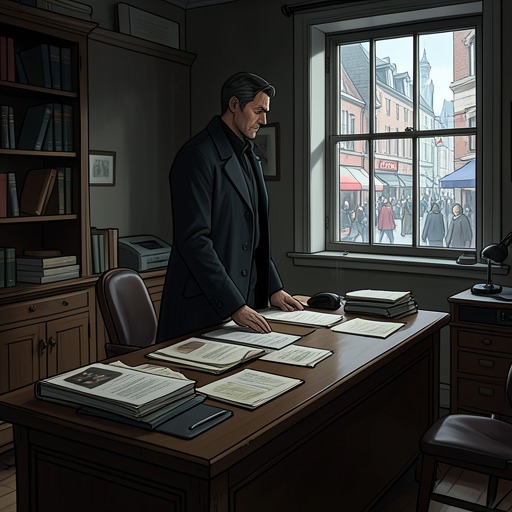
The city’s political geography is established through the German Foreign Ministry, housed in a sprawling three-storey nineteenth-century building in the government sector at Wilhelmstrasse. There, Hartmann is considering a confidential telegram from London when military noise interrupts his work. The scene begins inside an office, with a document in hand, but the disturbance is physical enough to make the pages tremble. Hartmann and his colleagues go to the window to discover what is passing through the capital.
A long column of olive-green vehicles is moving south along Wilhelmstrasse from the direction of Unter den Linden. It includes artillery half-tracks, Panzers carried on tank-transporters, and heavy guns pulled by trucks and teams of horses. Judging by its length, Hartmann takes it for a full motorised division. The procession makes military preparation visible in the heart of the government district: machinery and weapons occupy the same public thoroughfare as the Foreign Ministry’s official business.
The spectators do not give the column the triumphant reception Hartmann expects. Only a handful of Foreign Ministry staff have gathered outside, while people at the German Propaganda Ministry watch from its windows. Swastika banners hang above the street, but the people below are not cheering or waving; many keep their heads down or stare ahead. Under an overcast sky, the banners give the Ministry facade a festive appearance that contrasts with the subdued crowd. For Hartmann, the gap between the staged symbols and the public’s behaviour suggests that the regime’s spectacle is not working as intended.
Streets, Railways, and Uneasy Public Life
Berlin’s streets also carry a more ordinary, unsettled life. On another journey, Hartmann crosses Potsdamer Platz, where the Haus Vaterland and its cinema and café remain brightly lit despite the prospect of war. He then waits for a tram and crosses to Bahnhof Wannsee, boarding a suburban electric train travelling south-west. The movement from an illuminated central square to a carriage passing through darkness gives the city a changing scale: public brightness recedes into parks, small stations, and deserted platforms.
Hartmann chooses the last carriage and feels unable to shake the sense that he is being followed. At first, it contains two drunken passengers and a man in the Sturmabteilung reading a newspaper. The drunks leave at Schöneberg, and the remaining passenger’s presence becomes more conspicuous as the train continues through Friedenau and Feuerbachstrasse toward Steglitz. The carriage is not a secret refuge; it is an exposed, moving space in which Hartmann must share the journey with a representative of the regime. The novel’s Berlin is thus not divided neatly between safe interiors and dangerous public streets. Even an apparently routine trip across the suburbs leaves the possibility of surveillance in view.
Offices, Documents, and Clandestine Networks
The city’s government buildings are also places where opposition takes shape. In the Prussian State building, a small group of conspirators meets at five o’clock in Kordt’s office. The participants include Gisevius and Schulenburg from the Interior Ministry, Dohnányi from Justice, Oster from the Abwehr, and Kordt and Hartmann from the Foreign Service. Their chosen cover is deliberately mundane: if questioned, they will describe the meeting as an informal discussion about an inter-departmental planning group for the newly liberated Sudeten territories. The ordinary administrative setting conceals a far more dangerous purpose.
The gathering is small enough to make Hartmann doubt its prospects. He counts only six men against a dictatorship that controls a country of eighty million, and his first response is contempt for the scale of the undertaking. The contrast between the group’s modest numbers and the regime’s reach makes Berlin’s official architecture double-edged: ministries are instruments of state authority, yet people inside them also use their positions to organize opposition. When Hartmann and Kordt leave together, the city seems briefly changed. They cross Wilhelmstrasse in sunshine as government workers pour out of the ministries, laughing and going home. It is the first ordinary street life Hartmann has seen since the Czech crisis began more than two weeks earlier. The calm does not end the danger, but it registers a moment when the city’s residents appear able to resume daily life.
The Foreign Ministry’s typing rooms form another point in this network. When Kordt and Hartmann return to the State Secretary’s outer office, Frau Winter and two other typists are at their machines. Their work is part of the institution’s visible routine, but Frau Winter is also connected to Hartmann’s private life and to the resistance plot. The novel places her at the intersection of clerical labour, official access, and personal risk rather than treating the ministry as a world occupied only by senior officials.
Berlin as Origin, Destination, and Return
Berlin is linked to the story’s secret documents even when they are read elsewhere. A military directive bears the heading Berlin, 30 May 1938, and is identified as Hitler’s plan for a war on two fronts with the main effort in the south-east, under Strategic Concentration Green. In London, Cadogan examines the pages and weighs whether they are genuine; the text’s date and language are compared with Hitler’s recent statements. The document makes Berlin not simply the setting of official power but the point of origin indicated by a piece of evidence that can alter how events are understood beyond Germany.
The city is also where Hartmann’s personal history with Leyna took a political turn. He later explains that after their separation she returned to Berlin and became more deeply involved with the communists, whose newspaper continued underground after the Nazis banned it. She was arrested in 1935 and sent to Moringen, and was later arrested again after returning to political activity. Berlin, in this account, is a place of political commitment whose consequences reach beyond the city into imprisonment and persecution. The information reaches Legat during the drive back to Munich, so Berlin enters that conversation as the origin of a past Hartmann knows only incompletely.
After the events in Munich, Hartmann’s return to Berlin is itself marked by suspense. He expects arrest at every stage, including when he leaves the Führerbau, boards the Foreign Ministry’s chartered Junkers passenger plane, and lands at Tempelhof. Instead, he crosses the terminal unmolested and reaches the taxi rank. The city is full of Friday-night revellers enjoying the unexpected peace. Hartmann no longer regards them with the contempt he had felt in Munich; he sees a raised glass, a smile, or an arm around a lover as a gesture against the regime. The change is not in Berlin’s public life alone, but in how he reads it.
That return leads him to Frau Winter’s apartment. The bell rings unanswered for a long time, and he is close to giving up before the lock turns and the door opens. Later, as they lie at opposite ends of a bath by candlelight, an illegal foreign radio station plays jazz through the open door. The scene brings Berlin’s larger tensions into a private room: the risk of Hartmann’s continued resistance, the possibility of arrest, and the fragile intimacy of a life not wholly governed by official channels. Across the novel, the city’s defining contrast is between what can be displayed in its streets and what must be carried quietly through its offices, trains, documents, and homes.