Reich Chancellery
MunichThe Reich Chancellery is both the seat of Nazi authority and a carefully staged threshold through which the novel’s characters try to reach the people who can still alter events. Its position beside the German Foreign Ministry puts diplomacy almost against power; its guarded entrances and crowded reception rooms make clear that physical proximity does not guarantee access.
Setting and Public Spectacle
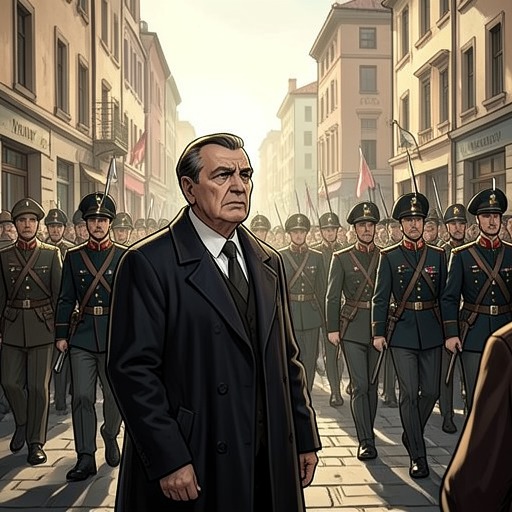
The Reich Chancellery stands next to the German Foreign Ministry, with Wilhelmplatz across the road. During a parade, a small, unmistakably pro-Nazi crowd gathers in the square, some wearing swastika armbands. Ragged cries of greeting rise from the crowd; arms lift in salute, and the men in an armoured column turn their heads and salute in return. Hartmann, watching with Kordt, notices that the soldiers are mostly young, and close enough to see their amazement, wonder and pride.
The building’s balcony makes that public display a scene of concentrated authority. Beyond the high black iron railings, Adolf Hitler stands alone above the main entrance, in a brown jacket and cap. One hand clutches his belt buckle; the other reaches out in a rigid, repeated salute. Hartmann is about fifty metres away. Kordt salutes and mutters a greeting, and Hartmann follows suit. The gesture places them inside the spectacle even as their private purpose sets them against the political world it celebrates.
The Chancellery as a Route to Power
On a later night-time visit, Hartmann carries a folder from the German Foreign Ministry toward the Chancellery. Wilhelmstrasse is sparsely lit, its lamps making isolated pools in the darkness. A street cleaner shovels up horse manure left by the parade, an unceremonious trace of the public pageantry Hartmann has just passed. At the open iron gate, a Mercedes drives out toward Anhalter Bahnhof; he cannot see who is inside. A policeman takes Hartmann’s name and department and waves him through.
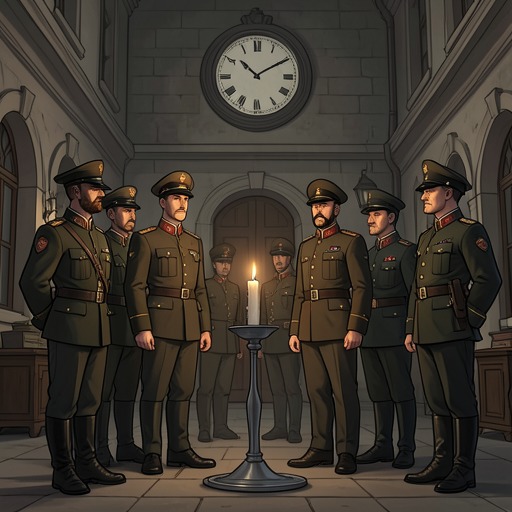
Activity gathers within the courtyard. Lights burn in the surrounding windows, and Hartmann passes a machine-gun-carrying guard beneath the entrance canopy before entering a reception hall where two more armed guards stand. He gives his pass and says he has come to see State Secretary Ernst von Weizsäcker. While he waits, he counts the security presence: two policemen at the gate, four Nazi SS guards in the hall and at least three more in the guardroom. The count registers both Hartmann’s alertness and the layered control of the building.
An SS adjutant eventually escorts him through double doors, across a long Persian-carpeted passage and up a marble staircase past Gobelin tapestries. Another guard watches the route. On the second floor, Hartmann is brought to what he understands to be Adolf Hitler’s private apartment. The waiting room is unexpectedly modern and restrained, with paintings, lamps, flowers, a rug and simple chairs. Hartmann remains standing. After about fifteen minutes, Ernst von Weizsäcker emerges and gives him an envelope: Adolf Hitler’s reply to Neville Chamberlain. He instructs Hartmann to take it at once to the British Embassy, Berlin, give it personally to Sir Nevile Henderson or Ivone Kirkpatrick, and draw attention to the final sentence, which responds directly to that evening’s broadcast.
Access During the Ultimatum
The Chancellery becomes a different kind of threshold as the ultimatum approaches its expiry. Hartmann crosses from the German Propaganda Ministry and finds twenty or thirty official cars crowded in the forecourt, long black limousines bearing swastika pennants, some with SS number plates. He identifies himself to the policeman at the gate as a German Foreign Ministry official carrying an urgent message for Joachim von Ribbentrop. Repeating that claim steadies him: it is true, though the truth alone does not guarantee entry.
At the main entrance, armed guards block his way. Hartmann presses the adjutant to take him to the Foreign Minister immediately, invoking his own height and ancestry and threatening consequences for the adjutant’s career if he delays. The adjutant yields. The episode makes access appear neither open nor wholly sealed: it depends on rank, nerve, and the ability to make a claim that those guarding the doors cannot safely dismiss.
Inside, a crowded salon holds a central group of about a dozen men, with smaller clusters around them and uniforms of several colours among civilian suits. Goebbels stands alone, brooding beside a chair; Hermann Göring holds court to an attentive circle. As Hartmann threads through the room, the people he passes turn to look at him. Their expressions are eager and curious, and he realizes that even the most powerful figures present are waiting for news. Beyond another set of doors, the mood is quieter: diplomats whisper in a reception room. Sturmbannführer Sauer rises from an armchair to challenge Hartmann, who replies that he has a message for the Foreign Minister. The account establishes his entry and the charged uncertainty inside, not the eventual outcome of that encounter.
Narrative Function
The building’s recurring geography gives political crisis a physical form. Gates, passes, sentries, closed doors and successive reception rooms divide the people who carry information from those empowered to receive it. Hartmann can be close enough to see Adolf Hitler’s gestures from the square, yet reaching a senior official requires negotiation at every threshold. During the ultimatum, the crowded salons make that tension visible on a larger scale: the regime’s leading figures assemble within the centre of power, but they too are waiting for knowledge.
The contrast between the balcony and the interiors is especially telling. Outside, salute and spectacle turn authority into a public image; inside, armed guards, whispered conversations and urgent messages reveal the controlled, uncertain machinery beneath it. The cleaner’s shovel, the tally of guards and the wait for a sealed reply keep the Chancellery from becoming an abstract symbol. It is at once a real route through which documents move and a place where political proximity, surveillance and delay shape what characters can do.