Humanism
NauseaHumanism, as the Self-Taught Man professes it, promises a common human purpose and grounds social commitment in love for people. Roquentin’s rebuttal is that this universal benevolence turns individuals into symbols and converts every dissenting attitude into one more expression of the creed. The dispute makes Humanism a test of whether abstract ideals can meet particular people and an unruly, contingent existence without smoothing either into a reassuring story.
The Self-Taught Man’s Humanist Ideal
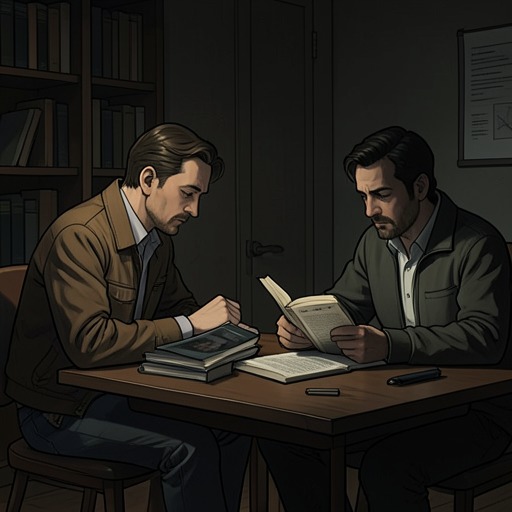
At lunch, the Self-Taught Man tells Roquentin that life has a direction because humanity supplies its goal. His claim is not merely that people should be treated kindly: he imagines humanity as the end toward which individual effort ought to move. When he says that all men are his friends, he describes his morning walk to work as a holiday. The other workers he sees become the unwitting recipients of his devotion, its purpose and destination even though they do not know it.
The intensity of the conviction is real, but Roquentin hears in its phrasing a familiar performance. He remembers Parisian humanists whose declaration that there are people carried an emotional eloquence the Self-Taught Man cannot reproduce. For Roquentin, this difference exposes a gap between the ideal’s grand language and the man’s naive, provincial expression of it. The scene does not present his kindness as a simple fraud; rather, it shows how an inherited humanist vocabulary can speak through him before he understands the conflicting traditions packed inside it.
A Taxonomy That Absorbs Its Differences
Roquentin’s account of humanists unfolds as a catalogue of social and intellectual types. The radical humanist is friendly with officials; the left humanist preserves human values while sympathizing with the humble; the Communist writer loves people since the second Five-Year Plan and punishes them in the name of that love. The Catholic humanist turns the lives of workers into beautiful, sad stories for readers’ edification. Alongside these types stand the philosopher who assumes elder-brotherly responsibility, the savior who acts with or without consent, and humanists who idealize either life or death in people.
The catalogue’s point is not that these figures agree. They oppose one another as individuals, but Roquentin argues that humanism can house the whole quarrelsome collection. Its capacity to include opposing positions makes it difficult to refuse: anti-intellectualism, mysticism, pessimism, anarchy, egotism, and even misanthropy can all be recast as incomplete stages within a larger humanist harmony. The doctrine’s apparent breadth thus becomes a mechanism of containment. Opposition does not escape it; opposition is digested and given a place within it.
Roquentin’s Refusal of the Label
When the Self-Taught Man tentatively asks whether Roquentin is a misanthrope, Roquentin recognizes what the label would do. Accepting it would let humanism classify him and fold his refusal into its scheme; rejecting humanism head-on would give the doctrine another opponent to assimilate. He therefore declines the offered counter-label as well as the creed itself: he is not a humanist, he says, and does not accept the premise that either hatred or love can be turned into a universal account of a person.
The exchange becomes more pointed when the Self-Taught Man claims that Roquentin sees people only as symbols: youth, love between man and woman, or the human voice, rather than actual individuals. Roquentin’s criticism is that such abstractions do not exist as independent human realities. The man answers that no one can judge another by a resting face or know the full resources within a person. His defense of human possibility, however, is itself an abstract defense: Roquentin sees a candid face and believes the Self-Taught Man’s tenderness for humanity prevents him from being touched by the particular face before him.
Roquentin briefly adopts the language of universal admiration, saying that all men are admirable as creations of God. The Self-Taught Man takes the statement at face value, while Roquentin’s framing makes its premise the point: this praise rests on a shared theological category rather than on knowledge of particular lives. The difference between them is not simply optimism against hostility. It is a conflict over whether a universal claim can count as genuine recognition of the person in front of them.
Existence Against Human Consolation
The argument over Humanism belongs to the novel’s wider resistance to treating existence as a settled concept. Earlier, a rain-soaked school notebook page lies beside a puddle after a cavalry officer steps over it. Roquentin bends to pick up the pulp, as he often enjoys doing with discarded paper, but cannot make himself touch it. The ordinary action has become inaccessible: he straightens up empty-handed and feels that he is no longer free to do as he wills. His response is bodily before it becomes an argument about doctrine.
The page calls back to the pebble he held at the seashore, whose sickening quality seemed to pass from the stone into his hand. In these episodes, objects cease to be neutral tools or surfaces arranged for human use. Roquentin describes contact with them as unbearable, and a seat in a moving car similarly resists its familiar name: its red plush appears as an obscene, bloated thing rather than as a designed place to sit. The everyday categories that make the world useful do not erase what is there; when they fail, things confront consciousness as strange and excessive.
The chestnut root brings that rupture into focus. Sitting alone before its black, knotty mass in the park, Roquentin loses the word root and the practical meanings attached to things. He realizes that existence is not an empty form added to objects while leaving their nature unchanged; it is the very substance of things. The root, bench, grass, and gates cease to appear as neatly distinct objects, and existence emerges as a naked, disordered presence beneath their familiar identities. Against that discovery, a doctrine that assigns humanity a goal risks doing to people what habitual names do to objects: making their existence seem already explained.
The Limits of Universal Love
Humanism’s central tension is that it speaks in the name of people while potentially turning them into an idea. The Self-Taught Man sees humanity as a shared end and hopes that even strangers on their way to work belong to his life’s purpose. Roquentin counters that an abstract love of humankind may attend more closely to Youth, Love, or the Human Voice than to actual people. The ideal can therefore sound generous and still miss its objects.
The novel does not resolve the conflict by offering an opposing universal doctrine. Roquentin refuses to call himself an anti-humanist because that too would provide humanism with a position to absorb. His resistance instead preserves the uncomfortable distinction between a person and the category meant to explain him, between naming a thing and encountering its existence. Humanism is significant not only as the Self-Taught Man’s sincere creed but as the example through which the novel tests how easily moral purpose can become a consoling system that claims to include everything.