Art’s Transcendence of and Defense of Existence
NauseaArt’s Transcendence of and Defense of Existence names the possibility Antoine Roquentin glimpses in a jazz melody and then considers for writing: art cannot abolish existence, but form may make something that seems to rise above its contingency. In the novel’s final café scene, the melody’s apparent permanence, the singer’s performance, and Roquentin’s proposed novel converge into a tentative artistic purpose, not a completed project or a settled answer.
The melody beyond existence
Roquentin distinguishes the melody from the sounds that carry it. A voice, a violin note, or the vibrations moving through air can be perceived, but the melody itself cannot be seized as though it were another object in the café. If he were to tear the record from its table and break it, he would not reach the melody; it remains beyond the physical sounds through which it is heard. This distinction gives art its peculiar force: the melody is not an additional thing among things, but an ordered form that the things disclose without containing.
The contrast is sharpened by Roquentin’s account of existence as surplus and disorder. The world’s people and objects are caught in an unplanned, everyday drift; relative to the melody, they seem superfluous, while the melody possesses a precise integrity of its own. That does not mean it literally ceases to exist. Rather, Roquentin experiences its composed form as something that is, without the excess and contingency that make ordinary existence oppressive to him. Art’s distance from existence is therefore an effect of form, not escape into a separate, factual world.
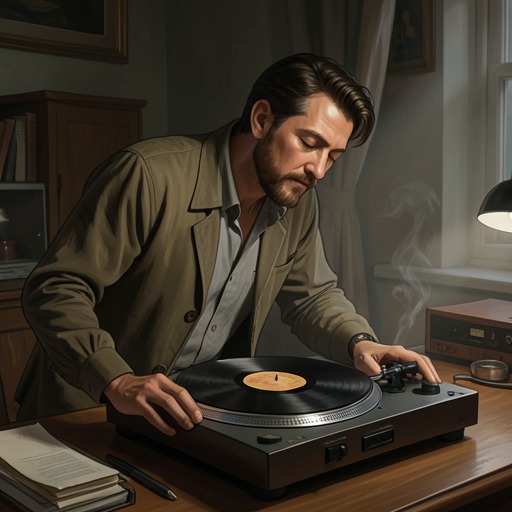
The record makes that distinction audible through damage. A scratch causes the needle to cough, and the disc itself is wearing out; the singer may already be dead. Yet the melody appears untouched by the defect. The material vehicle deteriorates from present to present, without securing a past or future, while the tune persists in Roquentin’s hearing as young, firm, and pitilessly constant. The contrast does not rescue the disc or its maker from time. It shows instead how a work can be experienced as stable even when its medium and human origins remain vulnerable.
From failed escape to an artistic possibility
The melody matters because Roquentin recognizes in it the desire that has driven his failed attempts to get beyond existence. He has wanted to purge the passing moments, harden and purify himself, and give back the saxophone note’s sharpness and precision. He pictures the mistake as a man trying to live behind paintings, books, and records rather than in the ordinary world, only to find himself in a bistro before a glass of warm beer. The musical experience does not confirm that he has escaped into art; it makes the limit of that fantasy clear while showing him what artistic form might achieve.
The imagined history of the tune’s composer brings this possibility down to a human scale. Roquentin pictures a man writing it in the oppressive heat of a room, with bills to pay and perhaps a woman who does not return his feelings. There is nothing conventionally glorious in these imagined troubles. The composer may have expected the tune to earn him only fifty dollars and may not have known what it would become for a later listener. Roquentin nevertheless finds the man’s sweat and suffering moving because they have entered a work that can be heard beyond the circumstances of its making. The imagined biography offers a contrast, not a factual account of the composer’s life: the tune’s significance cannot be reduced to what its maker intended or knew.
Roquentin stays to hear the Black singer perform once more. In that performance he thinks that she and the Jewish composer are, in a sense, saved: they seem washed, though not entirely, of the sin of existing, and become for him almost like figures from a novel. The thought surprises him, since he had no longer expected such a possibility. He experiences a small, fragile joy and wonders whether existence can be justified at least a little. Art does not grant the people he imagines an actual release from suffering or death. It makes their lives available to thought as something precious, rather than leaving them as anonymous, contingent facts.
The novel as an answer to history
From the melody, Roquentin turns to a book he might write. He rejects another history book because history speaks about what has existed, and one existing thing, in his account, cannot justify another. His abandoned effort to revive the Marquis de Rollebon thus appears as a mistaken way of seeking meaning: assembling a past cannot transform the bare fact that anything exists. He does not yet know what kind of book he could make, but he imagines a story whose printed words let readers guess at something beyond existence, perhaps an adventure that could never happen.
The imagined work would not erase its author’s ordinary life. At first, writing would be tiring and would neither prevent Roquentin from existing nor stop him from feeling that he exists. Its possible effect comes later: when the book is behind him, some of its clarity might fall over his past, allowing him to remember his life without repugnance. The shift is important. Art does not supply a hidden essence that was waiting inside his life all along; it may give the past a new shape retrospectively, by making it part of a completed form.
His imagined readers are part of this hope. They might think of the book as the work of Antoine Roquentin, a red-haired man who frequented cafés, and treat his life as precious and almost legendary, much as he now thinks of the singer. This imagined recognition is not a claim that public acclaim will cure his isolation. He explicitly dismisses simple humanitarian concern for the composer, and he does not know whether he has the talent to write the book. Rather, the thought identifies a possible relation between a work and a reader: someone else’s life, otherwise inaccessible and ordinary, can become meaningful to contemplate through the form that survives it.
An opening, not a resolution
The possibility remains conditional. Roquentin hesitates to leave the café, wants to hear the singer for the last time, and cannot decide whether to attempt a novel. He has written historical articles, but never anything of the kind he now imagines; talent is uncertain, and the prospective book might be troublesome work. His insight is therefore not a declaration that art has already justified his existence. It is a new course of action he can barely bring himself to choose.
As he waits for his train, Roquentin imagines that a future recollection might identify this gloomy hour as the one when everything began. The thought does not turn the present into a completed adventure or undo its misery. It offers the possibility that a finished work could make this moment legible from the past and help him accept himself. The novel closes on that distinction: artistic form cannot remove the world’s contingency, but it may give experience a clarity capable of changing how it is remembered.