Adventure
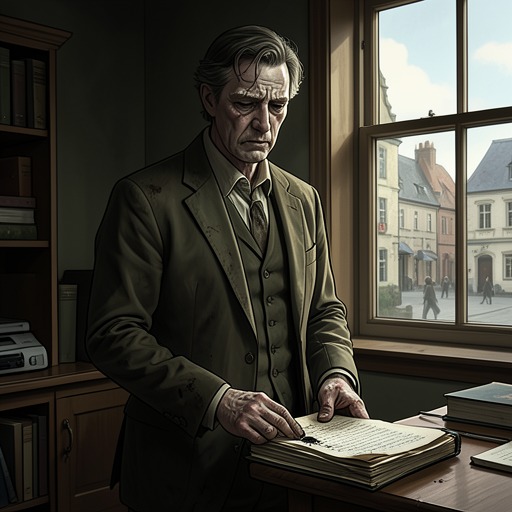
NauseaAdventure is the imagined quality that Antoine Roquentin wants his life to possess: a sequence that begins decisively, gathers significance as it unfolds, and becomes a whole with an ending. His reflections distinguish this literary shape from ordinary experience, in which events do not announce themselves as beginnings and minutes do not know what they will later mean. The distinction does not extinguish his longing. When the Sunday evening streets suddenly seem charged with expectation, he feels adventure happening to him again, making the concept both an object of critique and a recurrent desire.
The Desired Shape of an Event
Roquentin begins by separating adventures from the things that have happened to him. Even an incident involving violence in Meknes, where a man tried to stab him and Roquentin struck him below the temple before a crowd chased them toward Souk Attarin, remains merely an event in his account. What he had wanted was not simply more excitement. He had imagined that at certain times life could take on a rare and precious quality, and had looked back on moments in London, Meknes, and Tokyo as though they had possessed it. He now understands that this belief had sustained him for ten years without his fully recognizing it.
For Roquentin, an adventure must seem to begin as it happens. A slight rustling in shadow or a thin silhouette crossing a street might suddenly appear to open onto a larger design. The ordinary evening acquires the force of a beginning: the person living it senses that something is starting, even though its destination remains hidden. That expectation depends on more than unusual circumstances. A modest event can feel momentous if it appears to initiate a shape whose outlines are not yet visible.
The shape, however, contains its ending from the start. Roquentin imagines an adventure as something that cuts through tedium, gathers moments into continuity, and moves toward completion. A person may seize on each instant—the tenderness of a woman’s eyes, street noises, or the false dawn—as unique, yet know that it will pass and not try to prevent its annihilation. Once the adventure ends, the beautiful form sinks into the past and contracts until its end seems to meet its beginning. The wish to live the whole sequence again cannot restore it: an adventure neither returns nor prolongs itself.
Living and Telling
The central distinction is between living an event and recounting it. Roquentin concludes that even the most banal occurrence can become an adventure if someone begins to tell it. People live amid stories, interpret what happens through them, and may try to conduct their lives as though they were telling one. But the two activities do not coincide: he formulates the choice as living or telling.
He tests that distinction against an episode in Hamburg with Erna, a woman he distrusted who was afraid of him. While she was away in a small café in San Pauli, a phonograph played “Blue Skies.” Roquentin began narrating the events since his arrival to himself, describing a woman he had noticed entering a dance hall as the woman he was waiting for and imagining her return. As he told the episode, he felt violently that he was having an adventure. Erna then came back, sat beside him, and put her arms around his neck; he hated her without knowing why. The return to the lived moment broke the story’s spell. He understood that living again was making the adventure fade.
Ordinary life, as he describes it, offers no comparable dramatic pattern. Scenery changes and people come and go, but there are no clear beginnings; days accumulate without rhyme or reason. One can total a span of travel or residence, but that accounting does not give it a plot. Nor does one leave a woman, friend, or city all at once. Even places as distant as Shanghai, Moscow, and Algiers begin to look alike after two weeks. Rarely, a moment becomes a landmark, but then the procession of hours and dates resumes: Monday, Tuesday, Wednesday; April, May, June; 1924, 1925, 1926.
Retelling reverses that unshaped sequence. A story may appear to start with a fine autumn evening in 1922 and a notary’s clerk walking through Marommes, but for its audience the end is already present, though invisible. That anticipated ending gives ordinary details their later value. The clerk’s money troubles and moroseness become precious because readers see them in the light of future passions; a deserted street can seem like a promise whose importance will be understood afterward. In actual life, the future has not yet arrived. The walker does not know which details will matter and has not selected a path through them. Narrative makes past instants look like announcements of an outcome they could not announce to the person living them.
Irreversibility and Retrospective Order
Roquentin’s longing is consequently a longing to have time behave like memory organized into a story. He wants the moments of his life to follow one another in that order, even though he recognizes the impossibility of catching time by the tail. Narration offers a pattern that experience itself does not provide: it gathers successive instants around an ending and makes their relation seem necessary. What it cannot do is return those instants to life as they were first encountered.
This tension explains why the concept remains emotionally powerful after Roquentin sees through it. To recount an episode is to make its parts legible from the end backward; to live it is to encounter a present without that guarantee of significance. The promised shape can make an event seem precious, but it depends on a knowledge of the outcome unavailable in the moment. The distinction is not simply that stories are false and events true: Roquentin observes that what happens and what is later told run in opposite directions, because telling supplies the order that happening lacked.
The Sunday Evening Reversal
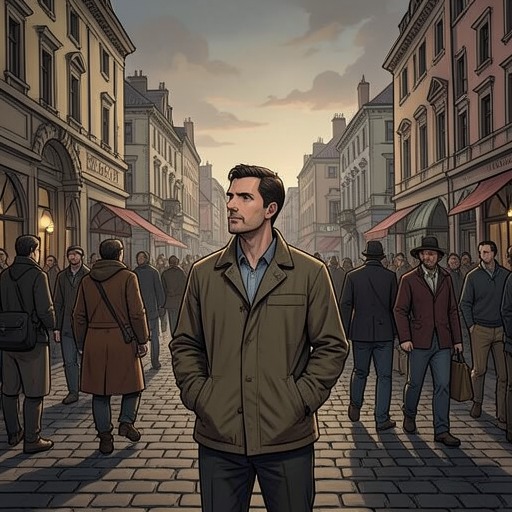
On Sunday evening, after the crowd has dispersed, the fading light, the lighthouse on the HeCaillebotte, and the deserted streets frame a renewed sense of expectation. Roquentin’s heart swells with a feeling of adventure. He says nothing has changed, yet everything is different: unlike the nausea, this experience makes him feel that an adventure is happening and that he is here, splitting the night, as happy as a novel’s hero.
The feeling takes the form of a destination just ahead. Roquentin imagines that something waits in the shadow of the Rue Basse-de-Vieille, where his life is about to begin. A stone that first looks black becomes whiter as he approaches; he expects the adventure to start when it is entirely clear, and feels almost afraid of the prospect. Though he briefly thinks of turning back, he advances, stretches out his hand, and touches it. At the Rue Basse-de-Vieille, the enormous mass of Sainte-Cecile stands in shadow with its windows glowing, and the familiar creak of the metal hat returns. The episode’s dramatic force lies in the contrast between the abstract insight and the felt scene: Roquentin has recognized how narration confers shape on life, yet again experiences the present as if it were the threshold of a novel.
The Sunday sensation does not erase his earlier account of irreversibility. It instead reveals how readily the desire for an adventure can reappear, turning an ordinary walk into an anticipated beginning. In the reflections surrounding this moment, Adventure is at once a real intensity of experience and a narrative construction: life supplies passing instants, while the imagined story makes them appear to move toward a meaningful end. Roquentin’s concept never resolves into a simple rejection of stories, because the longing for their order remains alive even as he recognizes what that order does to time.