Existential Solitude
NauseaExistential Solitude is the condition of being unable to escape one’s own existence, even when other people no longer recognize or sustain a sense of belonging. The novel presents it not as simple physical aloneness but as a division: Antoine Roquentin finds that consciousness keeps asserting itself from within, while the Self-Taught Man is cast out of a community whose memory still surrounds him. Their contrasting isolation gives the concept both a philosophical and a social force.
Consciousness as an Inescapable Solitude
Roquentin’s isolation begins in the failure of thought to provide an exit from existence. When he tries to stop thinking, the attempt itself becomes another thought; the effort to silence consciousness merely renews it. He recognizes that his thought is inseparable from himself and that he is the one who continues and unfolds it. Existence therefore feels less like a chosen identity than an ongoing burden: even disgust at being alive becomes another way of making himself exist.
This inward trap is not relieved by the body. Roquentin observes his hand and senses its weight as something that persists regardless of where he puts it. He can withdraw it from view, but cannot suppress his body or the fact of its presence. Thought and flesh converge in the same predicament: both continue, and neither offers a place outside existence from which he could regard himself without being implicated in it.
The Wound and the News
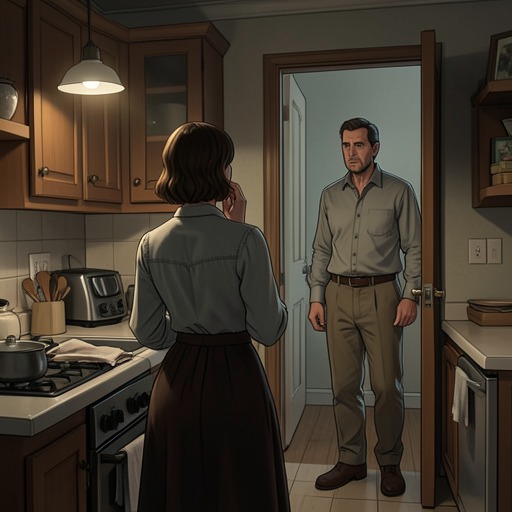
Roquentin’s attempt to introduce a change by stabbing his palm produces no transformation. The injury is superficial; he watches a small pool of blood appear on the paper and considers it a memory, but the sensation that follows is no more than another sensation. He writes that he has given up his book on the Marquis de Rollebon. The gesture makes visible his desire to break the monotonous continuity of existence, while its limited consequence confirms how little an act can alter the underlying condition.
Soon afterward, a newspaper reports that Little Lucienne’s body has been found and that the criminal has fled. The report pulls Roquentin’s attention between the child’s death and the surrounding things, each insistently present. His thoughts become disordered as the news brings violence and existence into an intolerable proximity; he drops the paper and flees. The scene does not offer solitude as calm reflection. It shows consciousness overwhelmed by what it cannot stop registering, including another person’s suffering and the world that remains around it.
The Root and the Limits of Explanation
The later encounter with the chestnut root gives Roquentin a language for the experience that had previously seized him without words. He identifies absurdity as the key to existence and to his nausea: the root is not absurd merely in relation to human circumstances, but exists without a reason that could explain it away. Explanations may account for what a thing does, but they do not account for the brute presence of this particular thing.
That insight deepens the solitude at stake. Roquentin’s consciousness confronts an existence that does not answer to human reasons, while the words he uses to grasp it remain inadequate to the encounter. He recalls that in the garden he had thought with things rather than through a clear formulation; later, writing, he tries to fix the experience in language. The gap between what he encountered and what he can say about it makes the act of understanding itself solitary: no shared explanation can remove the thing’s irreducible presence.
The Self-Taught Man and Social Exclusion
The Self-Taught Man’s isolation has a different source. After the library incident, Roquentin searches for him and imagines him wandering through Bouville in shame and horror. He believes the man’s dreams of culture and of mutual understanding with humanity have collapsed. Although Roquentin regards him as kind and well-intentioned, he recognizes that the library community has rejected him and that he is entering solitude against his wishes.
Roquentin imagines the Self-Taught Man returning in the evening to the Cour des Hypothèques, watching the library’s lit windows and remembering the rows of books and their bindings. The imagined scene makes exclusion concrete: the man is separated not from an abstract ideal of humanity but from the place and practices through which he had pursued connection. Roquentin regrets not accompanying him, but says the Self-Taught Man asked to be left alone; he describes the man as beginning an apprenticeship in solitude. In the Café Mably, as Roquentin prepares to record what happened, the man’s reproachful face and blood-stained collar remain in his mind.
Two Forms of Being Forgotten
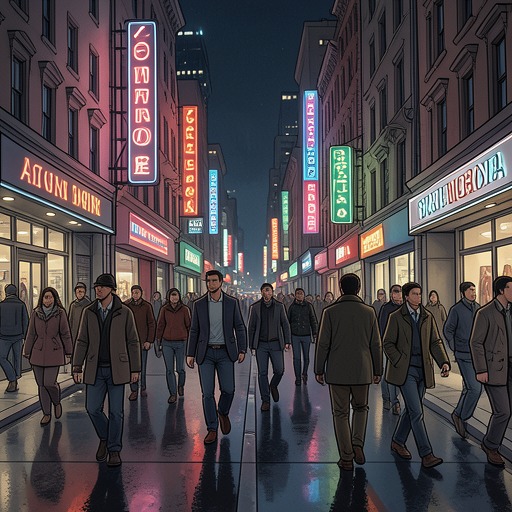
On his last day in Bouville, Roquentin pauses between cities and reflects that one knows nothing of him while the other no longer knows him. He feels forgotten and finds that the word I has become hollow. His name, Antoine Roquentin, seems like an abstraction, and the personal self fades until what remains is an impersonal consciousness aware of its own existence and superfluity. Even the announced departure of his train is registered as another voice within that consciousness, not as an escape from it.
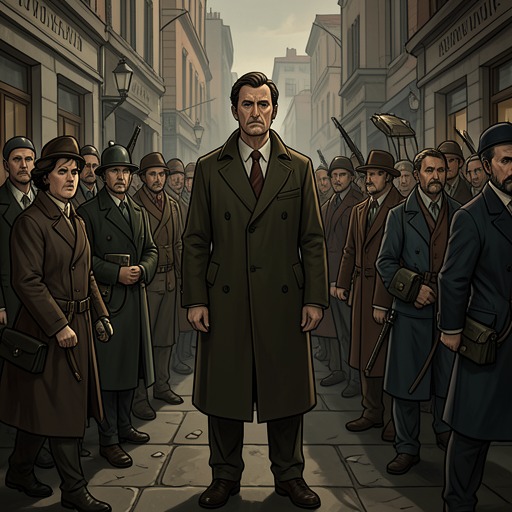
The Self-Taught Man, by contrast, walks in a city where people are still thinking about him. Roquentin imagines that the Corsican librarian, the woman, and perhaps others remember the incident; the man cannot lose himself from the scene that has marked him. The contrast is sharp: Roquentin is socially unremembered yet cannot forget his own consciousness, whereas the Self-Taught Man remains painfully held in other people’s memory despite being rejected by them. Neither form supplies belonging. The novel’s closing movement places these distinct solitudes beside Roquentin’s departure for Paris, leaving consciousness, social memory, and the hope of connection unresolved.