Historical narrative as a source of meaning
NauseaHistorical narrative as a source of meaning is the belief that a coherent account of the past can make existence intelligible and give the present a place in a larger story. In Antoine Roquentin’s research on the Marquis de Rollebon, this promise breaks down: documents support competing possibilities but disclose no settled person behind them, while the sense of coherence comes from the historian arranging the evidence. The same instability reaches Roquentin’s own memories. History and autobiography alike offer not a recoverable foundation, but narratives that can lose their authority when confronted with the contingencies of existence.
The Promise of Historical Order
Roquentin initially treats his study of Rollebon as more than an academic undertaking. As other possible sources of meaning fail him, he returns to the research, hoping the past might supply a durable account where immediate experience and inward reflection cannot. For a time, the Marquis seems to stand between Roquentin and the emptiness of the present: a life to reconstruct, a sequence of actions to explain, and a subject around which his own work can take shape.
The attraction shifts, however, from the historical person to the book Roquentin hopes to write. He finds that he no longer understands Rollebon’s conduct after 1801, despite having abundant material: letters, memoir fragments, secret reports, and police records. The difficulty is not simply a lack of sources. The testimonies neither agree nor directly contradict one another; they fail to seem as though they concern the same person. Roquentin wonders how other historians work from the same materials, but the question leaves him cold. His increasing desire to write begins to exceed his interest in the man whose life is supposed to justify the writing.
Documents and the Making of a Life
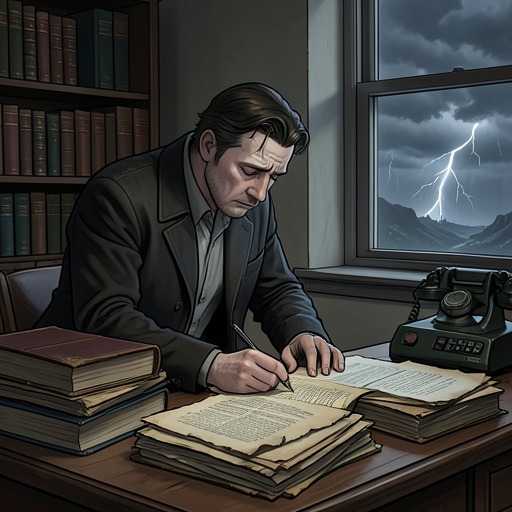
The assassination of Paul I provides a concrete test of what the archive can establish. Tcherkoff’s account makes Rollebon an influential conspirator, paid by Count Pahlen and charged with persuading the conspirators to kill the Czar. According to this version, most of the plotters were content to depose and imprison Paul, while Pahlen wanted him dead. Roquentin distrusts the witness, whom he regards as unreasonable and given to turning events into something demonic. He cannot reconcile Tcherkoff’s theatrical account of Rollebon with his own sense of the Marquis as a cold, restrained intriguer. The evidence offers a claim and a witness; it does not settle the character or motive behind them.
Roquentin can construct a broader, plausible career from the records. Rollebon might have taken part in Paul I’s assassination, accepted a major espionage mission in the Orient from the Czar, and betrayed Alexander in Napoleon’s favor, while also corresponding with the Comte d’Artois and sending him only trivial intelligence to simulate loyalty. He might even have profited from selling rifles to Asian principalities. But plausibility is not proof. Roquentin recognizes that these hypotheses are his own means of unifying the facts: the documents do not supply a confirming insight from Rollebon himself. Their details submit to the order he imposes, yet remain outside that order. What looks like recovered history begins to resemble pure invention, and Roquentin suspects that the characters in a novel would feel more genuine.
His growing resentment makes the projection personal. Having spent a month checking one of Rollebon’s claims about a short visit to Bouville in 1790, Roquentin discovered that the Marquis had impregnated a tenant farmer’s daughter. The revelation turns a grand historical persona into a possible low comedian, but the disappointment is also intimate: Roquentin had hoped that Rollebon would make an exception of him and disclose the truth. Instead, the dead man has told him no more than he told Alexander or Louis XVIII. Roquentin can imagine the charm, gestures, and sudden violence that might have belonged to Rollebon, but knows that the imagined character is not established by the surviving letters and works. The desire for a trustworthy historical companion exposes how much of the supposed life has been supplied by the researcher.
A Past That Will Not Stay Present
The crisis is not confined to the archive. Roquentin’s recollections of travel also lose the vividness they seem to promise. A sudden image of sun and blue sky carries him toward Meknes, but the apparent return proves deceptive. He can no longer see the square he visited daily; what remains is the phrase identifying it as charming, while any fuller scene he tries to produce may be invention. A remembered encounter with a man from the hills retains a few details, but Roquentin cannot be sure whether the surviving scraps are memories or fiction. In another kind of loss, stories persist after their images have gone: they preserve a sequence of actions and place-names, yet the person who travelled through them no longer feels like Roquentin.
Photographs, which might appear to anchor recollection in a visible record, fail to restore that continuity. A faded picture of a woman beside a tank leaves Roquentin unable to recognize her until he reads its inscription: Anny, Portsmouth, April 7, 1927. The caption identifies the person and place, but does not return the lived experience. Roquentin concludes that he constructs memories from his present self. He feels confined to the present, unable to rejoin the past; the archive’s problem of incomplete evidence has become a bodily and autobiographical estrangement.
The same separation marks his recollection of Anny. Their shared instants once seemed to remain alive in sounds, smells, light, and unspoken thoughts, but the ending of the relationship changed their temporal status. When Anny left, the three years they had shared crumbled into the past; after Roquentin decided in Saigon to return to France, the remaining faces, places, and river quays were wiped away. His present is no longer continuous with those experiences simply because he can name or picture them. The past appears instead as a vacuum, while the travel scenes that once seemed to make a life can remain only as images or words.
The Limits of Historical Justification
Roquentin’s notes register a residual dependence on the project even as its authority weakens. After writing four pages, he records a long moment of happiness and warns himself not to think too much about the value of History, because that risks making him disgusted with it. He still describes Rollebon as the only justification for his existence. The entry makes the tension explicit: historical work has become doubtful as a source of knowledge, but Roquentin remains emotionally invested in it as a reason to continue.
That investment finally confronts the material remains themselves. In an episode involving yellow pages that he associates with Rollebon, Roquentin recounts a chain of transmission: the Marquis’s nephew was allegedly killed by the Czar’s police in 1810, his papers were confiscated and taken to the Secret Archives, and the documents later entered the State Library, from which Roquentin says he stole them in 1923. Yet even this account does not make Rollebon present. It seems no more true to him than other stories that might explain how the papers came to be in his room. The pages are marks on paper, not a channel to the dead man; even the physical remains of a person would consist only of matter existing independently of the life Roquentin hopes to recover.
The failure of historical narrative is therefore not just a verdict on one inadequate biography. It reveals a wider gap between evidence and the meanings imposed on it. Documents can constrain a story without resolving it; a historian can organize testimony without making the resulting order originate in the past itself. Roquentin’s memoirs and photographs show the same gap in personal experience: records may identify a person or preserve a phrase, but they cannot guarantee that the past has returned. Historical narrative can still be written, but it cannot, on this evidence, deliver the secure existence or justification Roquentin sought from it.