Freedom
NauseaFreedom in Nausea is both a philosophical condition and a practical capacity that Antoine Roquentin discovers he cannot simply assume. The attempt to pick up a ruined school page ends with him standing empty-handed; that small failure unsettles his confidence that he can do what he wills and gives an abstract problem the force of a physical encounter.
Freedom as Becoming
In the novel’s philosophical frame, freedom is tied to the instability of identity. A person begins in the emptiness of existence and makes a self through choices; being is therefore never finally fixed, but remains in the process of becoming. On this account, freedom is not merely a possession that guarantees ease or mastery. It is the burden and possibility of having to make oneself through action.
That process has a limit in death. Without death’s contingency, the account suggests, becoming would have no end—and neither would the philosophy that follows it. Freedom thus belongs to an existence without a predetermined essence, yet it does not promise that the individual can control how existence feels or what each choice will mean.
The Failed Gesture
The crisis takes shape in an incident Roquentin initially leaves out of his account. At eight-fifteen, as he was leaving the Hotel Printania for the library, he wanted to pick up a paper on the ground and could not. He later recognizes that his earlier pages, which claimed there was nothing new, had concealed the force of the incident: it had made him feel that he was no longer free.
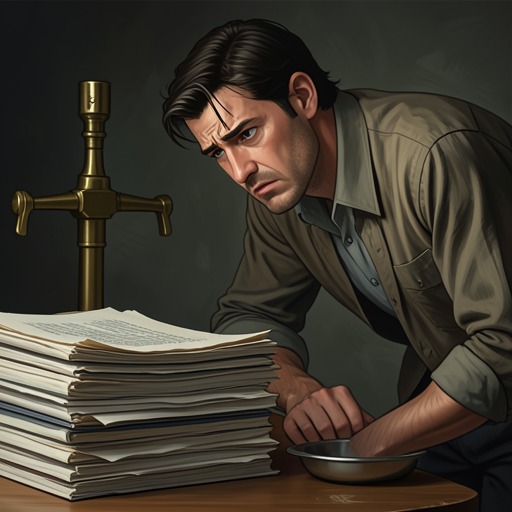
The paper’s ruined condition sharpens the encounter. Roquentin sees a rain-soaked, twisted notebook page beside a puddle, its red margin smeared pink and its bottom hidden under mud. He bends down, expecting to handle the damp pulp, but cannot act. After reading the words Dictation: The White Owl, he straightens empty-handed. The contrast between the specific, ordinary task and the failure to perform it turns freedom from a general idea into a question about the body’s ability to carry out an intention.
The incident also changes the meaning of the pages that precede its disclosure. Roquentin says the failed gesture is responsible for those pages, though pride and awkwardness had kept him from naming it. His account is therefore not a transparent record of experience: he first disguises the event as nothing, then revises that judgment and admits its weight. The act of writing restores neither a simple explanation nor a lost ease of action; it makes the concealment itself part of the evidence.
Contact and the Material World
Roquentin connects the paper’s impact to a wider disturbance in his relation to objects. Objects should be useful things that people handle and put back in place, yet he experiences their contact as unbearable, as if they were living beasts. This reversal unsettles the familiar arrangement in which a person acts upon passive things: the ordinary world seems capable of pressing upon him, while his own agency becomes uncertain.
The paper also recalls the earlier pebble at the seashore. By linking the two encounters, Roquentin places his inability to pick up the page within a recurring pattern of material contact and disturbance. The page is not simply another object to use; its presence brings back an earlier bodily experience and makes the question of freedom recur in a new form.
Significance and Limits
The failed gesture gives the novel’s account of freedom its sharpest concrete expression in these episodes. Roquentin’s feeling that he can no longer do what he wills does not establish that he has ceased to be free in a comprehensive philosophical sense. Rather, it shows how the ordinary expectation of control can fracture, and how an intention that seems straightforward may fail at the point of action.
The broader account of freedom as self-making offers a way to understand that fracture without resolving it into a simple lesson. If identity is made through choices, then freedom is inseparable from uncertainty about who one is and what one can do. The episode leaves that uncertainty active: a sodden page, a bent posture, and an empty hand are enough to expose the distance between willing and acting.