Bourgeois rights and duties
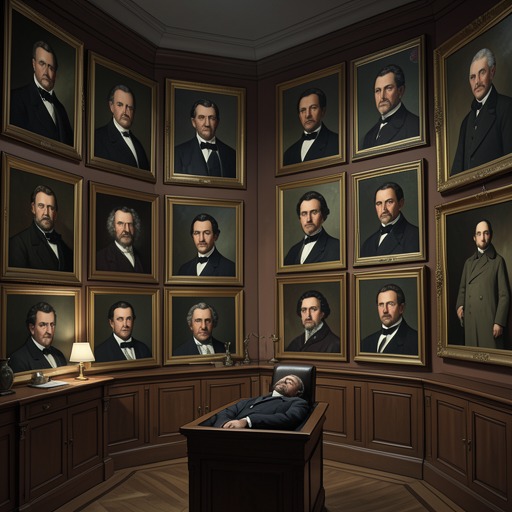
NauseaBourgeois rights and duties are the linked claims by which Bouville’s elite turns privilege into a public virtue: the right to live, prosper, command, and be remembered is represented as the reward and counterpart of dutiful service. In the museum, Antoine Roquentin sees this moral system embodied in the town’s commemorative portraits and biographies. Their assurance that authority is deserved becomes a pointed contrast to his discovery that existence has no necessary foundation and grants no one rights simply for being there.
The code of rights and duty
For the elite represented in the museum, rights are not abstract principles detached from social position. They are attached to a life already secured by family, wealth, education, and leadership. Jean Pacome’s portrait gives the code its most intimate form: Roquentin imagines Pacome claiming, as a child, good upbringing, a united family, an unblemished name, and a prosperous business; as a husband, care and affection; as a father, veneration; and as a leader, unquestioning obedience. Each role arrives with its own due, while duty supplies the respectable language that makes those claims seem legitimate.
Pacome’s success confirms the system to itself. His family has become the richest in Bouville, and his imagined habits suggest how thoroughly entitlement can pass for moderation: even pleasure is treated as a right, enjoyed without any need to question its basis. Duty, in this portrait, does not challenge privilege; it gives privilege an orderly moral shape. Rights and obligations appear as two sides of the same arrangement, with the authority to receive deference accompanying the duty to perform one’s assigned role.
Public ritual and social distinction
The code is reinforced beyond the museum, in the repeated ceremonies of Bouville’s public life. On Rue Tournebride, families move slowly through Sunday greetings, clasping hands, raising hats, and introducing one another with elaborate courtesy. These gestures make rank visible while presenting it as good manners. Roquentin learns to distinguish people associated with Boulevard Maritime from those of Coteau Vert by dress and bearing: a new overcoat, soft felt hat, and dazzling shirt mark one group, while worn faces and a sunken appearance mark the other. The ceremony does not erase class division; it lets the town enact it as a familiar social order.
The museum’s painted faces extend that performance into history. Roquentin observes that the portraits have been minutely rendered, yet seem stripped of the mysterious weakness found in ordinary human faces. The elite entrusted Renaudas and Bordurin with images of themselves that make their mastery of the landscape appear to have remade humanity as well. In the canvases, the conquest of nature and the language of the Rights of Man and Citizen serve as ornaments of an authority that presents its own position as the culmination of civic achievement.
Institutions, leadership, and inherited authority
The portraits’ accompanying histories make the political claims explicit. Olivier Blevigne, after the Paris Commune insurrection drove him to Versailles, vowed to devote his life to restoring order. He founded the Club de l’Ordre, entered politics, and argued that the ruling class had a primary duty to govern because heredity, education, and experience had made it fit to exercise power. His formulation recasts the elite’s continued rule not as an interest to defend but as a responsibility that others would be wrong to leave unfulfilled.
The town’s civic record gives this claim material substance. The elite built Sainte-Cecile-de-la-Mer and founded the Federation of Shipowners and Merchants of Bouville in 1882, describing its purpose as cooperation in national recovery and resistance to disorder. Its members improved the port and broke the shipping strike of 1898; Blevigne returned to Bouville during the strike and became a guiding force in the resistance. The public account thus places infrastructure, civic leadership, and the suppression of labor conflict within one narrative of service. It turns the power to direct the town—and to contain opposition—into evidence of fitness to rule.
The museum’s lesson and Roquentin’s counter-reading
A painting of a solitary bachelor offers a darker version of the same moral logic. The canvas shows a dying man unattended, while his mistress counts his money, a stranger waits in the doorway, and a cat laps milk. The scene is presented as punishment for a life lived only for oneself: the bachelor’s isolation warns against failing to secure the family and social ties that the town treats as the proper setting for a respectable death. The portraits around it, by contrast, commemorate men whose lives ended within the recognized order of family, inheritance, and last rites. The museum’s arrangement makes social belonging appear not merely desirable but the condition of a life deemed worthy of remembrance.
Roquentin initially finds Jean Pacome difficult to criticize. Yet the portrait’s calm gaze becomes an accusation: Pacome’s imagined confidence in his rights confronts Roquentin with the thought that his own existence has no such warrant. The difference is not simply that one man is admired and the other feels isolated. Pacome’s life has been interpreted through a ready-made structure of duty and entitlement; Roquentin sees himself as having appeared by chance, like a stone, plant, or microbe. Where the portrait supplies a coherent account of why Pacome belongs and deserves, Roquentin cannot find a comparable justification for his own presence.
That contrast sharpens when Roquentin recognizes contingency in the chestnut-tree root and concludes that existence is simply there, not something that can be deduced from necessity. The insight overturns the elite’s claim to natural entitlement: no one has rights merely by existing, and people who conceal their freedom behind ideas of rights remain as contingent as everyone else. Bourgeois rights and duties therefore function in the novel as both a social code and a defense against an unsettling fact. The code makes authority look necessary; Roquentin’s experience reveals that its necessity is a human construction.