Existence
NauseaExistence is the sheer, contingent fact of being there, independent of the names, uses, and explanations people attach to things. For Antoine Roquentin, this is not an abstract proposition but an invasive experience: existence floods the body, strips familiar objects of their reassuring identities, and reveals a world that has no necessary reason to be. The insight culminates in the chestnut-root vision, which makes his nausea intelligible not as a passing illness but as his confrontation with existence itself.
From borrowed purpose to bodily presence
Before the vision in the park, Antoine Roquentin recognizes that his work on the Marquis de Rollebon had furnished him with a borrowed reason to live. He had treated the dead man as a partner who needed him in order to exist, while he needed Rollebon to avoid feeling his own existence. Roquentin supplied the raw material of his life; Rollebon supplied an imposing figure and a purpose. In that arrangement, even Roquentin’s gestures seemed to belong to the Marquis: writing became an act that prolonged Rollebon’s existence, and Roquentin experienced himself as a means rather than as a presence in his own right.
That dependence breaks when existence ceases to be something Roquentin can keep at a distance. He tries to remain still, but a movement of his shoulders is enough for the waiting reality to seize him. His response is not that he has discovered a new purpose, but that he is the thing he had tried not to feel: he exists. The recognition is at once gentle and disturbing. He describes it as sweet, slow, and light, yet it also fills him so completely that he experiences his mouth, tongue, and throat as part of an unbroken bodily presence. Existence is no longer supplied by Rollebon’s story; it is immediate, physical, and his own.
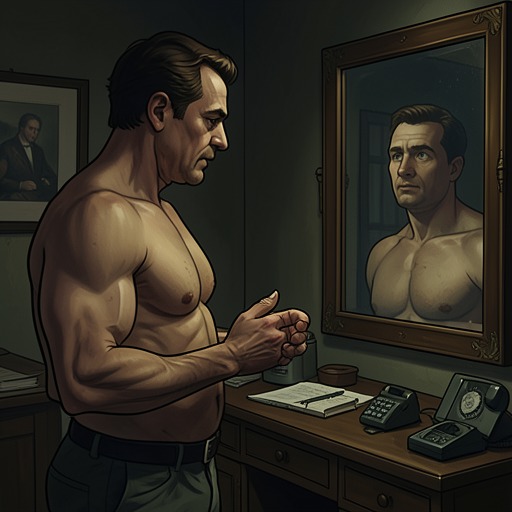
The hand provides another scale for the same recognition. Spread on a table, it lives; when its fingers open and move like the claws of an overturned crab, it appears strange even to the person whose hand it is. The familiar body is not simply a transparent instrument of intention. Seen as present matter, it can become animal-like and unfamiliar. This moment anticipates the larger disturbance in which Roquentin’s surroundings, too, will resist their ordinary names and functions.
Names, uses, and the material world
The seat in the railway car gives that disturbance a concrete form. Roquentin knows the object’s history and intended use: people made it from leather, springs, and cloth so that passengers could sit on it. Yet when he leans on it and recoils at its existence, the word seat no longer seems able to settle what is before him. He murmurs its name as if to exorcise the object, but the word remains on his lips instead of attaching itself to the thing. Red plush and its rows of small raised forms take precedence over its practical identity; the seat appears instead as an enormous, grotesque, belly-like mass, comparable in his perception to a dead donkey floating in floodwater.
The episode distinguishes naming an object from encountering its existence. A name organizes a thing around a human use, but it cannot make the thing’s presence necessary or harmless. Roquentin finds himself among things that are nameless in the sense that their words no longer protect him from their material reality. They surround him without demanding or explaining anything. Even the thin black line of shadow beneath the cushion persists as a line in its own right; he knows it is not a smile, but its suggestive appearance cannot make it cease to exist. The scene makes perception unstable without resolving that instability into a hidden message: the object is there, while the meanings laid over it prove insufficient.
The contrast is especially sharp because the railway car continues to move through an intelligible landscape. Houses pass the windows, the view opens toward the sea and the airfield as the car climbs Eliphar Hill, and a passenger sits opposite Roquentin. But ordinary scenery and ordinary purposes no longer restore the world to a settled order. Roquentin can recognize a seat and know why it was made while simultaneously experiencing it as something that its name cannot contain. The episode connects the shock of existence not to an absence of information, but to the failure of information and use to explain why anything is there at all.
The chestnut-root vision
In the park, the failure of familiar reference becomes more complete. Roquentin sits alone before the chestnut tree’s black, knotty root, stooping forward with his head bowed. He can no longer remember it as a root in the ordinary, stabilizing sense. Words have vanished along with the significance and uses they conventionally provide. The park’s recognizable distinctions—the root, the gates, the bench, and the grass—lose their authority as separate, manageable things. In their place he encounters masses of existence, naked and excessive, whose presence frightens him.
The revelation changes his understanding of how he had previously looked at the world. He had been able to identify the sea as green and a white speck as a seagull without feeling that either existed in the full force of the word. He had treated objects as scenery, tools, or members of categories, attending to their qualities and likely resistance rather than to the fact that they were there. He had supposed existence to be an empty form added to things without changing them. Now existence is no longer an abstract category hovering outside the object: it is the very substance of things, the matter in which the root seems kneaded. The root is not an example that proves a definition; it is where the previously unnoticed fact becomes impossible to avoid.
This perception is bodily as well as intellectual. The tree’s bark looks black and swollen, like boiled leather; the fountain’s water sounds in Roquentin’s ears, and the smell of the surroundings presses upon him. He experiences the world not as a collection of clear objects viewed from a safe distance, but as a density that exceeds the boundaries between separate senses and familiar categories. The vision leaves him motionless and icy, caught in an ecstasy that is also horrible. Its intensity does not offer comfort or mastery: existence weighs upon him and makes the ordinary world difficult to bear.
Contingency and the meaning of nausea
Roquentin identifies contingency as the essential discovery. Existence cannot be defined as necessity: what exists can be encountered, but its presence cannot be deduced from a necessary cause. Things do not have to be there simply because a name, function, or explanation can be assigned to them. Roquentin regards contingency not as a temporary illusion that a better account might dispel, but as an absolute condition. The park, the city, and Roquentin himself are free in this sense: they are present without a necessity that would justify their existence in advance.
That discovery also unsettles claims to human privilege. The people on Coteau Vert, Roquentin observes, try to conceal the burden of contingency behind their ideas of rights. Yet rights do not make existence necessary or remove the condition of being there. In Roquentin’s account, people remain free and cannot escape feeling superfluous. This is not a claim that existence is unreal; it is the opposite. The fact of existence is so undeniable and without sufficient justification that no inherited social assurance can make it feel deserved or inevitable.
The experience of the root does not remain a stable object of thought. For a time Roquentin feels both distinct from it and lost in it, conscious of its existence while absorbed in its presence. Then the root can no longer be thought of: repeating that it exists has no force. Existence cannot be contemplated safely from a distance; it must invade consciousness, or else cease to be available in that moment as a thought. When his attention is released, the wind moves the tree’s upper branches. Their motion offers a contrast to the inert presence that had held him. Roquentin understands movement as passage between existences, not as an independent substance that could explain how being begins.
A changed account of the self
At six o’clock, Roquentin does not describe himself as relieved or satisfied. He feels crushed, and the nausea has not disappeared; he does not expect it to leave soon. What has changed is its status. It is no longer, in his understanding, an illness or a passing fit that has happened to him from outside. It is himself: the continuing recognition of existence that the root’s presence has made unmistakable.
The concept also clarifies why the abandoned Rollebon project had once been so compelling and why it could no longer suffice. Historical reconstruction let Roquentin live through another person’s apparent purpose, diverting attention from his own existence. The park offers no substitute purpose and no necessary account of the world. Instead, the root, the seat, the body, and the city disclose the same difficult fact from different angles: being there precedes the stories and categories by which people try to make presence intelligible. Existence is therefore both Roquentin’s discovery and his predicament—a reality that cannot be reasoned away, yet supplies no ready-made justification for living.