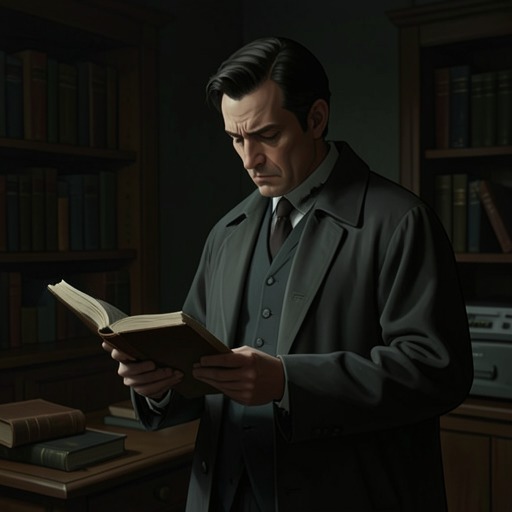
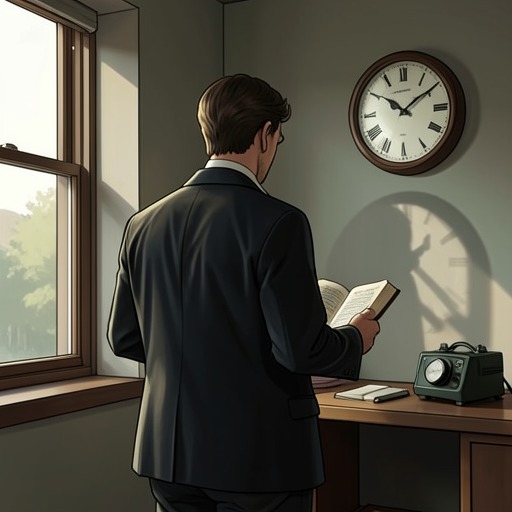
Existence and essence
NauseaExistence and essence is the distinction through which Nausea makes ordinary things newly strange. Essence comprises the qualities and functions by which an object can be recognized; existence is the brute fact that it is there. For Antoine Roquentin, that difference is not a detached philosophical puzzle. It arrives as bodily unease, as the failure of familiar names and purposes to contain what he encounters, and finally as the recognition that existence itself is irreducible to the meanings imposed on it.
The Distinction and Its Discovery
A familiar object can be described by the properties that let a person identify it: a Venetian glass paperweight, for example, is recognizable through its roundness, weight, smoothness, and color. Those features form its essence. Its existence, by contrast, is simply the fact that it is. The distinction becomes consequential when Roquentin discovers that the familiar qualities do not exhaust what an object is: once the sense of a thing as a recognizable kind of object falls away, its sheer presence remains.
The first acute encounter comes on the seashore, when Roquentin holds a pebble and is overcome by an odd feeling. The object’s recognized identity no longer settles his experience of it; instead, he feels confronted by bare existence. The narrative later identifies the sensation as a sweetish sickness that seems to pass from the stone into his hand. What had been an object he could take up and handle becomes, through touch, an unsettling presence that cannot be neutralized by knowing what it is called.
Contact and the Failure of Use
The distinction recurs when Roquentin sees a lined page beside a puddle. A cavalry officer steps over it, and Roquentin approaches, anticipating the pleasure of handling the sodden paper. He sees its rain-swollen surface, the red margin smeared pink, the ink running, and its lower edge disappearing under mud. Yet he cannot pick it up. After reading the words “Dictation: The White Owl,” he straightens empty-handed, feeling that he is no longer free to do what he wills. The episode gives the philosophical crisis a precise practical form: the paper is identifiable and its potential use or handling is familiar, but neither recognition nor intention restores the ordinary ease of acting upon it.
That failure alters Roquentin’s sense of the relation between people and things. Ordinarily, objects are handled, used, and returned to their places; their usefulness keeps them in the background. Now their contact feels unbearable, as though they were living beasts. The inversion is crucial: the objects have not simply lost their uses, but have become insistently present in a way their uses cannot explain. The pebble and the paper make material contact the point at which supposedly passive, familiar things press upon his awareness.
Names, Bodies, and Unruly Matter
In a railway car, Roquentin tries to steady himself by naming the red-plush object beneath his hand a seat. He can reconstruct its designed purpose: leather, springs, and cloth were assembled to make something for people to sit on, and it was placed in the moving car for that use. But the word will not settle onto the thing. Its plush becomes a field of small, dead-looking paws; its upturned, swollen form suggests a dead donkey floating belly-up in a river. The ordinary category remains available in language, yet the perceived matter exceeds and unsettles it.
This scene sharpens the difference between an object’s conventional identity and its existence. The seat’s purpose has not vanished as a fact of manufacture, but naming and purpose no longer master the experience of its material presence. Roquentin finds himself among nameless things, surrounding and supporting him without offering a reason for being there. The episode extends the earlier bodily encounters: a hand on the seat, like a hand on the pebble, becomes the means by which existence stops being a remote idea and becomes an immediate problem.
The Chestnut Root and Existence Itself
The distinction reaches its fullest force in the park, where Roquentin sits before a chestnut tree’s root. He can no longer remember that it is a root: the word, the significance of things, their uses, and the human points of reference traced over them have fallen away. The root appears as a black, knotted, frightening mass. In the ensuing vision, he recognizes that he had previously treated existence as an empty form added to external things, while attending instead to their classifications and relations. He could say that the ocean was green or that a seagull belonged among existing things, yet had not grasped the force of the seagull’s existing.
The revelation overturns that account. Existence is not an abstract category laid over objects after their qualities have been identified; it is the very stuff of things. The root is “kneaded into existence,” and the root, park gates, bench, and sparse grass lose their apparent separateness as their familiar identities dissolve. What remains is a disordered mass, stripped of the reassuring veneer of individuality and exposed in an obscene nakedness. The scene gathers the pebble, paper, and seat into a single progression: each loosens the hold of use and recognition, while the chestnut root makes their underlying problem impossible to avoid.
Significance
Existence and essence gives form to Roquentin’s nausea by explaining why knowledge of an object’s name, properties, or purpose cannot dispel its presence. The familiar world depends on distinctions and practical categories, but his encounters show those arrangements to be insufficient: beneath a thing’s recognizable identity is the bare fact of its existence, which cannot be made necessary or rational simply by describing it. The resulting anguish is not caused by an obscure object alone. It arises when existence, previously hidden behind ordinary appearances, becomes palpable.
The concept also organizes the novel’s movement from isolated bodily disturbances toward metaphysical recognition. A pebble passes sickness into a hand; a page that Roquentin longs to touch defeats his intended action; a manufactured seat breaks loose from its name; and the root finally makes existence visible as the common reality beneath the differentiated objects of everyday life. These episodes do not prove that objects literally act with human intention. They show how matter, once no longer absorbed by use or classification, can become an active pressure within experience. The crisis is therefore both philosophical and perceptual: Roquentin discovers not a new property added to things, but the irreducible fact that they are.