The nonexistence of the past
NauseaThe nonexistence of the past is Antoine Roquentin’s recognition that what has ceased to exist is not waiting somewhere behind the present, preserved as a second mode of being. A page, a sentence, and a bundle of historical papers may remain; the thought, person, or event they seem to carry does not. This recognition breaks the imaginative connection through which Roquentin had sustained the Marquis de Rollebon in his research, and turns the act of writing history into a confrontation with absence rather than a recovery of the dead.
The present and the written page
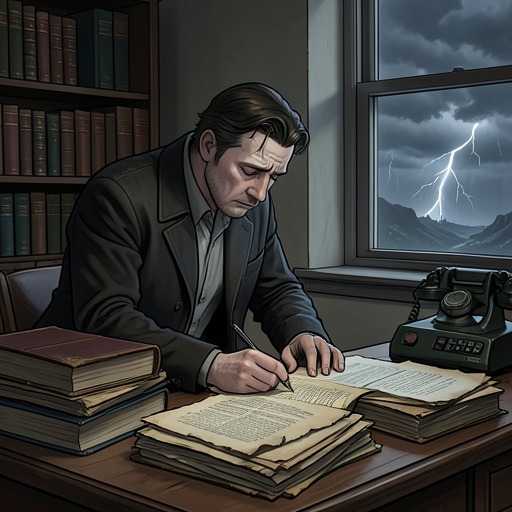
The recognition takes shape as Roquentin tries to resume his book. He studies the white sheets and the sentence he has just written: while it was still forming, the sentence had felt like a small part of himself; once inscribed and dry, it confronts him as something separate, no longer recognizable as his thought. He cannot recover its origin from the letters on the page, and doubts even that he wrote it. The page makes the transition from present thought to past trace visible in a small, ordinary act of writing.
From the sheet, Roquentin’s attention turns to the room: its furniture and his own body are there in the present. He concludes that what exists is what is present, and that what is not present does not exist—not in things and not even in thought. Previously, he had imagined the past as beyond his reach, or as a kind of retirement in which events, after playing their part, were politely put away. Now that reassuring model fails. There is no hidden storehouse behind appearances; the apparent continuity between a present object and what has passed cannot restore what no longer exists.
Rollebon and the failure of historical recovery
The consequence falls first on the historical figure around whom Roquentin has organized his work. As he returns to the manuscript, he reaches a sentence about Rollebon having made his will, and experiences a sudden sickness. The familiar room has not changed, but Rollebon, whom Roquentin had felt as a living presence within him, has died for a second time. Roquentin recognizes the connection between his conclusion about the past and this loss: after declaring that the past does not exist, he can no longer sustain the figure he had inwardly called up.
Rollebon’s letters offer material traces, but not the person who wrote them. Roquentin recalls a chain of custody that seems to explain their presence: Rollebon’s nephew was assassinated by the Czar’s police in 1810, the papers were confiscated and taken to the Secret Archives, and, a hundred and ten years later, the Soviets deposited them in the State Library, from which Roquentin took them in 1923. Yet even this account cannot make the papers a living connection to their author. The historical story feels less convincing than the yellow pages themselves; the documents remain, while the dead man does not.
Roquentin makes one last attempt to evoke Rollebon by repeating a description associated with Mme de Genlis. The image returns readily, and he can shape the dead man’s features in his mind, but that ease only clarifies the distinction: the image is a fiction in the present, not Rollebon restored from the past. What survives is a mental construction and a bundle of papers, not the person they appear to preserve. Roquentin’s loss therefore concerns more than a failed research method: the account of the past that had supplied his work with its central subject has ceased to function as a way of making that subject present.
Writing, thought, and the break with the book
The episode also unsettles Roquentin’s sense of authorship. A sentence that began as his thought becomes an object he can no longer recognize, and its newly dried ink marks how quickly an act of consciousness becomes a trace. Writing does not hold the thought in the present; it records something that has already passed. The sheet preserves marks, but cannot preserve the living moment from which they came.
The same crisis reaches his thinking itself. Roquentin finds that he cannot simply stop thinking: an attempt not to think turns into another thought, and the repeated awareness of existing renews the very existence he finds disturbing. This matters to the account of the past because thought cannot serve as a secure archive. Remembering or imagining Rollebon does not bring him back; it produces a present image, just as writing produces a present mark that points to an absent act.
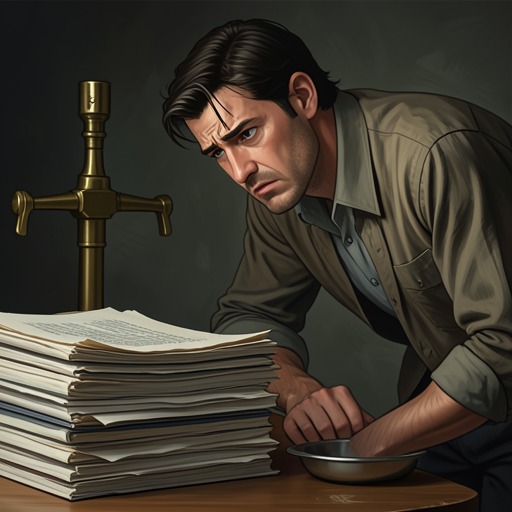
The loss becomes concrete when Roquentin gives up his book on the Marquis. He tries to make the change legible by writing that he has stopped, but the sentence and the ink cannot turn the past into a preserved possession. After stabbing his palm, he watches a small pool of blood on the paper and thinks of it as a memory; the gesture leaves a mark, not a lasting escape from the present. The decision to abandon the research follows from the collapse of the premise that historical writing could save Rollebon’s past.
Death, traces, and the limits of memory
A newspaper brings the problem into the present through its report that Little Lucienne’s body has been found and that her attacker has fled. The report is itself a written trace, but it does not restore the child. Roquentin’s response turns on the contrast between the continued existence of the body and the child’s absence: what has happened leaves material consequences, while the person who has died is no longer there. The moment extends the earlier insight beyond historical research and makes the difference between evidence of a past event and the continued existence of its subject immediate.
The novel thus distinguishes persistence from survival. Documents can be held, words can be read, and images can be formed; none of these gives the past an ongoing existence. Even a plausible narrative about how papers arrived in a library remains an account in the present, not the vanished past itself. In Roquentin’s experience, historical explanation can arrange traces into a story, but it cannot reverse the disappearance on which those traces depend.
Narrative and thematic significance
The recognition is presented through Roquentin’s first-person notebook-like consciousness, moving from a close observation of paper to reflection, loss, and the collapse of his research project. The shifts in scale are essential: dry ink, furniture, letters, and a newspaper are not decorative details but tests of the same question. Each object persists in the present while exposing the absence of what it might seem to carry. The passage’s movement from a particular manuscript sentence to Rollebon’s documents and then to reported death gives the insight an increasingly broad reach without turning it into a detached historical theory.
The nonexistence of the past also undercuts the comforting narrative that events can be retired into an orderly store of completed meanings. Roquentin had treated the past as a place where a life might remain available for reconstruction; the encounter with the page shows instead that reconstruction occurs now, through traces and present acts of imagination. The resulting distinction is stark: a record may attest that someone existed, but it cannot make that person exist again. For Roquentin, this is both the end of his attempt to preserve Rollebon through scholarship and a decisive exposure of the limits of memory, documents, and historical storytelling.