Alastair
NeverthelessAlastair is a leader among Navon’s exiles whose defiance is more complicated than simple withdrawal from the kingdom. He rejects the label of criminal for people banished after refusing battles that were not theirs, yet, when Tzara’s soldiers reach the exiles’ refuge, he helps turn a community defined by its freedom from obligation into a force prepared to fight. His welcome to Mabel is similarly mixed: he calls her a soldier and trusts her to face danger, but later objects to a woman representing him in war.
Identity and Place Among the Exiles
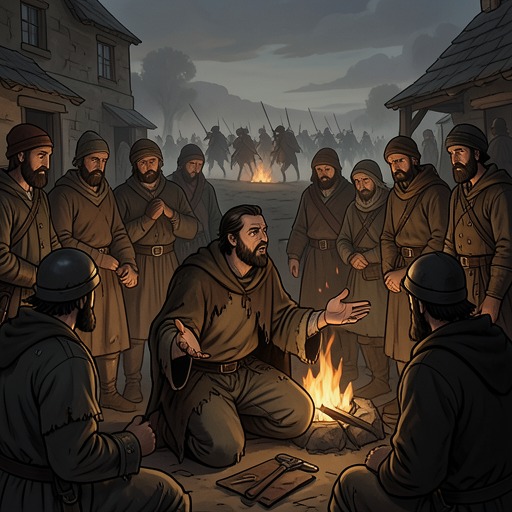
Alastair appears at a refuge in the forest where Shai brings Mabel to meet the outlaws. The settlement’s meeting place is not a formal inn but a large wooden house adapted with tables and drink, with a fire in the hearth, candles on the tables, and chandeliers overhead. The men there have been laughing and drinking until the newcomers arrive; their attention turns to Mabel. A rugged man with long hair and beard, broad shoulders under what appears to be bearskin, Alastair comes forward to ask why a girl has been brought there. His question is not a casual greeting: the group’s next move depends on the response.
Shai says Mabel comes from Navon and might intercede with the king for their cause. Alastair answers with irony, rejecting the premise that the exiles would want to return to the ruler who sent them away. He says they will defend their land, while Navon defends its own. His distinction is fundamental to his politics: attachment to a homeland does not mean accepting the authority that expelled him or volunteering for every war that authority demands.
Exile, Family, and Obligation
When Shai asks whether the men care about families still in Navon, Alastair turns the question back on him. He asks whether Shai’s family ever visited during his years in exile, to see how he was doing or whether he needed clothes. The remark strikes a wound: Shai falls silent, his eyes reflecting pain, and stiffens beside Mabel. Mabel steps in front of him, trying to shield him from the humiliation. Alastair’s challenge thus reveals both the rupture exile has created in Shai’s family life and the harshness with which Alastair uses that shared history in argument.
Alastair also contests the language used to describe the people gathered at the refuge. When Mabel calls them criminals, he insists that most are not criminals at all, but deserters and exiles—expatriates, as he puts it—who refused to fight battles that did not belong to them. He argues that it is unjust to condemn them simply for refusing those wars. Navon’s history gives his position a political context: the kingdom had sent men to fight on behalf of other kingdoms, while its own alliance has now failed in the face of Tzara’s threat. The kingdom’s shortage of soldiers is therefore tied to the obligations and alliances that helped produce desertion in the first place.
His account of life outside Navon is starkly transactional. The exiles have no taxes and no obligations, and he describes their freedom as a refusal to owe anyone anything. When Mabel argues that the present struggle is different because their home is in danger, Alastair says they do not care, adding that exile has left them without such feelings. The claim makes their refuge sound like a shelter from political demands as well as a place to live. Yet the attack that follows tests the distinction between rejecting Navon’s authority and abandoning the land itself.
The Attack and Mabel’s Place in the Fight
When warning comes that Balthasar’s men are approaching, someone urges the gathered people to hide. Alastair refuses. He orders the exiles to arm themselves and declares that the Expatriates’ Order will not hide, while pointing Mabel toward the option of staying out of the fight. He narrows his eyes and calls her a soldier. The gesture holds two positions at once: he claims the right of the exiles to resist, but does not require Mabel to risk herself merely because she is present.
The defenders plan to shoot at the soldiers as they climb the mountain. Archers fire from among rocks and from the roof, while fighters engage the men who reach the top. Mabel takes up a bow, then changes to her sword after seeing a soldier beat the young messenger she had first targeted and witnessing other acts of cowardice. Alastair fights in the same melee. His ferocity stands out alongside Shai’s knife work and Gaspar’s effectiveness; the narration presents Alastair as a formidable combatant rather than only the group’s spokesman. The force sent by Tzara proves too small for the resistance it encounters, and the defenders win the encounter.
After the battle, Alastair stops Shai from rushing to Mabel while she is still struggling with an enemy soldier. He warns that such danger will come sooner or later and that Shai may not always be there to help her. Shai answers that he would rather she not be killed; Alastair tells him not to underestimate her. His intervention is severe, but it treats Mabel’s ability to fight as real. He refuses to make her safety depend entirely on Shai’s protection, even when that refusal means allowing her to face immediate danger.
Authority, Gender, and the Limits of Acceptance
Alastair’s support for Mabel does not amount to an uncomplicated acceptance of women as combatants or representatives. Later, when Shai’s proposal to send Mabel to war is challenged, Alastair asks whether Shai means to use her to stimulate the young soldiers and accuses him of seeming not to care whether she lives or dies. He then turns his hard gaze on Mabel and says that no woman will represent him. The surviving account breaks off as he begins to identify the exiles, so the full scope of his objection is not given. What remains is a telling contrast: he calls Mabel a soldier when she chooses to fight, but draws a boundary when her presence is framed as representing him.
That contradiction places Alastair between two kinds of exclusion. He rejects Navon’s judgment that deserters are criminals and refuses the kingdom’s claim on their labor, while his own language still limits who may stand for the group. His conduct during the attack complicates, rather than resolves, that tension: he rallies the exiles, permits Mabel to choose whether to join them, and recognizes her competence in combat, yet resists her political or collective representation. The narrative gives no further account here of Alastair’s fate or of whether his position changes.