Sven
NeverthelessSven is one of the Royal Army’s most formidable soldiers, a physically imposing fighter whose confidence in his strength initially makes him a bully. Mabel’s unexpected victories challenge the certainty he places in his own superiority; over time, their hostility gives way to a guarded, practical acceptance that they are on the same team.
Identity and reputation
When Mabel first observes the soldiers, Sven stands out not only for his size but for his command of military theory and skill as a fighter. The narration distinguishes him from the out-of-shape soldiers around him, describing him as a predator among weaker animals. Yet his strength is not directed solely toward military opponents: he torments soldiers who seem unable to defend themselves, including a stableman whose work involves caring for horses. Mabel sees no glory in this treatment and wishes someone would put Sven in his place.
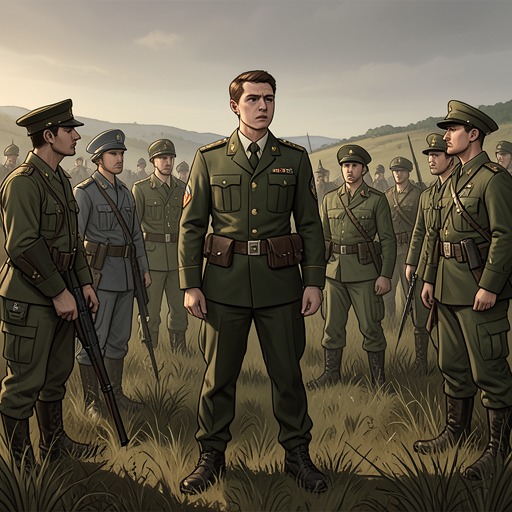
His appearance reinforces the impression of a soldier accustomed to occupying space. He is twice Mabel’s size, with powerful arms and a muscular build; he has blue eyes, sun-lightened golden hair, and golden facial hair. The narration presents his central flaw as an assumption that he is above others and that physical force can solve any problem. That confidence sometimes displaces good judgment. His mixture of genuine ability and careless arrogance makes him more than a simple measure of strength: the same soldier who can dominate a training ground can misread an opponent.
Mabel’s first challenge
Sven’s bullying of Aury brings Mabel into direct confrontation with him. Despite being smaller even than Aury, she challenges Sven to pick on someone his own size and attacks before he can answer. Applying a lesson from her father about putting strength into her legs, she brings him down through his unsteady legs, recovers her sword, and holds its point just short of his neck. For Mabel, who has been relegated to support work in an army that excludes women, the moment is a startling experience of power: she has turned the soldier’s imposing size into no guarantee of victory.
The defeat, however, does not establish that Sven has ceased to be dangerous. Mabel recognizes that she caught him off guard and doubts that another victory would come so easily. Sven himself later insists that the result was luck. He calls himself the most prepared soldier to have trained there and considers it impossible for Mabel to beat him a second time. His response reveals both his pride and the limit of what he has learned from the encounter: he acknowledges the result without accepting that it might expose a weakness in his judgment.
Rivalry and the second fight
The antagonism resurfaces over the soldiers’ food. When Mabel has to serve a meal in the cook’s absence, Sven knocks a plate to the floor and insults what she has prepared, comparing it to animal leftovers. Mabel answers without showing that the provocation has intimidated her. The confrontation becomes a proposed fight, which Sven accepts as retaliation for their earlier encounter. They meet behind the arsenal after work, with a larger-than-expected crowd watching.
This time Sven uses his size directly. He catches Mabel off guard and shoves her down with both hands; she protests that the move was unfair, while he challenges her assumption that the fight should follow her idea of fairness. The evidence shows the cost of their second encounter in Mabel’s injured nose. Later, as she walks away, Sven calls after her to ask about it in a teasing voice. Mabel replies that breathing is a little difficult but says she is fine. Their exchange keeps the edge of the rivalry, yet the narrator also describes Sven as kind to her in the fight. His teasing does not erase the injury, but the episode complicates the earlier picture of a man who uses force simply to humiliate weaker people.
From antagonism to solidarity
At the Winter Solstice Festival, Mabel finds herself ignored, and Sven becomes one of the people who asks her to dance. The narration makes the gesture meaningful because he does not do it out of an old affection for her: after she made him feel ashamed at the training camp, he had not wanted to help her. What changes the situation is the recognition that they are now on the same team. Sven is willing to make himself look foolish in front of Navon’s people to offer her public companionship. Mabel receives more dance partners than the girls around her, though she does not know how to navigate the competition or the social expectations that surround it.
The gesture is a limited but visible change in their relationship. It does not turn Sven into a confidant or undo the earlier cruelty, and Mabel’s experience remains divided between the soldier she has worked to become and the girl she feels expected to be. But Sven’s action marks a shift from treating her as an opponent to acknowledging her place among the soldiers. His support is expressed not through an apology or a declaration, but through a conspicuous choice to join her when she is being left out.
Place in the battle narrative
When Navon is attacked, the narrative returns to Sven’s physical power in mythic terms, presenting him as an arrogant centaur who seems impossible to overthrow. The image recalls the confidence that shaped his earlier clashes with Mabel, but now his formidable presence belongs to a battlefield shared with the people he once antagonized. Aury and Yelsew appear in the same account of the battle, which emphasizes that survival is uncertain and that not everyone will be lucky. Sven’s characterization thus carries from the training ground into the larger conflict: he remains a force to reckon with, while his growing connection to Mabel and the other soldiers places his strength within a team rather than above it.