Navi Spyridaki
NeverthelessNavi Spyridaki is Navon’s prince and natural heir, a young ruler-in-waiting asked to make decisions for a kingdom short of soldiers and exposed to its neighbors’ demands. His struggle to gain military command is not simply a contest with his father: it places him between the practical compromises of diplomacy, the danger of war, and a promise to protect Mabel Peloponnese that he treats as an obligation even when she resists it.
Identity and Political Position
Navi’s office is both a working political space and a distinctly personal one. More like a library than a meeting room, it is crowded with books and shelves of unfamiliar tools that fascinate him because they preserve knowledge of a past unlike the one he knows. A long rectangular table leaves only narrow room to pass or reach the shelves. The arrangement makes the office a place for study, but its books do not insulate him from the immediate business of governing: counselors meet there to debate how Navon can secure help.
Although he is the only natural heir to the throne, Navi has not yet received the title of general. He already has full control over the castle’s political affairs, but military command remains the position he wants and his father refuses to give him. The king fears seeing his son on a battlefield, where a kingdom’s leader may be expected to stand at the front and be the first to fall. Navi, by contrast, sees command as part of the role he is meant to assume, not merely a prize to be withheld.
Diplomacy Under Pressure
In the negotiations described in his office, Navi favors offering Navon’s best products in exchange for political alliances. His counselors object that neighboring kingdoms are exploiting Navon’s vulnerability and would impose conditions damaging in the long term. Navi also recognizes the injustice of exchanging special privileges for protection, yet sees few alternatives. The scene gives his diplomacy its defining pressure: he must bargain from weakness while trying not to mistake an expedient agreement for a fair one.
That weakness has a history. Navon had not previously faced a threat to its own territory; its earlier wars were fought on behalf of other kingdoms, including wars in which Mabel’s father served. Alliances had meant providing men to defend the lands of powerful neighbors. Many soldiers deserted rather than fight battles that were not their own, and Navon now finds itself without sufficient troops or the allied kingdom it had relied upon, which is afraid of Tzara. The account frames the crisis as both an external danger and the consequence of Navon’s earlier choices. Navi inherits the resulting shortage, not a secure position from which to dictate terms.
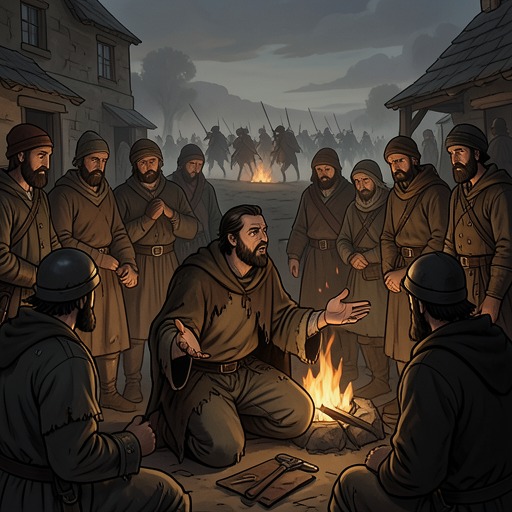
His dealings with Shai’s band extend that search for support beyond neighboring rulers. When Shai raises the possibility of fighting for Navon, Navi asks what the group’s conditions are and how much money they want. Shai answers that his people are not doing it for money. The exchange reveals the limits of a purely transactional view of military help: Navi begins by asking about the cost, while the offer is grounded in something other than payment. The evidence does not resolve every condition of their cooperation, but it places Navi in negotiations with potential allies whose motives do not fit the usual bargain.
Command, Family, and Mabel
The king makes Navi’s appointment conditional on marriage. He promises that the command will be his once he announces an engagement, though not necessarily as soon as a wedding takes place. Navi objects that his father is blackmailing him and argues that the army needs a general regardless. The condition joins private dynastic arrangements to public military need: the king offers the authority Navi seeks, but makes the announcement of a marriage the threshold to receiving it.
The king connects that arrangement to an old debt. Mabel’s father, Amyntas, had been his commander and saved his life more than once, including by taking the danger of a runaway horse upon himself. When the king asked what he could do in return, Amyntas mentioned his son Gael; by the time the account is told, only his daughter remains, while Gael is known as a deserter. The king presents his word to the dead commander as a matter of royal honor. Navi accepts that a king should keep his word but argues that honoring Amyntas need not mean making Mabel a princess: he doubts her diplomatic preparation and even her literacy. Their disagreement exposes different understandings of obligation. The king treats the promise as binding; Navi challenges the form it has taken and the consequences imposed on Mabel.
Navi’s conduct toward Mabel also reflects a separate promise made by his father. He tells her that he is protecting her because the king required him to take care of her, and insists that he has been responsible for her since she came to the hall. He says he will keep her out of trouble even if she hates him or he disappoints her. Mabel answers that this is strange coming from someone who does not habitually keep his word. Her retort makes the protection contested rather than sentimental: Navi claims responsibility, while Mabel questions whether his conduct has earned her trust. In a later exchange, Shai notices that Navi and Mabel had already discussed the matter being negotiated, and the understanding between their looks makes more sense to him than Navi’s earlier explanation. The scene suggests a shared history shaping their political dealings without erasing their tension.
From Obligation to Defense
Navi’s protective stance becomes especially concrete when Mabel is with Shai’s group. He tells her he will not leave her helpless and is considering another job she can do, but she insists that this misses her point. His answer returns to the king’s instruction: he regards her safety as his responsibility whether or not she consents to his intervention. The exchange places care and control close together. His concern is real within the scene, but so is the restriction it creates for someone who wants to decide her own part in the crisis.
When the threat reaches the village, Navi’s priorities become immediate and collective. He orders that the whole village be brought to the castle before battle, acknowledging that the work will be difficult and take time. He then says he will call the army and needs to find the soldiers at once. Shai asks where he can find Mabel, but Navi moves toward the door to put his decision into effect. The village is not left to face the danger alone: Shai’s men wake its inhabitants and escort them to the castle for shelter. Women and children are directed inside the walls, while men are told to stand and fight. Mabel questions whether it is fair for her to retreat after presenting herself as one of the soldiers. Against that decision, Navi’s plan shows a commander organizing protection through evacuation as well as military mobilization.
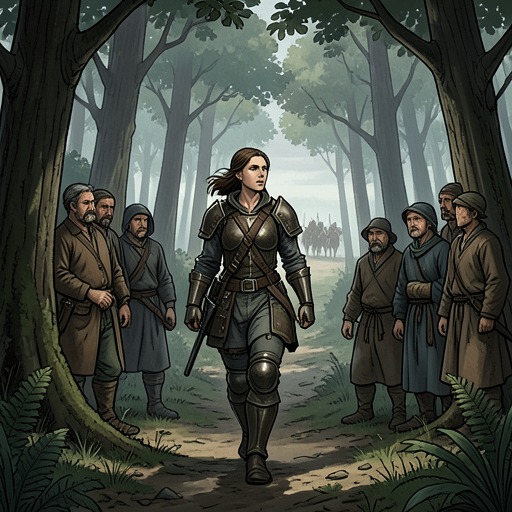
The fortifications give those choices a physical setting. Navon’s castle stands on a wooded hill, with the stone bridge at the front providing the passage into the fortress. Later, as Mabel reaches Tzara, its high wall hides the city and protects villages and plantations; the royal city is described as easier to leave than to enter. These contrasting defenses sharpen the political problem Navi faces: Navon must assemble people and allies to resist a kingdom whose borders are difficult to penetrate. The available scenes leave him moving from the village toward the army, with the defense being organized but its outcome unresolved.
Character and Narrative Significance
Navi’s scenes repeatedly turn on a gap between the authority he is expected to exercise and the authority he actually possesses. He governs political affairs but must bargain with counselors and neighboring powers; he wants military command but must meet his father’s marriage condition; he claims responsibility for Mabel while she disputes his right to decide what protection means. As Navon’s shortage of soldiers becomes an immediate threat to its people, those tensions converge in practical acts of negotiation, shelter, and mobilization.
His development is therefore presented less as a completed transformation than as a widening test of leadership. The office’s books and constrained table frame deliberation; the village’s nighttime evacuation turns deliberation into action. Between them, Navi must reckon with the costs of Navon’s history, the limits of promises made by kings, and the fact that military support may depend on motives other than money. His defining challenge is to make protection more than a claim of authority: it must become a workable defense for the kingdom and its people.