Aury
NeverthelessAury’s brief life in the army is defined by a quiet contradiction: others regard him as weak, yet his kindness gives Mabel companionship in a camp that largely excludes her. His friendship offers a glimpse of an ordinary future—work, love, and marriage—that the war ultimately takes from him.
Identity and Introduction
Aury first approaches Mabel while she is working at the training camp, where she has been serving as an apprentice squire. She has noticed a large soldier bullying a stableman and is angry at the men who watch without intervening. Aury, himself a target of the bully, advises her not to get involved or draw attention to herself. His relaxed manner seems at odds with his slight build: he has little muscle, but an insightful look and a composure that makes him seem almost beyond the bully’s reach. When Mabel challenges the soldiers’ failure to defend others, Aury offers no grand defense of their inaction; he shrugs and asks what else they can do.
Mabel has spent two weeks in camp with almost no one speaking to her apart from the commander, so she asks the stranger his name in the hope that they might become friends. He says he is Aury. Before he can ask her name, she introduces herself with unmistakable pride. Their brief exchange loosens the tension of the moment: Mabel smiles, and for a while her attention shifts away from the bullying she had been watching. At lunchtime, Aury invites her to eat with him. The gesture begins a companionship grounded not in shared status, but in their mutual experience of being treated as outsiders.
Friendship and Shared Outsiderhood
At lunch, Aury’s welcome takes a practical form: he looks at Mabel’s plate and transfers more than half her food to his own before she can answer. When she asks why he is being kind, he explains that they are both outcasts and should stay together. Their exclusion has different causes. Mabel is isolated because she is a woman in the training camp; Aury says the soldiers consider him too weak. Mabel recognizes that being seen with her could make him still more conspicuous, but senses his need for companionship and does not push him away. His gesture does not erase the camp’s hierarchy, yet it gives each of them someone with whom to face it.
Aury’s attention also reaches beyond mealtimes. At the end of the day, when Mabel cannot leave with the other soldiers because her apprentice-squire duties require her to gather, polish, and store the discarded weapons, he asks whether she is ready to go and walks home with her. She discovers that they are neighbors, though they had not previously noticed one another at village fairs or parties. On the way, she wonders whether the work imposed on her is merely an initiation before she can train like everyone else. Their walk makes the friendship a point of contact between camp and home, while her question exposes how uncertain her place in the army remains.
Their bond persists through Mabel’s absence. When they meet again beneath the tree associated with her father, the place they have treated as their own, Aury jokes that the general was relieved to have her gone, then puts his long arms around her neck and asks whether she will disappear again. Mabel assures him that he will not be rid of her so easily. The exchange turns reunion into a promise of continued presence: the companionship that began among camp outsiders has become part of Mabel’s return to army life. She already anticipates one small difficulty for him there, since he will have to adjust to the soldiers’ regulated diet despite his weakness.
Ordinary Hopes and the Cost of War
Aury’s life is not confined to the role the soldiers assign him as weak. He is a painter, someone who wants to preserve what he sees in colorful images and let others look through his eyes. He also wants a life with Suri. He tells Mabel that Suri agreed to date him because he was in the army, and that she accepts the risk that he might go to war and never return. Aury has come to believe that she wants marriage regardless of whom she marries or what he does; even so, he says he loves her too deeply to turn back. His account holds uncertainty and affection together: he does not describe himself as certain of a future, but he is willing to enter it with her.
That hoped-for future shapes his request to Mabel. He asks her to approach the general about securing him a place in the general’s guard, or even work as his personal servant, because he has heard the general has no one in that role. The request makes his military service more than a measure of strength: the army is also the setting in which he has found love and hopes to build a marriage. His ambition is modest, but it is directed toward remaining useful and close to the life he wants. The war will not allow that ordinary plan to unfold.
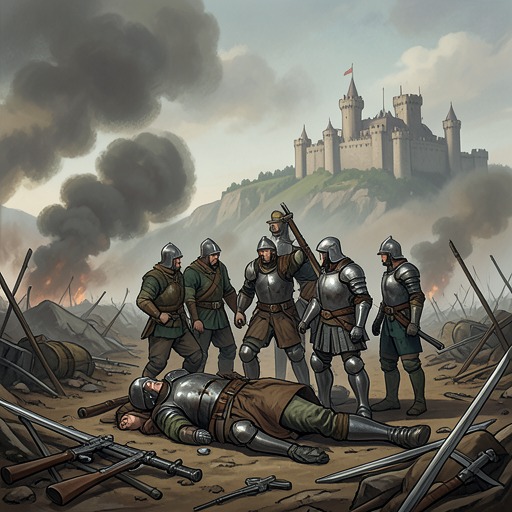
At the end of the battle, Aury is found among the bodies of strangers, a spear driven through his fragile body at the fifth rib. The narration recalls that he could only scream in pain and despair, then resists the easy conclusion that his perceived weakness defines him. He had not wanted war; he had wanted to paint, to make images endure, and to try marriage because he loved someone. The account imagines that he would have answered those who called him weak by saying he was trying to survive—and that he had tried. After his face is hidden beneath the blanket covering the dead, the people who knew and loved him are absent. His death therefore removes not only a soldier from the battlefield but also the person who could give his life its private meaning: to the army he is one of the dead, while his friends and family are left with the question of whether they could understand why he lost his life.
Narrative Role and the Meaning of His Death
Aury’s death makes the battle’s anonymous tally of bodies collide with the particular life each body contained. The narration recalls him not by rank or achievement but through the images he wanted to paint, the perspective he hoped to share, and the marriage he imagined with Suri. Once a blanket covers his face, that identity becomes inaccessible to everyone except those who loved him—and they are not present. The passage’s movement from vivid personal memory to a covered, unrecognized body echoes the loss Aury feared in war: not only life, but the chance to make others see the world through his eyes. His story thus refuses the camp’s judgment that weakness defines him, while showing how completely battle can erase a person from public view.