Yelsew
NeverthelessYelsew is a soldier in Navon’s royal army whose importance lies less in formal authority than in the everyday acts through which he makes room for others. Warm, alert to people around him, and willing to meet cruelty with irony, he helps turn Mabel’s uneasy presence among the soldiers into a source of solidarity. His role also becomes more urgent in violence: after Vilanis is left paralyzed amid a massacre, Yelsew intervenes to take him away.
Identity and Presence
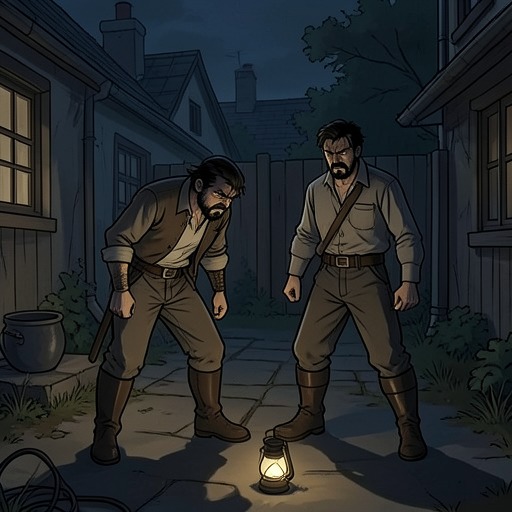
Yelsew is introduced among the soldiers gathered around Mabel, where the narration singles out his impulse to accommodate everyone. His head is shaved, his dark eyebrows frame a deeply cut face, and his broad smile is especially striking for its very white teeth. The description makes his welcome visible: he is not merely part of the surrounding group but someone inclined to draw people into it.
That disposition is tested in a company where Mabel’s presence makes her conspicuous. At one meal, the soldiers occupy a table and she watches them through the narrow opening in her helmet. Sven jokes that she has never seen so many naked women before, and the men laugh; Navi laughs too, trying to disguise it. Yelsew’s place in this masculine camaraderie does not prevent him from noticing when the group’s teasing and attention bear differently on Mabel. His later actions show that accommodation, for him, means more than making space at a table.
Mabel and the Soldiers
When the soldiers discuss Mabel after she leaves, Sven blames women for causing trouble. Yelsew answers with irony: women are troublesome, he says, especially when they can beat a man in a fight. The remark turns the accusation back on the men and makes Mabel’s victory over Sven part of the argument. Sven insists that she was lucky and that no girl could defeat him a second time; Yelsew’s dry agreement leaves the boast exposed without escalating the exchange.
Yelsew later explains why Sven has permission to tease the soldiers. The general allows it because threatened men might fight back and learn to defend themselves, although Yelsew admits that the approach did not work. Mabel’s confrontation with Sven, he says, achieved what the men’s training had not: the soldiers now think they should not be inferior to a girl. His account gives Mabel credit for changing their outlook, while revealing Yelsew’s ability to recognize an effect that the military’s deliberate method failed to produce.
His attention to Mabel is practical as well as interpretive. During a journey, the soldiers do not usually check on one another’s saddles or hands, but several of them check on her. Yelsew looks at her repeatedly until she touches her cheek and asks whether something is there. He tells her he is only checking on her. The small exchange suggests care without ceremony: unlike Sven and Navi, who behave as though nothing has changed, Yelsew acknowledges that a woman riding with the army is not experiencing the trip in quite the same way as the men.
He also uses humor to soften the roughness of military life. After Mabel’s nose has been hurt in her fight with Sven, Yelsew waves to her and says she did well for a girl, adding that Sven was kind and her nose will not look so bad. The soldiers laugh. Mabel privately wonders whether these men are the ones who will protect Navon’s villagers, women, and children. The episode leaves that doubt in place, but Yelsew’s teasing is not simply dismissal: elsewhere he notices her, credits her effect on the soldiers, and includes her in their company.
Welcome and Companionship
The change in Mabel’s standing becomes clearest when the soldiers go to celebrate at the village tavern. She expects not to be invited: she is a girl, she believes soldiers should not bring a girl along, and she does not consider herself their friend. Yelsew trots over and puts an arm around her neck, then tells her that the soldiers want her there and will not accept a refusal. He frames her attendance as fitting because she is the reason for their celebration. What had seemed to Mabel like a closed group thus makes a public gesture of welcome, with Yelsew taking the lead in bringing her into it.
At another gathering, when Mabel stands apart while others are invited to dance, Yelsew offers his hand and asks her to dance. She says she does not dance, but he draws her in anyway; his clumsiness makes the experience feel less awkward to her, and she smiles. The moment reverses the pattern of exclusion without pretending Mabel has become like the other women around her. She remains conscious of her sword-worn hands and bruised, wounded skin, while Yelsew offers a form of companionship that does not require her to conceal those differences.
Yelsew’s welcome also has a protective edge in conversation. When the commander speculates that Behrooz might take an interest in Mabel and suggests she should stay behind, Yelsew interrupts to ask what the king’s women have to do with her. The question challenges the men’s assumption that Mabel’s safety should be managed through speculation about a ruler’s appetite. It does not settle the danger or change the commander’s decision, but it marks Yelsew as unwilling to let the discussion pass without registering its treatment of her.
Crisis and Loyalty
Yelsew’s warmth is not confined to banter. After Vilanis has been caught in a violent scene and is left on his knees, paralyzed and unable to respond, Yelsew touches him and takes him away from the massacre. The narration calls him a savior, making this intervention a decisive counterpart to his lighter role among the soldiers. Where his jokes help Mabel endure exclusion, here his physical presence answers another person’s helplessness.
The group goes to the tavern afterward to support Vilanis. Mabel joins them despite having promised not to celebrate with the soldiers again; she is willing to go because they are true friends, even though their place in the army is low in its order of importance. Yelsew’s rescue belongs to that larger demonstration of fellowship. The soldiers’ status may be marginal, but their care for one another is tangible, and his intervention helps make that loyalty visible.
During the later battle, the narration places Yelsew somewhere in the chaos, trying to survive. It predicts that he will make it through the night because he is too clever to die on a starry night like that. The passage offers confidence in his resourcefulness, not a detailed account of what he does in the fighting. In the journey toward Tzara, he is again among the men riding with Mabel in the rear group, alongside the commander and Vilanis, while other soldiers ride ahead with the carriage. The route crosses a very long, high bridge, one that frightens Mabel; the account establishes Yelsew’s place beside her on the journey without attributing a particular act on the crossing to him.
Narrative Role
Yelsew repeatedly occupies the space between the group and the person left out. He does not erase the army’s gender hierarchy: Mabel is watched, teased, and made conscious of being unlike the other soldiers. Instead, he responds to particular moments—her vulnerability on the road, her achievement against Sven, her exclusion from celebration, and her solitude at the dance—with attention that changes what she can share with the group. His welcome makes belonging something enacted through a checked cheek, an arm around her shoulders, an invitation, and a hand offered for a dance.
That social attentiveness is joined to an ability to act when levity is no longer enough. The same character who answers Sven’s boasting with irony and turns a dance into fun moves Vilanis away from a massacre. Across these scenes, Yelsew is neither presented as a commander nor given a grand campaign of his own; his significance comes through the smaller choices by which he notices, includes, and helps other people. In an army shaped by exclusion and violence, those choices give fellowship a practical form.