Shai
NeverthelessShai is a mercenary leader whose offer of practical help draws Mabel Peloponnese into the forest community of exiles and whose later diplomacy brings that community into contact with Navon. He presents himself as a useful ally against the kingdom’s enemies, but the account ultimately exposes a concealed identity: Shai is identified as Golnar, Balthasar’s missing brother. That revelation makes his coalition-building newly suspect, turning an apparent story of mutual aid and political alliance into one shadowed by questions of deception and dynastic ambition.
Identity and First Encounter
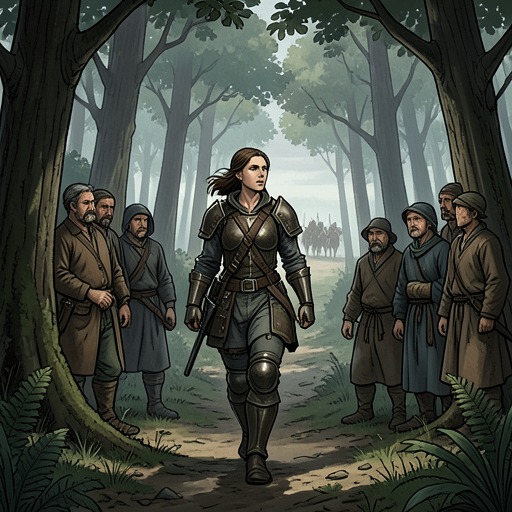
Shai first approaches Mabel while she is on horseback and trying to get away. He attempts to calm her, then describes his group as bounty hunters or mercenaries who undertake unwanted practical services for payment: rescuing people, capturing murderers, and recovering stolen money. His self-description gives the band a transactional, workmanlike face rather than presenting it as a conventional army. When he proposes that they could fight for Navon, he makes the condition explicit: they would need money. Asked how much, he names three gold weights.
The price unsettles Mabel, who doubts that he is genuinely interested in helping her if money is the basis of the offer. Shai counters by questioning the practicality of her search for her brother: the world is large, the trail may not exist, and her father may not have intended her to pursue it in this way. His intervention therefore mixes a concrete proposal with an attempt to redirect Mabel’s purpose. He does not simply promise to help her search; he offers a place in a larger cause.
When the two formally introduce themselves, Shai tells Mabel he has never seen a girl fight as she did and says she fought bravely. His interest in her is immediate and attentive, but it is also tied to her evident ability. The scene establishes a relationship in which personal recognition and strategic usefulness can coexist, leaving open how much of his attention is trust and how much calculation.
The Exiles’ Community and Mabel’s Place in It
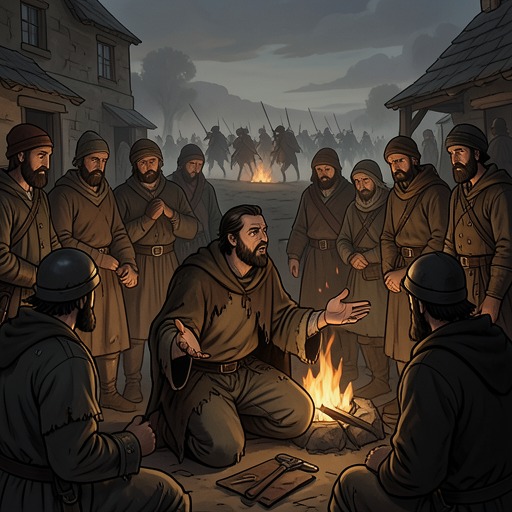
Shai leads a band living in the forest, where Mabel spends several weeks with him and his men. Their routine is communal and spare: they hunt in the morning and return with dinner for the group, sharing the same food and resources. The small camp includes wives and children, and its members maintain family-like relationships even though exile and criminality have disrupted the lives those relationships would ordinarily represent. The narrative describes the camp’s social world as an invented society, built from roles and attachments that do not correspond to a fully recoverable life elsewhere.
The band grows beyond its original small circle. People can join, and, as Mabel understands it, no one leaves. The camp is characterized by an absence of rules, obligations, duties, labels, and moorings. For Mabel, this is not merely a refuge from the city: living among Shai’s people gives her a sense that she has become part of a community organized outside Navon’s formal structures. The forest setting and the group’s shared daily labor make belonging tangible, even while the account emphasizes the provisional, constructed quality of their social bonds.
Shai also acts with care toward Mabel in smaller, personal exchanges. When she fears that Navi Spyridaki will not let her travel with the band, Shai gives her a note with coordinates and tells her she can seek him out if she needs anything in the future. The note creates a continuing channel between them beyond her immediate stay. His promise of future help sits beside his political recruitment, reinforcing the relationship’s double character: he offers Mabel both an individual point of contact and a route into a collective cause.
Building an Alliance with Navon
Shai’s political objective becomes clearer when he tells Mabel about a meeting at which outlaws will put aside their disagreements and unite to protect Navon. He speaks as a mercenary who knows what is happening, presenting the gathering as a real possibility rather than a speculative hope. The proposed coalition broadens his earlier offer to fight for the kingdom: instead of relying on one band, he imagines formerly divided outlaws acting together against a common threat.
The obstacle is that Shai cannot simply enter Navon and speak to its prince. When he and Gaspar discuss the next step, Shai says they will approach the prince; Alastair immediately points out that the men cannot get into the kingdom, referring to the mark at the end of Shai’s neck and the ban on exiles entering. Gaspar explains that Mabel will carry their message. Shai’s dependence on her is thus both practical and political: her access can bridge a boundary that excludes his group.
Mabel eventually returns to Navon with Shai, who is authorized to enter the castle, while the rest of the band waits outside the city. The group had wanted to accompany him, partly to protect him if complications arose, but Navi Spyridaki judged that one person would be enough. Shai then presents the alliance proposal directly to the prince. He says he has convinced the deserters to join the King’s Army of Navon because they all need help, and argues that their numbers could help win the war. He adds that he had tried to secure a personal meeting days earlier but had been unable to do so. When Navi Spyridaki asks how many deserters there are, Shai answers that they are too numerous to count.
Warning of Invasion and the Identity Reversal
Shai later comes to Navi Spyridaki with an urgent warning that Tzara will cross Navon’s borders and that there is little time before its forces arrive. He says he has brought his men and that the expatriates will also be there, then asks what Navi Spyridaki will do about them. Navi Spyridaki agrees to tell the guards to let them through and asks how Shai knows of the impending attack. Shai attributes the information to scouts and allies. In this scene, the band he has assembled is not merely a proposed source of manpower: he brings it forward as a force already responding to the danger.
Shai’s identity is radically reframed after Mabel is captured. The King’s Winner tells her that Shai is Balthasar’s missing brother and that his name is Golnar, asserting that he used her to obtain an army and depose Balthasar. This accusation reverses the meaning of the earlier political story. The supposed exile who could not enter Navon now appears, in the captor’s account, to have used that exclusion as part of a concealed identity and a strategy for gaining power. Mabel objects that Shai is a marked man banned from Navon; the King’s Winner counters that Shai was never a Navonian and therefore could not have been marked there. The contrast turns the visible mark from apparent proof of Shai’s past into a disputed piece of evidence.
The same captor also tells Mabel that her brother Gael is dead and that Golnar killed him. These claims reach her together, linking Shai’s hidden identity to the personal search that first brought her into his orbit. Mabel does not accept the accusations without resistance: she doubts both what she is told about Gael and the charge against Shai, and recognizes the possibility that her intuition has failed. The evidence therefore establishes the revelation and its effect on her trust, but it does not independently confirm the King’s Winner’s allegations about Shai’s motives or Gael’s death.
Relationships and Narrative Significance
Shai’s relationship with Mabel develops through a sequence of assistance, recruitment, intimacy of access, and suspicion. He praises her fighting, welcomes her among his people, gives her a way to find him later, and relies on her to deliver the message that opens a path to the prince. Those actions create real dependence and connection, yet the later charge that he manipulated her forces each earlier gesture into a second interpretation. The narrative does not resolve that tension in the available scenes; instead, it places Mabel’s personal trust directly against a political accusation.
His relation to Balthasar is presented through the revelation that Shai is Golnar, the missing brother, and through the claim that he sought to replace him. The identity makes Shai more than a leader of displaced people: it connects the forest coalition to a struggle within a ruling family. His appeal for unity can consequently be read both as a response to Navon’s danger and, in the King’s Winner’s account, as a means of assembling power for his own purpose. That unresolved doubleness is central to his role. Shai helps make collective resistance imaginable, but the revelation that his public identity may conceal a dynastic one leaves the meaning of that resistance unsettled.